



















If you want to skip a 30–60+ minute rental line, avoid bad boot fits, and stop hauling giant ski bags, compact snow gear is the simple fix. I’d look at it this way: if your ski days are mostly groomers, short trips, family outings, or casual laps, owning compact gear can save time, cut repeat rental costs, and make travel way less annoying.
Here’s the short version:
- Rentals make sense if you ski once in a blue moon
- Compact gear makes sense if you go a few times each season
- Full-length skis still win for high speed, steep terrain, and deep powder
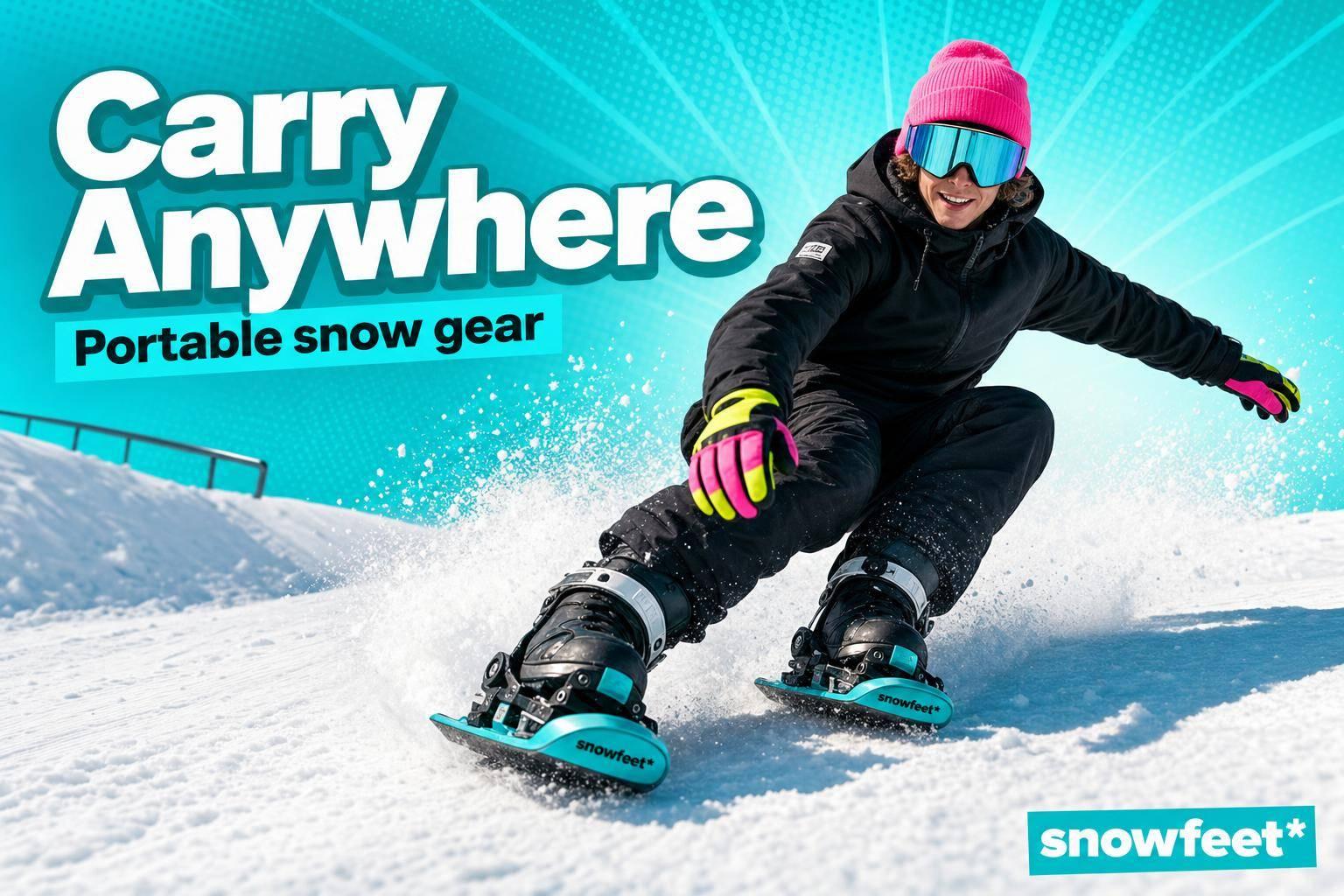
- Snowfeet gear is easier to pack because models from 17–26 inches fit in a backpack or suitcase
- Some models work with winter boots or snowboard boots, so you may not need ski boot rentals at all
A few numbers tell the story fast:
- Busy rental lines can take 30 to 60+ minutes
- Damage or loss fees can hit $300 to $800+
- Adult ski boots often weigh about 8 to 10 pounds
- Full skis are often about 5 to 6 feet long
So, if your main goal is to get on the snow faster with less fuss, compact gear is a smart pick. If your goal is bombing steep black runs or floating through deep powder, stick with longer skis.
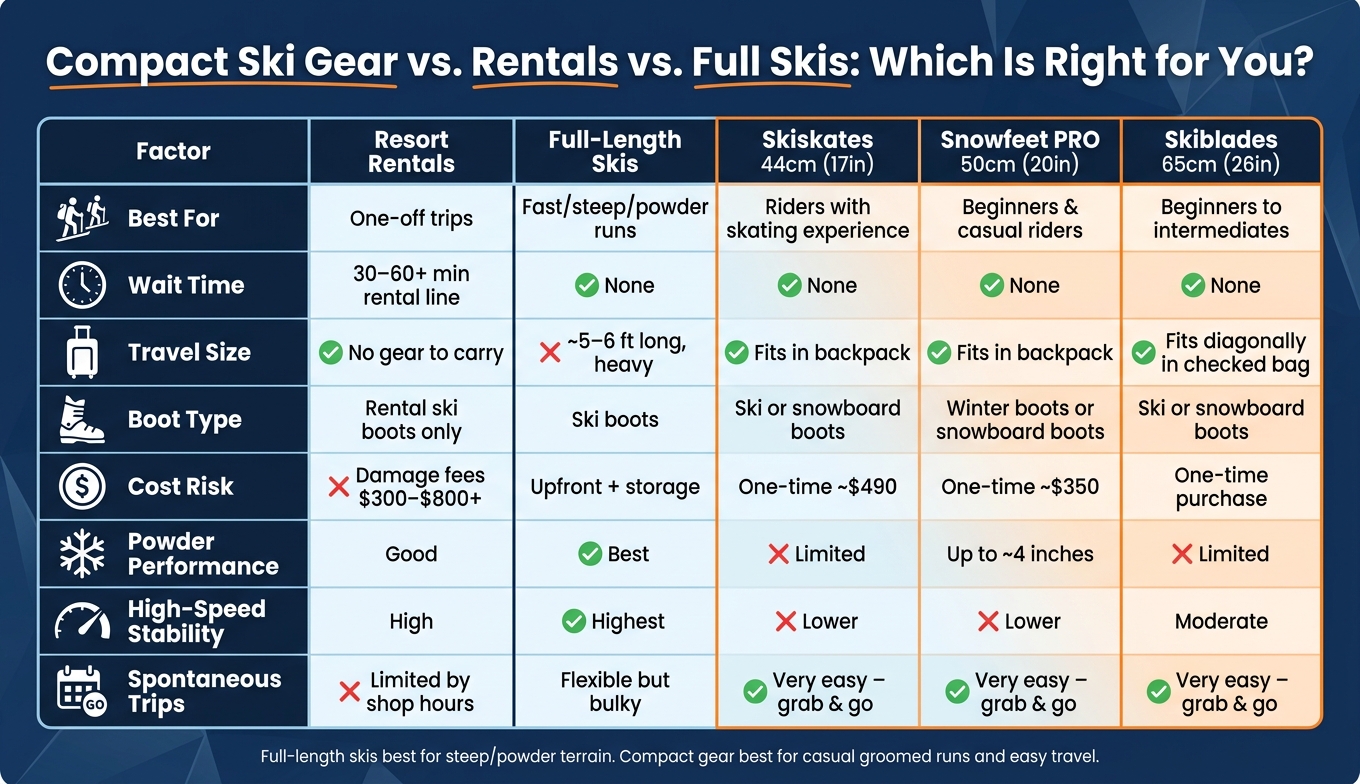
Compact Ski Gear vs. Rentals vs. Full Skis: Quick Comparison Guide
Snowboarder tries Snowfeet* | Which Snowfeet* Short Ski is the Best? | Snowblades 44, 65, 99 Review
Quick Comparison
| Option | Best For | Boots | Travel Ease | Main Drawback |
|---|---|---|---|---|
| Resort rentals | One-off trips | Rental ski boots | Easy until you hit the shop line | Wait times, fit issues, repeat fees |
| Full-length skis | Fast skiing, steep runs, powder | Ski boots | Harder to carry and pack | Big, heavy setup |
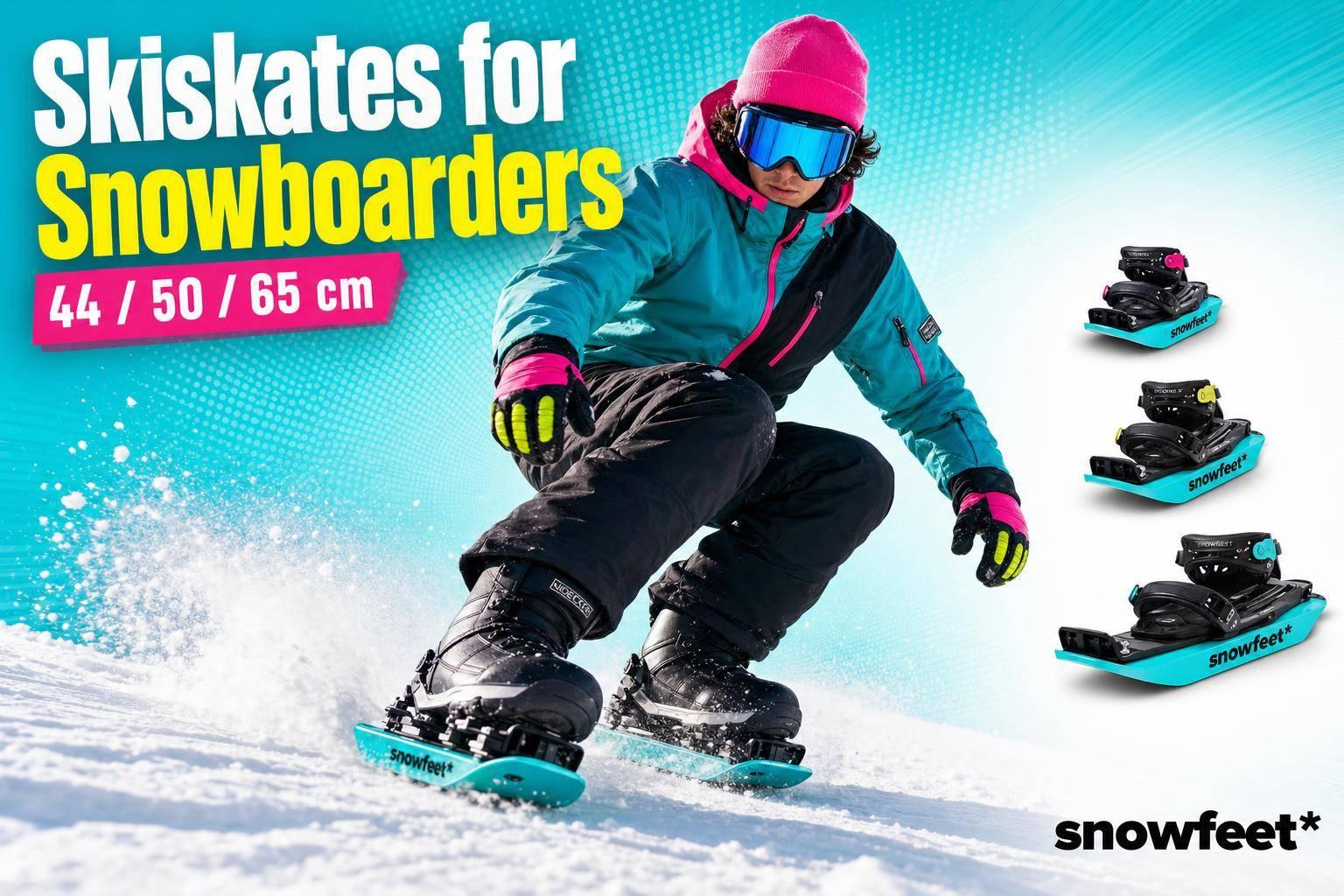
| Snowfeet Skiskates 44 cm (17 in) | Strong balance, small packed size | Ski or snowboard boots | Very easy | Less stable than longer options |
| Snowfeet PRO 50 cm (20 in) | Beginners, casual riders | Winter boots or snowboard boots | Very easy | Less top-end stability |
| Skiblades 65 cm (26 in) | People who want a more ski-like feel | Ski or snowboard boots | Easy | Still not built for deep powder days |
If I were choosing, I’d match the gear to my usual day, not my dream day. That one choice can save money, time, and a lot of parking-lot grumbling :)
Fast take:
- Pick Skiskates for the smallest setup
- Pick Snowfeet PRO for the easiest learning curve
- Pick Skiblades for more stability and a feel closer to skiing
If you want a quick look at how these ride, here are a couple of useful videos:
- Snowfeet Official YouTube
- Skiskates playlist on YouTube
- Skiblades riding videos on YouTube
From there, it just comes down to your boots, your trips, and how much hassle you want to cut out.
1. Identify Which Rental Problems You Want to Solve
Start by naming the exact rental headache you want to get rid of before you buy compact gear.
That matters because rental pain shows up in different ways. Some skiers hate wasting half the morning in line. Others get annoyed by surprise add-ons at checkout. And for some, the worst part is dragging bulky gear through an airport like they're moving a couch.
Time loss, sizing problems, and extra fees
On weekends, holidays, and powder mornings, the 8:30–10:00 a.m. stretch is often the slowest. That’s when rental lines pile up, boot sizes get picked over, and your plan for an early first run can go sideways fast.
Sizing is a big pain too. Rental fleets often have limited half sizes, plus fewer wide or narrow choices. If you have wide feet, high arches, or sensitive feet, rental boots can fit badly and throw off your balance. For beginners, that can make the day feel rough in a hurry.
Then comes the price tag. A base rental can look fine at first. But once you add a helmet, a damage waiver, or a performance package upgrade, the total can jump a lot. And if you skip the waiver, damage or loss can cost $300 to $800+
Those are the exact hassles compact gear is built to cut out. And they hit hardest when they mess up the trip before you even get on the mountain. That’s why the next step is looking at buying versus renting.
Bulky gear and inflexible travel plans
Full-length skis are about 5 to 6 feet long, and a pair of adult ski boots weighs around 8 to 10 pounds. That’s a lot to haul through airports, hotels, shuttles, and jammed parking lots. Some U.S. airlines count skis and snowboards as one checked bag, which helps, but oversize cases can still mean extra fees
Road trips aren’t always much better. Full ski gear eats up trunk space and can lock you into rental shop hours. Compact gear changes that. It can fit in a backpack or a standard suitcase, so you can pack once and head straight to the slope.
That’s where compact gear has its biggest edge for travelers. If packing light matters more to you than the feel of full-length skis, compact gear starts to look like the smarter play. Once you know which hassle bothers you most, it gets much easier to decide if buying compact gear beats the rental counter.
2. Decide Whether Buying Compact Gear Makes More Sense Than Renting
Match your trip style, skill level, and boot preferences
Buy compact gear if you ski more than once or twice each season and want to skip rental lines, boot fittings, and those repeat fees. If you only go once every few years for a big trip, renting still fits. But if you sneak in a few day trips or weekend laps each winter, owning compact gear starts to look like the smarter move.
Your trip style matters a lot. Local day-trippers, road-trip skiers, and families who like to head out on short notice get the most from owning their gear. Some Snowfeet* models work with winter shoes, snowboard boots, or ski boots, depending on the model. That cuts out one of the biggest rental hassles: boot fit.
That choice gets a lot easier when you stack up cost, storage, and convenience side by side.
Renting vs. owning long skis vs. owning Snowfeet*: a side-by-side look
Here’s the fastest way to compare them:
| Factor | Resort Rentals | Owning Long Skis | Owning Snowfeet* |
|---|---|---|---|
| Cost over time | Recurring rental fees each trip | Upfront purchase plus storage and maintenance | One-time purchase; no repeat rental fees |
| Storage space | None needed | Large - needs dedicated storage space | Fits in a backpack or suitcase |
| Baggage convenience | No gear to carry | Bulky; harder to travel with | Easy to pack and bring along |
| Learning curve | Ready to go after fitting | Moderate to steep | Beginner-friendly; fast to pick up |
| Boots required | Rental ski boots | Ski boots | Winter shoes, snowboard boots, or ski boots |
| Spontaneous ski days | Limited by shop hours | Flexible, but gear is heavy | Very easy - grab and go |
Repeated rentals can pile up fast, especially on busy days. It’s a little like paying for the same cup of coffee every morning when you could’ve bought the machine already.
Convenience matters, sure. But performance still counts.
Trade-offs to know before you buy
Full-length skis still win in some cases - and it’s best to be straight about that. If you’re carving at high speed, racing, or skiing steep, fast, or deep-powder terrain, longer skis give you edge control and stability that compact gear just can’t match. That’s a real gap, not sales fluff.
But for groomed runs, smaller resorts, terrain parks, and moderate-speed recreational riding, compact Snowfeet* gear works well for most casual riders. The trade-off is simple: you give up some top-end performance for gear that’s much easier to use, pack, and carry. For a lot of casual riders, that’s a pretty easy call.
Next, match that trade-off to the right Snowfeet* model.
sbb-itb-17ade95
3. Pick the Right Snowfeet* Model for Your Trips
Now it’s time to match the model to your boots, your balance, and the kind of trip you’ve got planned.
Snowfeet* Skiskates 44 cm: the most portable option
At 44 cm (17 in), the Skiskates are the most portable option in the Snowfeet* lineup for ski slopes, starting at $490.
They’re short, fast, and easy to pack. But there’s a trade-off: that short length asks for better front-to-back balance. So, these are a better fit for riders who already have some skating or slope experience.
Skiskates use a wood core, fit ski or snowboard boots, and work well for people who want the smallest, fastest setup for groomed runs.
Snowfeet PRO 50 cm and Snowfeet* Skiblades 65 cm: more stability and edge grip
If you want something more forgiving, the Snowfeet PRO 50 cm is the easier place to start at $350.
Its shape makes turning easier and adds more stability. It also works with standard waterproof winter boots or snowboard boots, which means you can skip ski boot rental. That’s a nice little win for your wallet and your packing list. It can also handle fresh powder up to about 4 inches deep.
The Skiblades 65 cm are the longest compact option here, and they offer the most stability of these three models. They’re a good match for progressing beginners and casual intermediates who want something that feels closer to skiing, but without jumping to full-length skis.
How Snowfeet* compares to resort rentals and other short-ski options
All three models vary by length, boot fit, and rider type. Here’s the side-by-side view:
| Option | Length | Boot Compatibility | Fits in Backpack | Best For |
|---|---|---|---|---|
| Skiskates 44 cm | 44 cm (17 in) | Ski or snowboard boots | Yes | Riders with skating or slope experience |
| Snowfeet PRO 50 cm | 50 cm (20 in) | Winter boots or snowboard boots | Yes | Beginners and casual riders |
| Skiblades 65 cm | 65 cm (26 in) | Ski or snowboard boots | Yes | Beginners to intermediates |
| Resort rental skis | Much longer than compact models | Specialized ski boots only | No | Traditional skiing |
All three Snowfeet* models include metal edges, which is a common requirement for use at ski resorts.
Here’s the simple version:
- Skiskates 44 cm are the smallest and fastest
- Snowfeet PRO 50 cm is the easiest and most forgiving
- Skiblades 65 cm are the most stable and feel closest to full-length skis
That leaves one final step: pack it for flights, road trips, or a quick weekend run.
4. Plan a Faster, Lower-Stress Ski Day With Compact Gear
How to pack compact gear for flights, road trips, and family weekends
Pick the right model, and travel gets a whole lot easier. You spend less time wrestling with gear and more time getting to the fun part.
The biggest win? This stuff fits in luggage you already have.
The Skiskates (44 cm / 17 in) and Snowfeet PRO (50 cm / 20 in) can slide along the side of a standard checked suitcase with clothes around them for padding. The Skiblades (65 cm / 26 in) can fit diagonally in a larger checked bag, which is still much smaller than hauling a full ski bag.
For a 3-day flight trip, a couple can often fit both pairs in one checked suitcase. Boots and goggles can go in carry-on backpacks. That means no separate ski bag and no boot bag. Nice and simple :)
Family weekends get easier too. Four sets of compact Snowfeet* gear and four helmets can fit in one large duffel. That leaves the rest of the trunk open for bags, snacks, and all the other stuff families somehow always bring. No roof box. No folded seats. No need for a larger SUV.
Replace the rental-shop stop with a direct-to-slope routine
Compact gear can skip the rental-shop detour, which can put you on the snow about an hour earlier on a busy weekend morning.
That time savings hits hardest when the rental line is long and everyone’s already tired before the day even starts. Set your bindings at home, buy lift passes online, and go straight from the car to the slope. It’s a cleaner routine, and honestly, it feels a lot less chaotic.
Use compact gear safely and with realistic expectations
Compact gear is easy to carry, but don’t treat the first run like a highlight reel. Start on green or easy blue terrain. Get loose. Warm up. Then move to steeper runs if things feel good.
It’s also smart to check your resort’s gear policy before you go. Some resorts ask for a leash or retention device. A quick look at the resort website can save you from an awkward surprise in the lift line.
And yeah, no matter what you ride, wear a helmet and follow the NSAA Responsibility Code.
| Feature | Snowfeet* Compact Gear | Standard Rental Skis |
|---|---|---|
| High-speed stability | Lower | High |
| Deep powder performance | Limited | Better |
| Weight | Very light | Heavy |
Conclusion: When Compact Gear Is the Easier Choice
For most casual ski days in the U.S., compact Snowfeet* gear makes the whole trip simpler. You skip rental lines, boot fitting drama, and the usual baggage headache. If those are the things that make a ski day feel like work, owning Skiskates (44 cm / 17 in), Snowfeet PRO (50 cm / 20 in), or Skiblades (65 cm / 26 in) is a much cleaner fix.
So it comes down to one thing: which Snowfeet* model fits the way you ski?
Skiskates are best if you want max portability.
Snowfeet PRO makes sense for people who ride most weekends.
Skiblades give you the most ski-like feel and the most stability of the three.
That said, the model isn’t the whole story. Terrain still sets the limit.
Full-length skis are still the better pick for high-speed carving on steep black-diamond runs or for deep powder days. That’s where edge length and float at speed matter in a real way.
But for frequent casual riders, convenience often wins. And yeah, that matters more than people like to admit :)
Snowfeet* can pay for itself after a few rental weekends each season. The smart move is to think about your usual ski day, not the one dream powder day you might get once in a while. If your ski days look more like the first kind, Snowfeet* is the easier choice.
FAQs
How many ski trips make compact gear worth buying?
Even if you ski just once or twice each season, compact gear like Snowfeet* can make more sense to buy. At $150 to $199, the upfront cost may end up lower than renting at $50 to $70 per day.
There’s also the stuff people forget to count. Compact gear can help you skip oversized airline baggage fees, avoid dealing with roof racks, and ditch the need for specialized boots.
Can I use compact gear at any ski resort?
Usually, yes - compact gear like Snowfeet* is allowed at most U.S. ski resorts.
With metal edges, heel brakes, and optional safety leashes, it will often fit the safety rules many resorts use for on-mountain gear.
That said, resort rules can change from one mountain to the next. So before you go, check the resort’s equipment policy or contact mountain management to make sure they allow snowblades or snow skates on their lifts.
Which Snowfeet* model is best for beginners?
For beginners, Snowfeet Mini Ski Skates (38 cm) and Snowfeet PRO (50 cm) are the best picks. They’re easy to control, which makes it simpler to learn balance and turns on bunny hills and groomed slopes.
The 65 cm Skiblades are also a solid pick for beginners. They offer a playful, agile ride and tend to feel more forgiving than regular skis.
One more nice perk: all three work with your own winter boots, so you can skip the rental boot hassle. That alone is a pretty sweet win :)











ฝากความคิดเห็น
เว็บไซต์นี้ได้รับการคุ้มครองโดย hCaptcha และมีการนำนโยบายความเป็นส่วนตัวของ hCaptcha และข้อกำหนดในการใช้บริการมาใช้