



















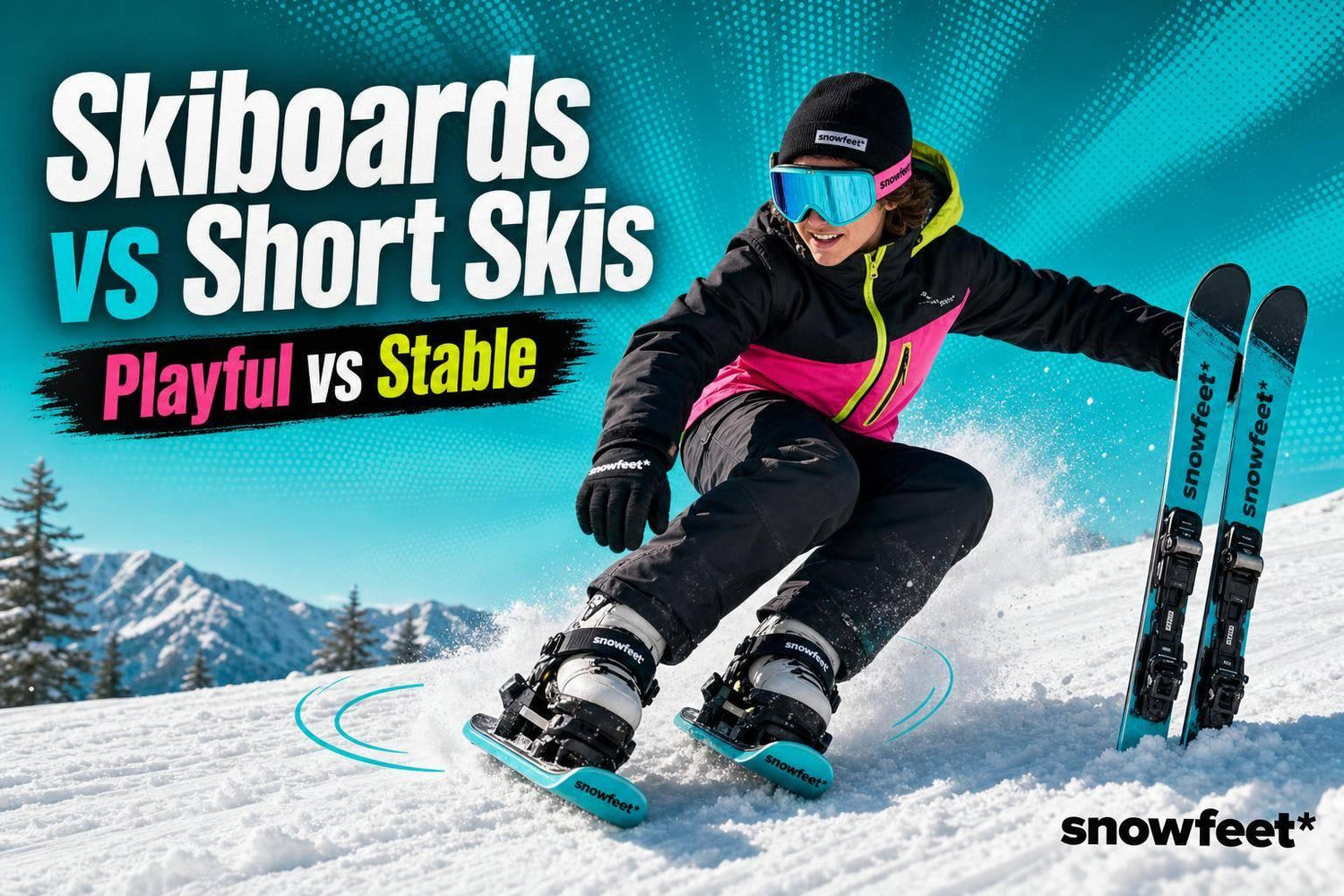
Here’s the short answer: skiboards are usually shorter, fatter, and more playful, while short skis are longer, more directional, and more stable at speed.
If I were helping you in a ski shop, I’d say: ignore the name first. Look at length, shape, and bindings. That tells you how the setup will turn, how calm it feels, and which boots you can use.
The big takeaways:
- 44 cm to 65 cm options feel loose, playful, and easy to pivot
- 99 cm to 120 cm options feel more planted and closer to normal skis
- Twin tips help with switch riding and park laps
- Boot fit matters a lot: some models work with ski boots, some with snowboard boots, and some even with winter shoes
- For high-speed carving, full-length skis still win. No drama there :)
A lot of riders mix up terms like skiboards, skiblades, snowblades, and short skis. That happens because the names overlap, but the ride feel does not. In this piece, I break down the stuff that changes your day on snow: turn feel, speed, terrain use, and boot setup.
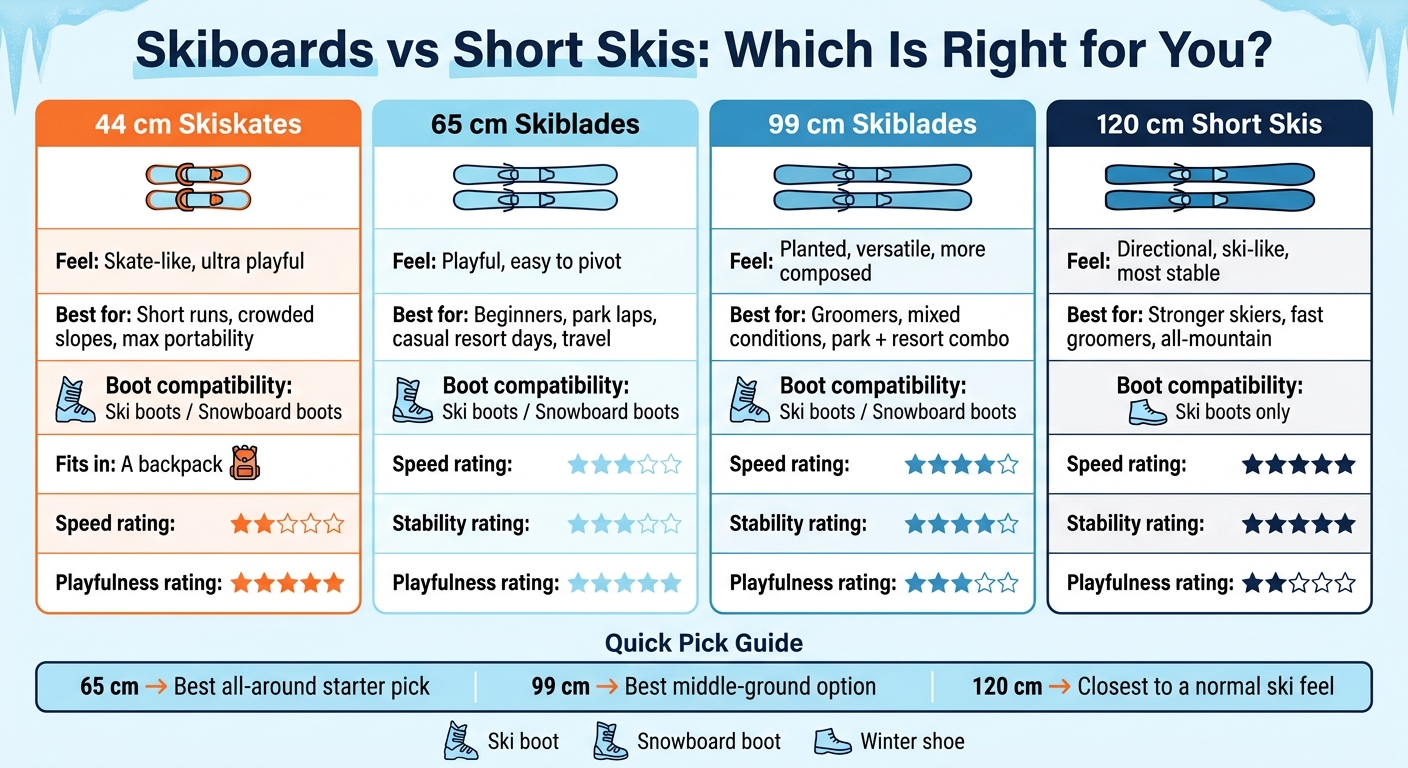
Skiboards vs Short Skis: Size, Feel & Best Use at a Glance
Snowboarder tries Snowfeet* | Which Snowfeet* Short Ski is the Best? | Snowblades 44, 65, 99 Review
Quick Comparison
| Type | Usual feel | Best for | Tradeoff |
|---|---|---|---|
| Skiboards | Playful, easy to pivot | Beginners, park laps, short runs, travel | Less calm at higher speed |
| Short skis | More directional, more planted | Groomers, mixed resort use, stronger skiers | Less loose and playful |
| Full-length skis | Most stable | Fast carving, steep runs, long descents | Harder to carry, store, and pack |
If you want the fast pick: 65 cm is a safe starting point for many people, 99 cm is the middle ground, and 120 cm feels the most like a normal ski.
For a quick visual explainer, these YouTube links can help:
- Short skis vs regular skis on YouTube
- Skiboards review on YouTube
- Snowblades for beginners on YouTube
So, if you’re trying to choose, I’d keep it simple: pick based on how you ride, what boots you own, and how much stability you want.
Skiboards vs short skis: design differences that matter
Length, width, and shape
Skiboards are wider and usually come with a twin-tip shape. Short skis are narrower, more directional, and feel more like smaller alpine skis. That may sound like a small design tweak, but on snow, it changes a lot. You feel it in the amount of ski under your feet and in the type of boots you can click into.
The Snowfeet* lineup shows that range in a simple way:
- 44 cm Skiskates: the shortest option; they feel closer to skating than standard skiing
- 65 cm Skiblades: the easiest to turn; a great all-around compact pick
- 99 cm Skiblades / POWDER 99: more stable; better if you want more control or extra float in soft snow
- 120 cm Short Skis: the most directional; the closest to a standard ski feel
Twin tips also make switch riding and park tricks easier. That’s one of those design choices that sounds small on paper, then makes total sense the first time you land backward and don’t feel like the ski is fighting you.
Put simply, these shape changes affect how each setup turns, how planted it feels, and how calm it stays as speed builds.
Bindings and boot compatibility
This is where Snowfeet* pulls ahead. On the 44 cm, 65 cm, and 99 cm models, you can choose ski boots or snowboard boots. The 120 cm version works with ski boots only.
That snowboard boot option matters more than it might seem. It lowers the barrier for casual riders and travelers, since you may not need a full ski boot setup just to get on the hill. It also gives Snowfeet* a more flexible feel day to day. If you like to keep gear simple, that’s a pretty big deal.
sbb-itb-17ade95
How they feel on snow: turning, speed, and terrain
Turning and learning feel
You notice ski length almost right away in the turn. Shorter skis pivot fast. That makes them easier to steer and a lot less intimidating when you're new or just out for a laid-back day.
The 44 cm Skiskates feel the closest to skates, especially if you already have inline skating experience. The 65 cm Skiblades feel more like skis, but they still love fast, playful direction changes. Both lengths turn with very little effort in tight spaces, which is a big deal on busy beginner slopes or small hills.
Step up to the 99 cm or 120 cm models and things calm down a bit. They feel more planted and steadier, closer to normal ski behavior, but they still turn faster than full-length skis.
Speed and stability tradeoffs
Here’s the simple tradeoff: shorter setups feel light, quick, and fun, but they get less settled as speed climbs.
The 44 cm and 65 cm options work best for easy resort laps and playful riding. If you want more grip and a smoother feel, the 99 cm or 120 cm Snowfeet* options do a better job. You keep the compact size, but gain more edge hold and a calmer ride.
Best terrain for each setup
That split between quickness and stability also shapes where each setup feels best.
- The 44 cm Skiskates are best on short runs and crowded beginner slopes, where quick, low-commitment fun is the whole point.
- The 65 cm Skiblades do well on easy all-mountain terrain and make a safe default for casual resort days.
- The 99 cm Skiblades are the most versatile choice for groomers and mixed conditions, especially when you want more composure.
- If softer snow is part of the plan, the Snowfeet* POWDER 99 cm fits better. It’s wider and built to float better in deeper, looser snow than the shortest models.
Those differences set up the next question pretty well: which one makes the most sense for beginners, travelers, and park riders.
Which option fits your riding style
The best pick comes down to three simple things: who’s riding, what boots you have, and where you plan to ski.
Here’s the quick-match chart:
| Rider type | Boot preference / setup | Suggested Snowfeet* model |
|---|---|---|
| Beginner adult | Ski or snowboard boots | Skiblades 65 cm |
| Kids & families | Winter shoes (MINI KIDS); ski boots (65 cm) | Snowfeet* MINI KIDS / Skiblades 65 cm |
| Traveler / weekend warrior | Snowboard or ski boots | Skiblades 65 cm or 99 cm |
| Casual resort skier | Ski boots or alpine bindings | Skiblades 99 cm |
| Park rider | Snowboard boots | Skiblades 65 cm or 99 cm |
| Stronger all-mountain skier | Ski boots or alpine bindings | Skiblades 99 cm or Short Skis 120 cm |
If you want the easiest way to choose, start with the rider and the terrain. That usually clears things up fast.
Best pick for beginners and families
If you’re new to this, go with the 65 cm Skiblades. They’re a good fit for groomed green and blue runs, and they work well for adults who want something easy to handle without feeling toy-like.
For kids, there’s a nice bonus. If they’re too small for standard ski rentals, Snowfeet* MINI KIDS can be a solid fit. This option works for shoe sizes under US 6.
Best pick for travelers and casual resort riders
If packability is the whole point, the 44 cm Skiskates are the tiny hero here. They fit in a backpack. That’s hard to beat.
The 65 cm and 99 cm Skiblades are also much easier to pack and store than full-length skis. So if you’re driving up for the weekend, flying with gear, or just hate stuffing giant skis into a closet, these make life a lot easier.
Boot setup matters too. Snowfeet* gives you choices that work with ski boots or snowboard boots, which is nice if you want to use gear you already own instead of buying a whole new setup.
For groomed resort laps, the 99 cm Skiblades hit a sweet spot. They’re light, easy to carry, and give you more confidence than the shortest models. Kind of like the “just right” option - not too twitchy, not too long.
Best pick for park riders and stronger skiers
If you care more about playfulness than stability, look at the shorter, park-ready lengths. A lot of freestyle riders lean toward the 65 cm Skiblades. That length works well for park tricks, and it pairs with snowboard boots.
If you want something that can handle both park runs and groomers, move up to the 99 cm. You’ll get a bit more support without giving up the fun part.
Stronger skiers should look at 99 cm or 120 cm for faster riding and mixed conditions. The Short Skis 120 cm feel the closest to regular skis in the Snowfeet* lineup, while still being much easier to travel with than standard long skis.
For pure high-speed carving, though, full-length skis still win. No magic trick there :)
Conclusion: the short answer
The labels overlap, but the ride feel doesn’t.
Skiboards lean toward quick, playful turns. Short skis feel more directional and more like regular skis. After looking at shape, bindings, and terrain, the pick comes down to how you plan to use them. Strip away the names, and the stuff that matters is pretty simple: length, stability, turn shape, and boot setup.
So, the real question is where and how you ride.
Snowfeet* covers the compact-ski range pretty well:
- 44 cm Skiskates for max portability
- 65 cm and 99 cm Skiblades for the best all-around mix
- 120 cm Short Skis for the most ski-like feel
You also get different boot setups depending on the model, from winter shoes to snowboard boots and ski boots.
Full-length skis still win if you care most about speed, hard carving, and long, steep descents. But for riders who care more about convenience and range of use than pure speed, Snowfeet* makes more sense. For most casual riders, a compact Snowfeet* setup is the smarter pick.
FAQs
Are skiboards harder to control than short skis?
No. Skiboards and short skis are usually easier to control than long, standard skis.
Why? Their shorter length and lighter weight make them more responsive on snow. That means:
- Quicker turns
- Easier stops
- Less leg fatigue
- Fewer issues like tip-crossing
For a lot of beginners, Snowfeet skiboards and short skis feel pretty natural. In many cases, people feel comfortable after just a few runs.
What length should I choose for my skill level?
Choose based on your skill level and what you want from the ride:
- 120 cm: best for complete beginners. It gives you the most stability and support.
- 99 cm: the go-to all-around pick. You get a nice mix of control and agility.
- 65 cm: best for tricks, tight turns, and a more skate-like feel.
If you come from skating or hockey, the 65 cm model may feel more natural right away.
Can I use snowboard boots with Snowfeet*?
Yes - most Snowfeet* models work with snowboard boots. The 65 cm and 99 cm Skiblades are made for snowboard boot bindings, so you can use your own boots. That means more comfort and easier walking. Nice little bonus when you’re hauling gear through the parking lot :)
The 120 cm model uses pro ski bindings, so it needs ski boots. That setup gives you the support you need for carving and for riding at higher speeds.











Lämna en kommentar
Denna webbplats är skyddad av hCaptcha och hCaptchas integritetspolicy . Användarvillkor gäller.