



















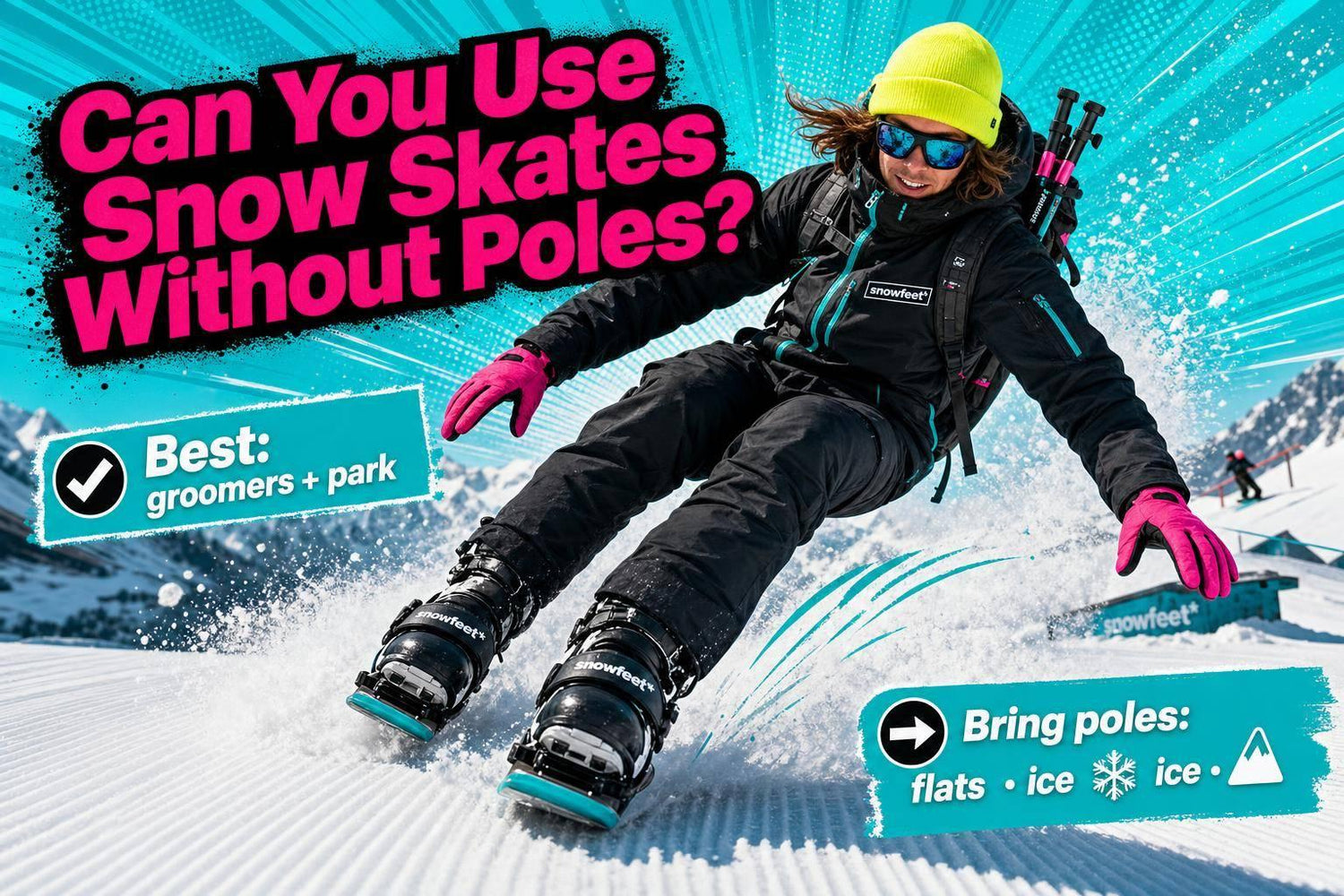
Yes - in most cases, you can ride snow skates without poles. In fact, I’d say most people are better off leaving them behind. Short snow skates put control in your feet, ankles, and hips, not in your hands.
Here’s the short version:
- Best without poles: groomed green and blue runs, terrain parks, and small backyard hills
- Poles can help: first-day learning, icy spots, steep sections, and long flat areas
- Why: short skates, often 15 to 20 inches long, turn fast and feel more like skating than skiing
- Main skills: centered stance, edge control, wedge stop, hockey stop, and short linked turns
If you skate, play hockey, or rollerblade, the movement often feels more natural right away. And if you’re new, going pole-free can help you learn balance from day one.
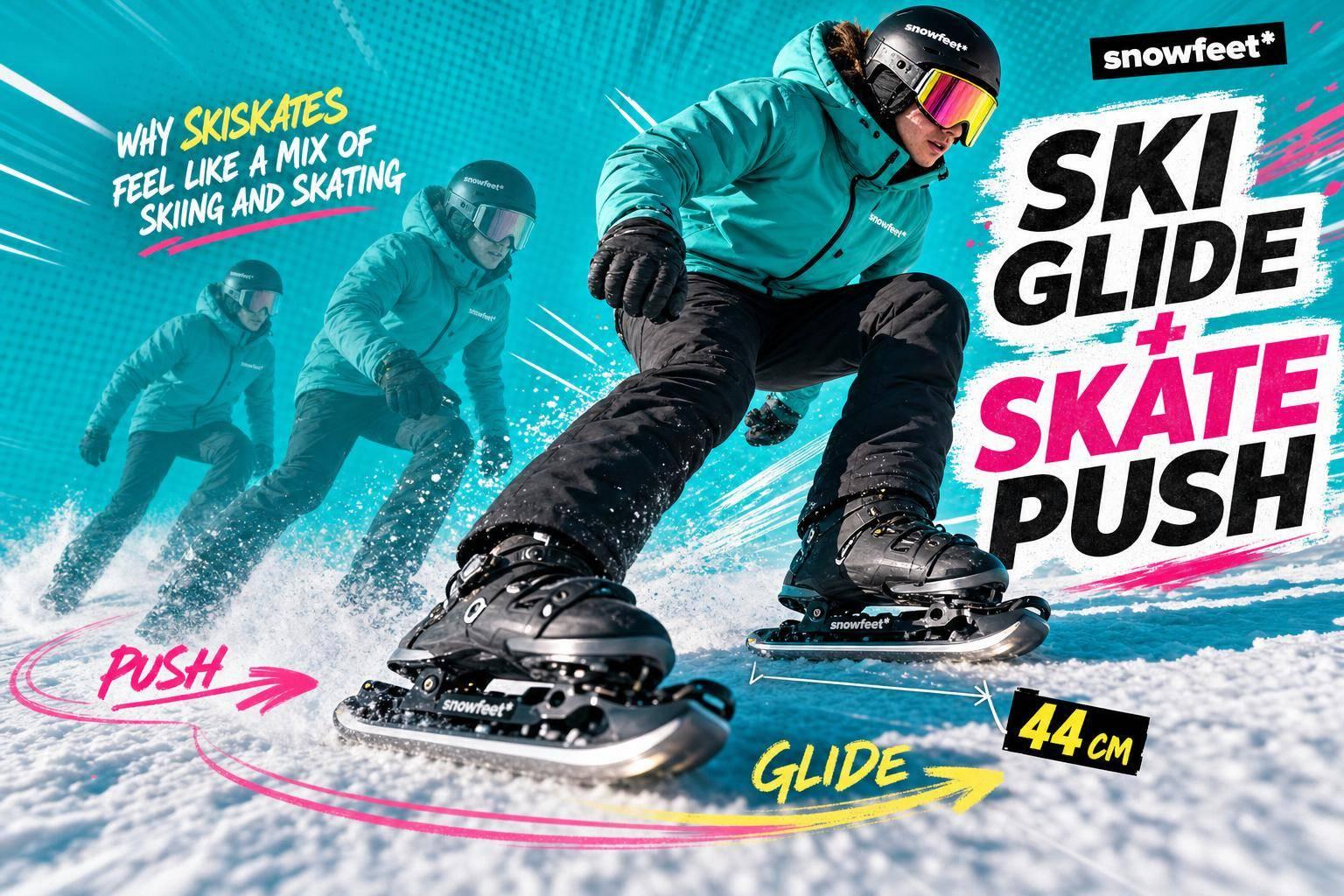
How to Use Snowfeet* Skiskates 44 CM | Skates for Snow | Mini Ski | Snowblades | Snowskates
Quick take
I’d keep it simple:
- Skip poles if you want freedom, easier movement, and park-friendly riding
- Bring poles if the snow is hard, the slope is steep, or you know you’ll hit flat runouts
- Start on smooth runs where you can focus on stance and turning instead of fighting rough snow
A lot of riders on 38 cm, 44 cm, and 50 cm snow skates ride pole-free for one plain reason: poles often don’t do much here. On short skates, small body movements do the job.
If you want a good visual on how short ski skates move, these videos can help:
So, if you’re wondering whether poles are a must, my answer is simple: usually no. Use them for a few edge cases. Leave them off for most normal runs, and enjoy the extra freedom :)
When You Can Ride Snow Skates Without Poles
Best Terrain for Pole-Free Riding
Pole-free riding works best on terrain that feels steady and easy to read. Groomed green and blue runs are the sweet spot. The surface stays even, so you can put your attention on balance, edge control, and smooth turns instead of fighting the snow.
Terrain parks are also a great match. Poles can just get in the way when you're going for grabs, spins, or tricks. Backyard hills work too, especially if you want a simple place to mess around and get a feel for the movement.
The Snowfeet* Skiskates (44 cm), Mini Ski Skates (38 cm), and PRO (50 cm) fit this kind of terrain best. On smooth snow, small weight shifts are enough to start a turn. That’s a big deal. It means these setups shine on clean, smooth runs instead of the kind of skiing where pole use does a lot of the work.
Riders Who Usually Skip Poles
Ice hockey players and inline skaters tend to adapt the fastest because the motion feels more like skating than skiing. That body position and foot-driven movement already feel familiar.
Beginners often do well without poles too. Going pole-free helps build balance and teaches better lower-body control from the start.
Why Snowfeet* Feels More Natural Without Poles Than Long Skis
Long skis lean more on poles. Snowfeet* doesn’t.
At 38 to 50 cm, these skates are short and light. You can toss them in a backpack, which is pretty wild if you’re used to hauling full ski gear around. More importantly, their size shifts the work to your lower body. Your ankles, knees, and hips do most of the steering.
That’s why the ride feels closer to skating. You’re not waiting on a pole plant to help set things up. You move your feet, shift your weight, and the turn starts to happen. Simple.
Once you’re on the right terrain, balance and foot control matter more than pole plants.
sbb-itb-17ade95
How to Control Snow Skates Without Poles
Balance and Stance on Short Snow Skates
Start with a ready stance: feet about hip-width apart, knees bent about 20–30 degrees, hips centered over the skates, and hands slightly forward. Keep your weight a bit over the balls of your feet instead of leaning back. Stay loose, centered, and ready.
With Snowfeet*, balance and stance do most of the heavy lifting. They ride more like skates than long skis, so small moves in your ankles and knees can fix your balance fast.
That setup flows straight into stopping and turning.
How to Stop Without Poles
On snow skates, you stop with your edges, not with poles.
If you're new, start with a wedge stop: tips slightly inward, heels out, and inside edges pressed into the snow. On Skiskates (44 cm), the short length makes edge control feel fast and easy to read.
After that starts to click, use linked turns to manage speed. Each time you finish a turn across the slope, you scrub off a bit of speed. When you're more comfortable, move up to a hockey stop - turn both feet sideways, lean a little into the hill, and let the edges bite for a fast stop.
Once stopping feels natural, turning becomes your main tool for speed control.
How to Turn Using Your Feet, Ankles, and Hips
Turning on Snowfeet* starts from the ground up. Keep your upper body calm so the skates can steer cleanly under you. Let your feet, ankles, and hips do the work.
Begin with step turns: take small, steady steps to point the skates in the new direction while keeping your weight centered. Then move to skidded turns: tip onto one edge with your ankle and knee, turn your hips with the skates, and let the tail slide a little to manage speed through the turn. On short models like the Skiskates (44 cm) or PRO (50 cm), edge-to-edge moves happen faster than on long skis, so direction changes feel snappy.
The PRO sits between skiing and skating, which helps make turns easier to start.
That quick response is also why poles matter less on easy terrain and more in a few specific moments. On steeper slopes or during first runs, poles can still help in some cases.
When Poles Still Make Sense
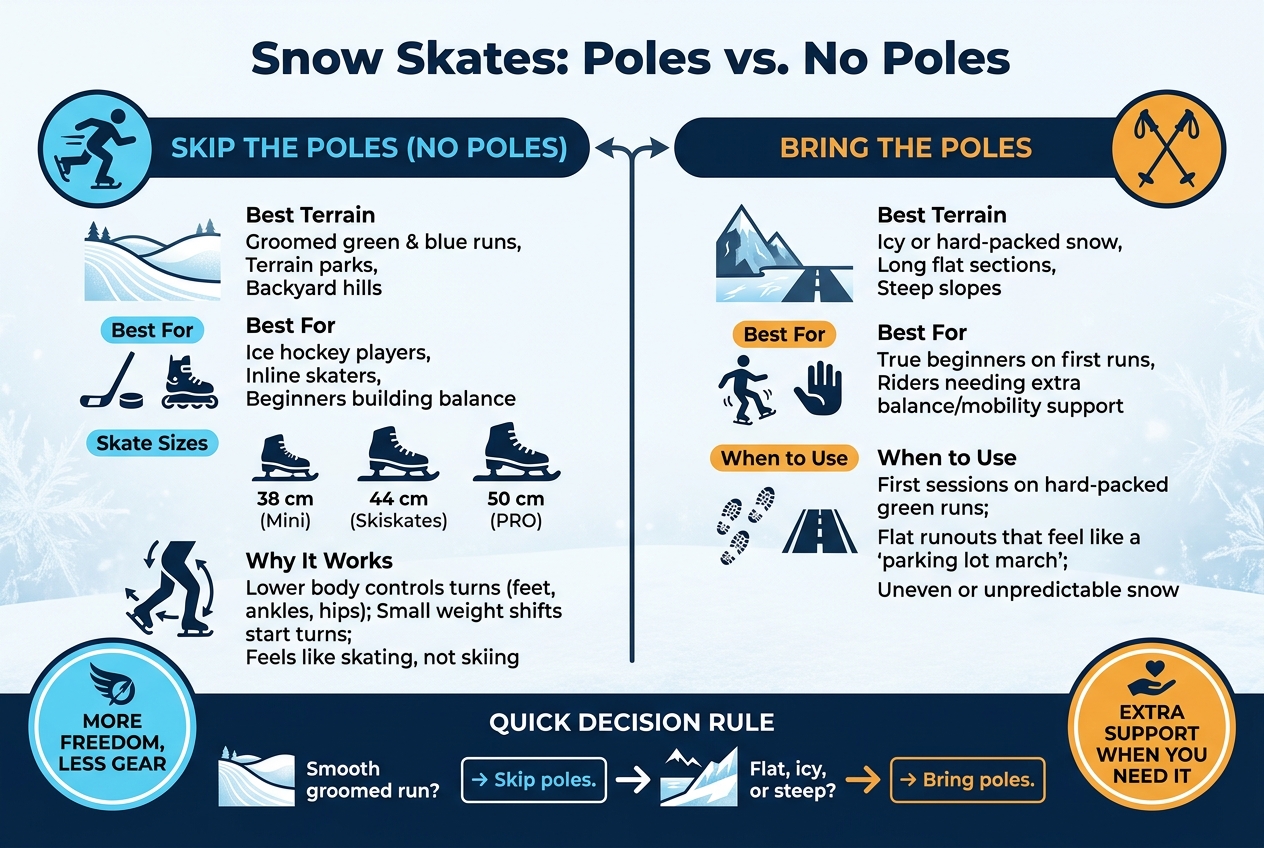
Snow Skates With Poles vs. Without Poles: When to Use Each
Situations Where Poles Can Help
Snowfeet* usually works best without poles. That’s part of the appeal: less gear, more freedom, and a ride that feels closer to skating than classic skiing.
That said, poles can still help in a few cases. They’re worth bringing if you’re in one of these edge-case spots: first sessions on hard-packed green runs, icy or uneven terrain, long flat approaches, or if you want extra support for balance or mobility.
Here’s the simple test: if none of those fit your day, skip the poles.
How to Decide If You Need Poles
Keep the decision tied to the terrain, not the gear.
Use poles if you’re a true beginner on hard-packed green runs, or if you need help on flats, icy patches, or with balance. Skip them for blue runs, skating-style riding, and terrain parks.
It’s pretty simple. If the hill is mellow but slick, or the flat section feels like a parking lot march in ski boots, poles can save some hassle. If you’re moving, turning, and playing around on normal terrain, they often just get in the way.
Poles on Snowfeet* vs. Long Skis: A Quick Comparison
On long skis, poles are part of the standard technique. Alpine skiers use them to help time turns, and cross-country skiers depend on them for propulsion. With Snowfeet*, poles are optional and mostly make sense on flat sections or during early learning.
| Snowfeet* Snow Skates | Traditional Long Skis | |
|---|---|---|
| Rider type | Skaters and snowboarders | Alpine, cross-country, or touring skiers |
| Terrain | Groomed runs, parks, forest paths | All-mountain, steep technical, backcountry |
| Need for poles | Optional - mainly for flats or beginners | Recommended or required for timing and propulsion |
When poles are optional, the big win is freer movement on short snow skates. And honestly, that’s where Snowfeet* feels the most fun :)
Conclusion: Most Snowfeet* Riders Can Skip the Poles
Yes - most Snowfeet* riders can skip poles.
Here’s why: Snowfeet* is controlled from the lower body, not the hands. On the Snowfeet* Mini Ski Skates 38 cm, PRO 50 cm, and Skiskates 44 cm, steering comes from your feet, ankles, and hips. On groomed runs and in parks, poles mostly just mean one more thing to carry, with little upside.
Still, there are a few times when poles make sense. Use them for:
- Long flat sections
- Steep icy terrain
- The first few learning runs
So, if the hill is smooth and you want more freedom, ride without poles. If the terrain is flat, icy, or steep, bring them. For most Snowfeet* riders, skipping poles means more freedom and less gear.
FAQs
Can beginners learn faster without poles?
Yes - beginners may learn faster without poles on Snowfeet. Riding pole-free often feels more natural, and it can help new riders focus on the big stuff first: balance, turning, and stopping.
That said, it depends on the rider and the terrain. Poles can still help in some cases, like a first day on the slope or on steeper runs.
What snow conditions make poles worth bringing?
The available information doesn’t say which snow conditions make poles worth bringing.
It also doesn’t give clear advice on when poles help more based on the snow.
Are Snowfeet* easier to control than traditional skis without poles?
Yes - Snowfeet* are often easier to control than standard skis without poles, especially if you're new to snow sports.
The big reason is simple: they’re short. Models like Skiskates 44 cm and mini skis in 38 cm or 50 cm feel easier to balance on, easier to turn, and less awkward to stop. That shorter shape tends to feel more natural, almost like a mix of skating and skiing.
Standard skis are a different beast. They’re longer, and that extra length can make them tougher to handle without poles. On normal skis, poles often help with balance, timing, and control.
With Snowfeet*, the ride feels more free and intuitive. You can move more naturally, which is a big plus for beginners. That said, poles can still be useful on steep slopes or when you're trying more advanced moves.











Lämna en kommentar
Denna webbplats är skyddad av hCaptcha och hCaptchas integritetspolicy . Användarvillkor gäller.