



















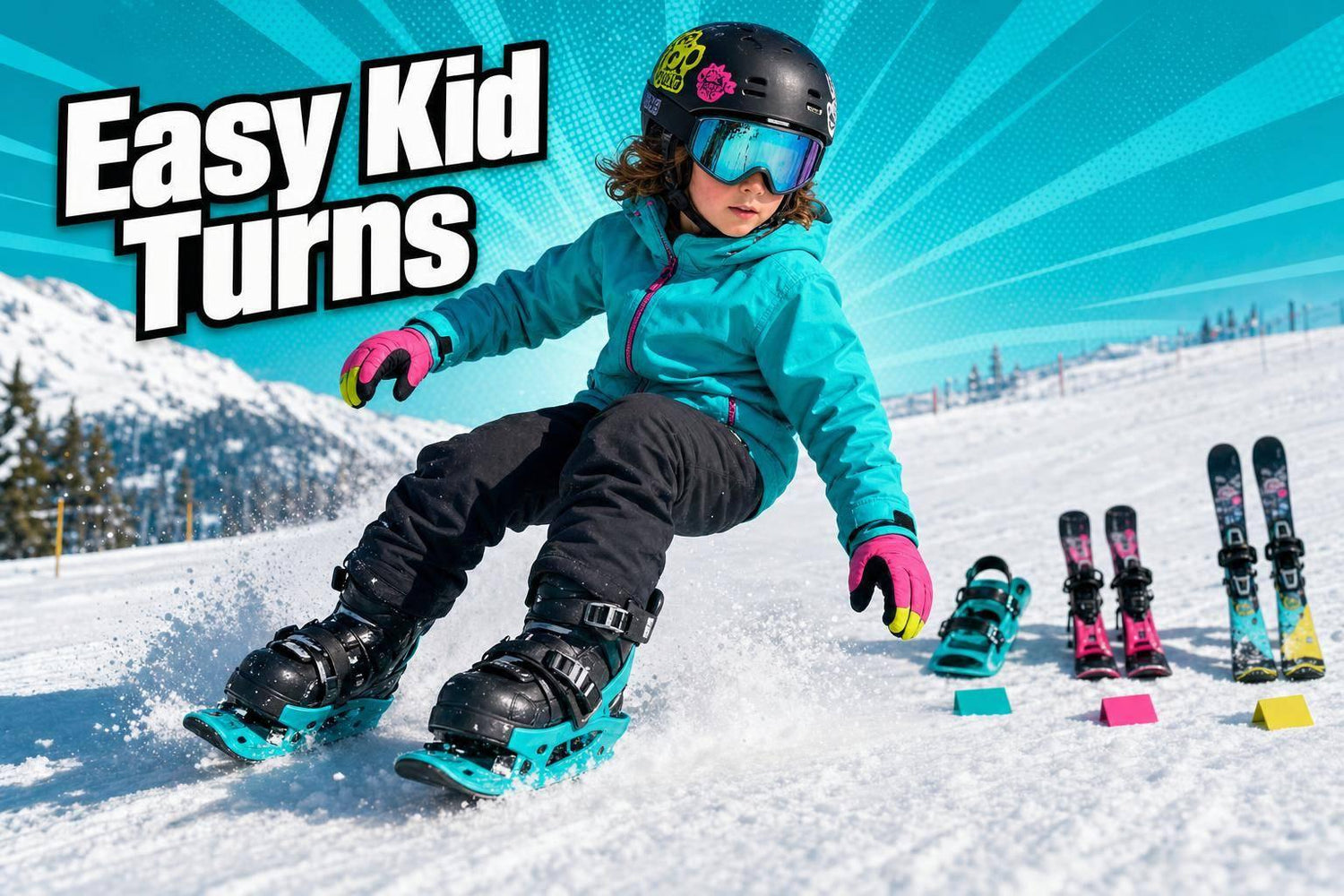
If I want the short answer: the easiest setup for first turns is the shortest one a kid can control on gentle terrain. In this lineup, that usually means Snowfeet* MINI KIDS for first-day learners, 44 cm Skiskates for kids who already balance well, and 65 cm Skiblades for those working toward linked turns.
Here’s the simple breakdown:
- Best for first-day beginners: Snowfeet* MINI KIDS
- Best for fast turn learning on groomers: Snowfeet* Skiskates 44 cm
- Best middle ground of turn ease and stability: Snowfeet* Skiblades 65 cm
- Best for later resort progression: Junior skis in the 90–120 cm range
- Best budget path: Used junior skis or low-cost generic snowblades, with trade-offs
What matters most?
- Shorter skis are easier to pivot
- Longer skis feel steadier at higher speed
- Winter boots keep setup simple
- Ski boots give more edge control
- Gentle terrain matters more than fancy gear
A few numbers tell the story. The article compares lengths from 44 cm up to 120 cm. The 65 cm Skiblades turn on about a 4-meter radius, which helps kids steer with less effort than full junior skis. Price ranges run from about $80 for cheap generic options up to $690 for short premium models.
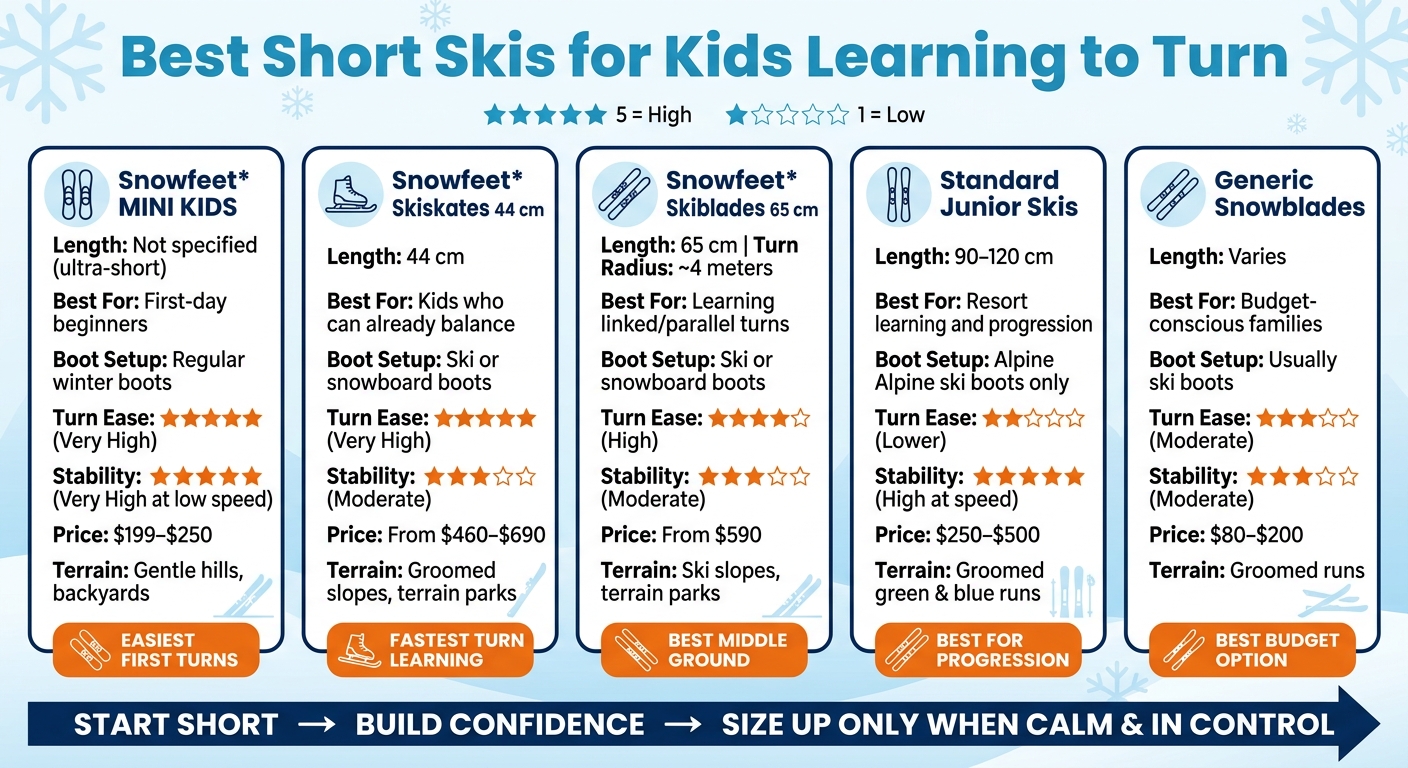
Best Short Skis for Kids: Quick Comparison Guide
How to Choose the Best Skis for Kids
Quick Comparison
| Option | Best For | Boot Setup | Main Trade-Off | Price |
|---|---|---|---|---|
| Snowfeet* MINI KIDS | First slides and first turns | Winter boots | Limited to mellow terrain | $199–$250 |
| Snowfeet* Skiskates 44 cm | Kids who can balance and want easy turns | Ski or snowboard boots | Less stable as speed builds | From $460–$690 |
| Snowfeet* Skiblades 65 cm | Kids learning linked or parallel turns | Ski or snowboard boots | More effort than 44 cm | From $590 |
| Junior skis (90–120 cm) | Resort learning and later progression | Alpine ski boots | Harder for first turns | $250–$500 |
| Generic snowblades | Lower-cost short-ski option | Usually ski boots | Build and tuning can vary a lot | $80–$200 |
So, if I were helping a parent in the shop, I’d keep it simple: start short, keep speeds low, and move longer only when the kid looks calm and in control. That’s usually the path with the fewest tears, the most smiles, and way less parking-lot drama :)
1. Snowfeet* MINI KIDS
Price: $250 | Fits shoe sizes: EU 27–38 (approx. kids' US 10 up to adult US 6)
Snowfeet* MINI KIDS are the smallest option in the Snowfeet lineup. They’re made for young kids with smaller feet, and they work with regular winter boots. That keeps things simple and helps cut setup costs.
The short platform and curved sidecut make turning feel much easier. Kids can start quick turns without fighting the gear. For those first turns, the smaller platform takes less effort to pivot, which is a big deal when a child is still getting the feel for sliding on snow. The light build helps too. It gives kids a better sense of control during early sessions.
There is a trade-off, though. These aren’t the best pick for steeper runs, deep powder, or icy hardpack. Short skis give up some stability and edge grip in those conditions. So, they make the most sense as a first step before moving to a longer setup or one that depends more on the boot.
A good boot match is an insulated, waterproof winter boot with firm ankle support and secure lacing or straps. Skip bulky snow boots. They may not sit well in the bindings, or they can be too long for the straps.
They work best for short turn drills on mellow terrain. If a kid wants more edge control and a feel that’s closer to skiing, the next move is the 44 cm Skiskates.
2. Snowfeet* Skiskates 44 cm
Price: $690 | Boot compatibility: Ski boots (EU 36–49 / US 4.5–14.5) or snowboard boots (EU 38–49 / US 6–14.5)
Skiskates 44 cm are the slope-ready move up from MINI KIDS. They put kids into a boot-based setup made for the slopes, which means more precise control. So if a kid is ready to leave winter boots behind, this is a solid next step.
At just 44 cm long, they feel a lot like skating on snow. That’s the fun part. Their parabolic shape and steel edges help kids turn fast and with less effort, even at low speed. That short length also makes it easier to start turns than it is on longer skis, which helps a lot when kids are still learning how to link turns without feeling pushed.
There is one catch: front-to-back balance matters more here. Since the skis are so short, kids need to stay centered, almost like they would on ice skates or inline skates. Kids who already skate often get the hang of them fast. Others may need a bit of time to settle in.
They work best on groomed slopes and in snow parks. They can handle about 4 inches (10 cm) of light snow, but once the snow gets deeper, things get tougher. If a kid wants more stability but isn’t ready for full junior skis, the 65 cm Skiblades make sense as the next stop.
User feedback tends to praise two things most:
- Easy control
- Quick turns
The main downside people mention is lower stability at higher speeds.
3. Snowfeet* Skiblades 65 cm
Price: Starting from $590 | Boot compatibility: Ski boots or snowboard boots
The 65 cm Skiblades sit right between the 44 cm Skiskates and standard junior skis. For kids who are past those first shaky sliding turns but still aren’t set for full junior skis, this size makes a lot of sense. It gives them more stability than the 44 cm model, but it’s still much easier to steer than skis in the 90–120 cm range. So, if the 44 cm version starts to feel a bit too twitchy, this is the natural next step.
They use a wood core, metal edges, and a sintered base, which helps them hold on groomed snow and packed snow. The parabolic shape also helps kids feel where the ski wants to go in a turn. That matters. A lot. Instead of wrestling with a longer, stiffer setup, they can get a feel for turning in a way that feels more natural.
The adjustable bindings work with either ski boots or snowboard boots. That’s a big plus.
- Snowboard boots can feel easier for kids and may give more ankle support
- Ski boots give a more standard on-slope feel
Either way, the 65 cm length keeps some of the easy, boot-based control of the 44 cm Skiskates, while feeling less nervous underfoot. That difference can help kids who are still figuring out their turns. The catch? More length brings more stability, but it also takes a bit more effort to turn.
These skiblades do best on groomed slopes and in snow parks. They’re not built for powder, but on prepared snow they give kids more stability than the 44 cm model. In this lineup, they’re the most even match for learning turns: easy to steer, but not so short that they feel wild.
| Feature | Snowfeet* Skiblades 65 cm | Standard Junior Skis |
|---|---|---|
| Length | 65 cm | 90–120 cm |
| Core Material | Sustainable wood core | Varies (often composite/foam) |
| Maneuverability | High | Moderate |
| Boot Compatibility | Ski or snowboard boots | Ski boots only |
| Learning Curve | Short | Longer / traditional |
Compared with standard junior skis, the 65 cm length stays easier to turn while adding more stability for kids who are ready to move forward. That makes it a better pick for kids who want easier turning without giving up too much stability.
sbb-itb-17ade95
4. Standard Junior Skis (90–120 cm)
Standard junior skis are a different beast from 65 cm Skiblades. They give up some of that easy, quick-turn feel, but in return kids get more stability. That’s why ski schools still lean on them so much: they feel familiar, steady, and closer to the skis most kids will use later on.
They also help kids build skills that carry over well. Things like edging and shifting weight side to side work much the same way on longer skis as they grow. So, if the goal is to learn the usual ski feel from the start, this setup makes sense.
For sizing, the basic rule is pretty simple: a beginner’s ski should stand somewhere between the chest and chin when placed upright next to the child. For a 7-year-old who’s about 3'11" (119 cm), that usually points to a 100–110 cm ski. That extra length starts to help once a kid can link turns, though it can make the first few pivots feel slower.
Standard junior skis also need alpine boots and bindings, and the bindings should be set by a shop tech. The plus side is better edge control. The downside? The whole setup is heavier and more bulky than the Snowfeet options covered earlier. Not a deal-breaker, but yeah, it’s more gear to wrangle in the parking lot :)
They work best on groomed green runs and easy blue runs, where kids practice wedge turns and begin linking parallel turns. In terms of price, new packages usually cost $250–$350. Used setups often come in at under $150.
If that still sounds like a lot of ski for a new rider, the next section gets into other short-ski and snowblade options.
5. Other Short-Ski Brands and Generic Snowblades for Kids
Generic snowblades are another option. But in most cases, they’re less kid-friendly than Snowfeet*.
For kids who are just learning to turn, the big question isn’t which setup looks more like a normal ski. It’s which one feels easiest to move in. That’s what matters on snow.
Most generic snowblades still require ski boots. That adds extra cost and can make things tougher for young beginners. They also tend to offer less natural edge control than Snowfeet*, which can make first turns feel clunky.
That’s where Snowfeet* pulls ahead: a simpler setup, easier control, and less hassle for kids who are trying to make those first turns click.
The biggest difference shows up in how fast kids can start linking turns. MINI KIDS skips the ski-boot step, so kids can focus on movement instead of dealing with gear. Skiskates and Skiblades use a boot-based setup, but their shapes help guide turn initiation in a way that feels more natural. Most generic options don’t put the same focus on that part.
So instead of fighting the equipment, kids can spend more time building confidence on snow.
That makes Snowfeet* the stronger default pick for kids learning their first turns. The next section compares the options side by side on turning, stability, boot setup, and terrain.
How They Compare: Turning, Stability, Boot Setup, and Terrain
Here’s the short version: some setups make first turns feel easier right away, while others give up some of that ease in exchange for more speed and a steadier feel.
| Option | Turn Ease | Stability | Boot Setup | Best Terrain |
|---|---|---|---|---|
| Snowfeet* MINI KIDS | Very high - ultra-short and easy to pivot | Very high at low speeds | Regular winter boots or snowboard boots | Sledding hills, backyards, gentle beginner slopes |
| Snowfeet* Skiskates 44 cm | Very high - skating-style movement makes turning feel natural | Moderate - wood core and metal edges add control | Ski boots or snowboard boots | Groomed slopes, terrain parks |
| Snowfeet* Skiblades 65 cm | High - compact shape helps with turn initiation | Moderate - stable for carving, less so at speed | Ski boots or snowboard boots | Ski slopes, terrain parks |
| Standard Junior Skis (90–120 cm) | Lower - length adds resistance for beginners | High at speed - best for faster runs | Traditional ski boots required | Groomed resort runs |
| Generic Snowblades | Moderate - depends on brand and length | Moderate | Varies; usually ski or snowboard boots | Groomed runs |
Snowfeet* makes first turns easier because shorter skis pivot faster at low speed. That’s the big pattern in the table. For a kid who’s just learning to twist, steer, and stop, that can make a huge difference.
Junior skis get steadier as speed goes up. Snowfeet* stays easier to steer at beginner pace. So the trade-off is pretty simple: easier turning now or more stability later on faster runs.
Boot setup matters too, and this part is easy to miss. MINI KIDS keeps things simple. Skiskates and Skiblades add the extra control that comes from ski or snowboard boots. Junior skis need full alpine boots, which means more gear and a more locked-in feel.
A quick way to think about it:
- Choose MINI KIDS for gentle hills, backyards, and easy first slides
- Choose Skiskates or Skiblades for groomed runs and terrain parks
- Choose junior skis when your child is ready for longer, faster runs
For new turners, the best setup is usually the one that cuts down resistance when they pivot, twist, and stop.
Next, break these differences into plain pros and cons.
Pros and Cons of Each Option
This quick pros-and-cons view turns the earlier comparison into a buying shortcut.
| Option | Key Pros | Main Cons | Approx. Price (USD) |
|---|---|---|---|
| Snowfeet* MINI KIDS | Ultra-short and easy to pivot; fits regular winter boots; simplest setup | Strap-on system with no release bindings; keep speeds very low; best on gentle slopes and backyard hills | $199–$250 |
| Snowfeet* Skiskates 44 cm | Skate-like feel makes turns quick and easy; very short, so tip-crossing is reduced; fits ski or snowboard boots | No release bindings; can feel twitchy at higher speeds; more expensive | From $460 |
| Snowfeet* Skiblades 65 cm | Short enough for quick turns; deep sidecut helps start turns; works with ski or snowboard boots; handles green runs well | Less stable at speed than longer skis; binding setup varies; not ideal for deep powder or steep terrain | From $590 |
| Standard Junior Skis (90–120 cm) | Pairs with proper junior release bindings; stable on faster groomed runs; easy to rent at U.S. resorts | Harder to turn for first-timers; requires dedicated ski boots; short lifespan for fast-growing kids | $250–$500 (full setup) |
| Other short-ski brands / generic snowblades | Lower entry cost; shorter than standard skis; easier to turn than full-length gear | Build quality varies a lot; some models are stiff or poorly tuned, which can make turns tough to link; binding quality also varies a lot | $80–$200 |
The main trade-off is pretty simple: easier first turns now, or more stability as speed picks up.
If your goal is low-speed fun and the least amount of gear, the shortest options can feel like a nice shortcut. If you want more control once your child starts sliding faster on groomers, standard junior skis still have a clear edge.
So, the next step is picking the setup that makes turning feel easy for your child without piling on extra gear or inviting more speed than they need.
Final Verdict: Which Short Ski Setup Makes Turning Easiest for Your Child?
The best pick comes down to your child’s current skill level, not just ski length.
First-day learner? Go with Snowfeet* MINI KIDS. They strap onto regular winter boots, so there’s less gear to deal with. On gentle slopes, they make pivoting feel simple and low-stress. No stiff ski boots. No long skis to fight with.
If your child can already balance and steer a bit: Snowfeet* Skiskates 44 cm are a great next step. They have more of a skate-like feel, which helps kids link turns fast and naturally on groomed runs.
Working on parallel turns? Pick Snowfeet* Skiblades 65 cm. That extra length over the 44 cm model gives more stability, but they still stay easy to turn. It’s a nice middle ground.
Ready for a more standard ski setup? Move to standard junior skis (90–120 cm) once your child can link parallel turns and wants more stability. The catch: those first turns are often tougher, and the gear setup is more involved.
So, keep it simple: choose the shortest setup your child can control right now. Have the boots and bindings checked by a shop tech, stick to easy terrain, and size up only when your child is set for it. For first turns, Snowfeet* is the easiest path. Standard junior skis tend to make more sense later, when stability starts to matter more.
FAQs
How do I know when my child is ready to move from MINI KIDS to Skiskates or Skiblades?
Your child is ready to move up from MINI KIDS (38 cm) when they can handle the basics on flat ground. That means balancing well, shifting weight side to side, and doing small, controlled hops without looking wobbly.
Once they feel steady and ready for gentle slopes, the 44 cm Skiskates are a great next step for working on turns. If you want a bit more stability and range in beginner zones, the 65 cm Skiblades are a better fit.
Are short skis safe for kids on beginner slopes?
Yes. Short skis are a safe, effective pick for kids on beginner slopes because they’re easier to turn and control than longer skis. That usually helps kids feel more at ease and build confidence faster.
Snowfeet* short skis come with a few other perks too:
- They help prevent crossed tips
- They put less stress on ankles and knees
- They make it easier to get up after a fall
- They work with regular winter boots, which makes the setup more comfortable and forgiving
For a kid who’s just starting out, that can make a big difference :)
Should my child use winter boots, snowboard boots, or ski boots?
One of the best parts of Snowfeet gear is the boot fit. Depending on the model, your child can use regular winter boots, snowboard boots, or ski boots.
For young beginners, MINI KIDS works with regular winter boots. That means more comfort and less fatigue, which is a big win when kids are just getting started. Skiskates and Skiblades usually fit ski boots or snowboard boots. Snowboard boots tend to feel more flexible and comfy, while ski boots give a more rigid, stable feel.











Lasă un comentariu
Acest site este protejat de hCaptcha și hCaptcha. Se aplică Politica de confidențialitate și Condițiile de furnizare a serviciului.