



















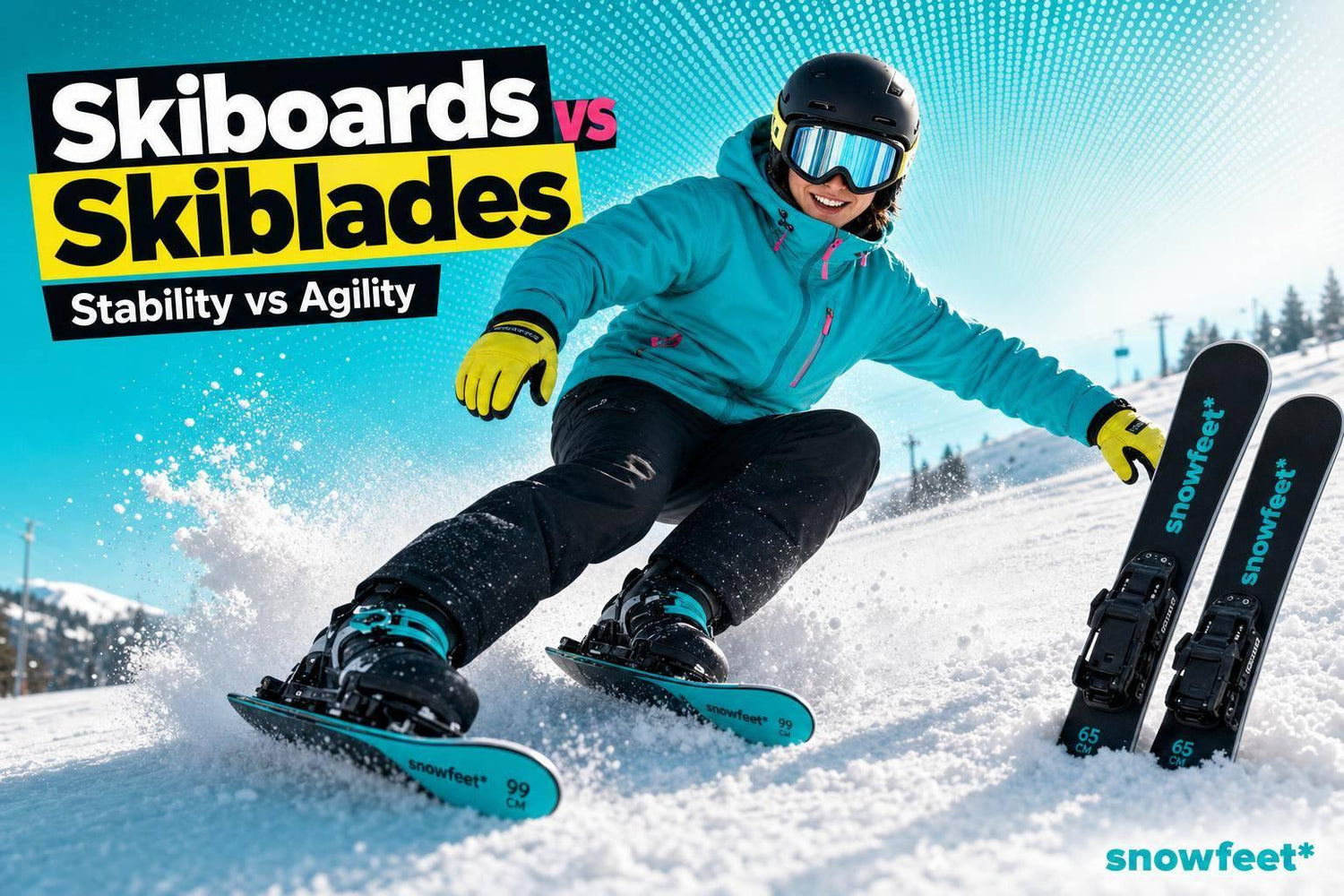
If I had to give you the short answer: 99 cm skiboards are the safest starting point for most beginners, while 65 cm skiblades are the fun pick if you want faster turns and lighter gear.
If you're brand new, here's the simple breakdown:
- 99 cm skiboards: more stable, calmer on green runs, easier to trust on day one
- 120 cm skiboards: a bit more stable at speed, but less easy to swing around
- 65 cm skiblades: easy to turn, playful, a nice middle ground
- 44 cm skiskates: tiny, backpack-friendly, but less stable for first-timers
- Main trade-off: shorter = easier turns, but less balance and less calm as speed builds
So, if you're nervous, I'd point you to 99 cm skiboards first. If you're athletic, playful, or come from hockey or skating, 65 cm skiblades may click faster. And if you want the most compact setup of all, 44 cm skiskates are the tiny wild card :)
A few facts from the article stand out:
- The gear covered ranges from 44 cm to 120 cm (about 17–47 in)
- 44 cm skiskates are the shortest option
- 99 cm shows up as the sweet spot for many beginners
- Stability tends to go up with more length, while turning gets easier with less length
How to choose Snowfeet* Snowblades | Skiblades | Skiboards | Short Ski
Quick Comparison
| Option | Best for | Feel on snow | Main watch-out |
|---|---|---|---|
| 44 cm Skiskates | Skaters, hockey players, short slopes | Very nimble, skate-like | Less stable as speed builds |
| 65 cm Skiblades | New riders who want easy turns | Light, playful, easy to steer | Less calm than 99 cm |
| 99 cm Skiboards / Skiblades | Most beginners | Best mix of control and ease | Not as snappy as shorter models |
| 120 cm Skiboards | Confident beginners on longer runs | More planted on groomers | Takes more input to turn |
What matters most for beginners isn't the label. It's this:
- Can you stop without panic?
- Can you turn without fighting the skis?
- Do you feel steady enough to relax?
That’s the whole game. And from this comparison, I’d sum it up like this:
- Pick skiboards if you want more stability and a calmer first day
- Pick skiblades if you want easier turning and a lighter setup
- Pick skiskates only if you already like a skate-style feel or want the smallest gear possible
If you want a quick visual before you buy, these videos can help:
So, if I were helping a first-time rider in my shop, I’d keep it simple: go 99 cm for control, 65 cm for fun, and 44 cm only if you know you want that skate feel. That’s the cleanest way to avoid the “uh, why are my feet doing that?” stage for a little longer.
Skiboards for Beginners: More Stable and Less Twitchy
If your main goal on day one is simple - stay upright - skiboards deserve a close look. The 99 cm and 120 cm Snowfeet* models land in a sweet spot for beginners. They’re short enough to feel manageable, but long enough to feel steady under your feet.
That’s what makes them the stability-first pick in the skiboards-vs.-skiblades choice. They give cautious riders a calmer base than shorter skiblades or skiskates. And that shows up fast when you look at stability, turning, and stopping.
How Skiboards Feel on Snow on Day One
A wider platform tends to feel more planted. Skiboards don’t react to every tiny movement the way ultra-short skiskates do, so small balance mistakes are easier to fix. That calmer feel can be a big relief on chopped-up groomers.
The 99 cm model, in particular, feels easier to balance on than ultra-short options because it reacts less to tiny errors. That means less “whoa, too much” and more “okay, I’ve got this” :)
How Skiboards Help with Learning, Stopping, and Control
For beginners, the difference between the 99 cm vs. 120 cm comes down to response.
The 99 cm reacts faster to weight shifts and edging. So when you’re working on a basic wedge stop or trying to slow down bit by bit, it usually feels less intimidating. Tip crossing is also less likely since the skis are shorter.
The 120 cm gives you a bit more platform and stability. That can feel nice on longer groomed runs, especially if you want an easier cruise. It reacts a little slower than the 99 cm, and some beginners like that at moderate speed because it feels calmer.
Still, for most nervous first-timers, the 99 cm is the better place to start. It gives you control without feeling like too much ski. The next step is seeing how that steadier ride stacks up against the quicker, more playful skiblade setup.
"These ski blades are a blast to use. Super easy to control, quick to turn, and way more forgiving than traditional skis... Only trade-off is at higher speeds, where longer skis still feel more stable." - Brad Tolin, Snowfeet* User
Skiboards: Pros and Cons for Beginners
| Beginner Factor | Advantage of Skiboards | Trade-off |
|---|---|---|
| Balance | More supportive front-to-back; less "twitchy" than ultra-short models | Slightly less agile than 44 cm or 65 cm options |
| Learning speed | Most riders feel comfortable quickly because they respond to basic weight shifts | Still requires front-to-back stance awareness |
| Stopping | Full metal edges make wedge stops and hockey stops straightforward | Less edge surface for braking at extreme speeds |
| Turning radius | Deep parabolic sidecut allows for easy, low-effort turns | Larger turning radius than shorter skiblades |
| Comfort at speed | Wood-core 99 cm and 120 cm models feel stiffer and more stable on groomed snow; not meant for high-speed racing or steep expert terrain | Best suited to mellow groomed runs and light powder |
| Portability | Much lighter and shorter than traditional skis | Less compact than 44 cm skiskates |
The trade-off is pretty simple. Skiboards give up some high-speed calm and steep-terrain ability in exchange for a smoother, more forgiving ride on everyday beginner terrain. That difference stands out even more in the side-by-side comparison below.
sbb-itb-17ade95
Skiblades for Beginners: Faster Turns and a More Playful Feel
Skiblades are the faster-turning, more playful pick. Because they’re shorter, they feel lighter and easier to steer. But length still changes a lot. 44 cm feels the most like skating, 65 cm is the easiest middle ground, and 99 cm feels closer to a short ski.
How 44 cm, 65 cm, and 99 cm Options Change the Beginner Experience
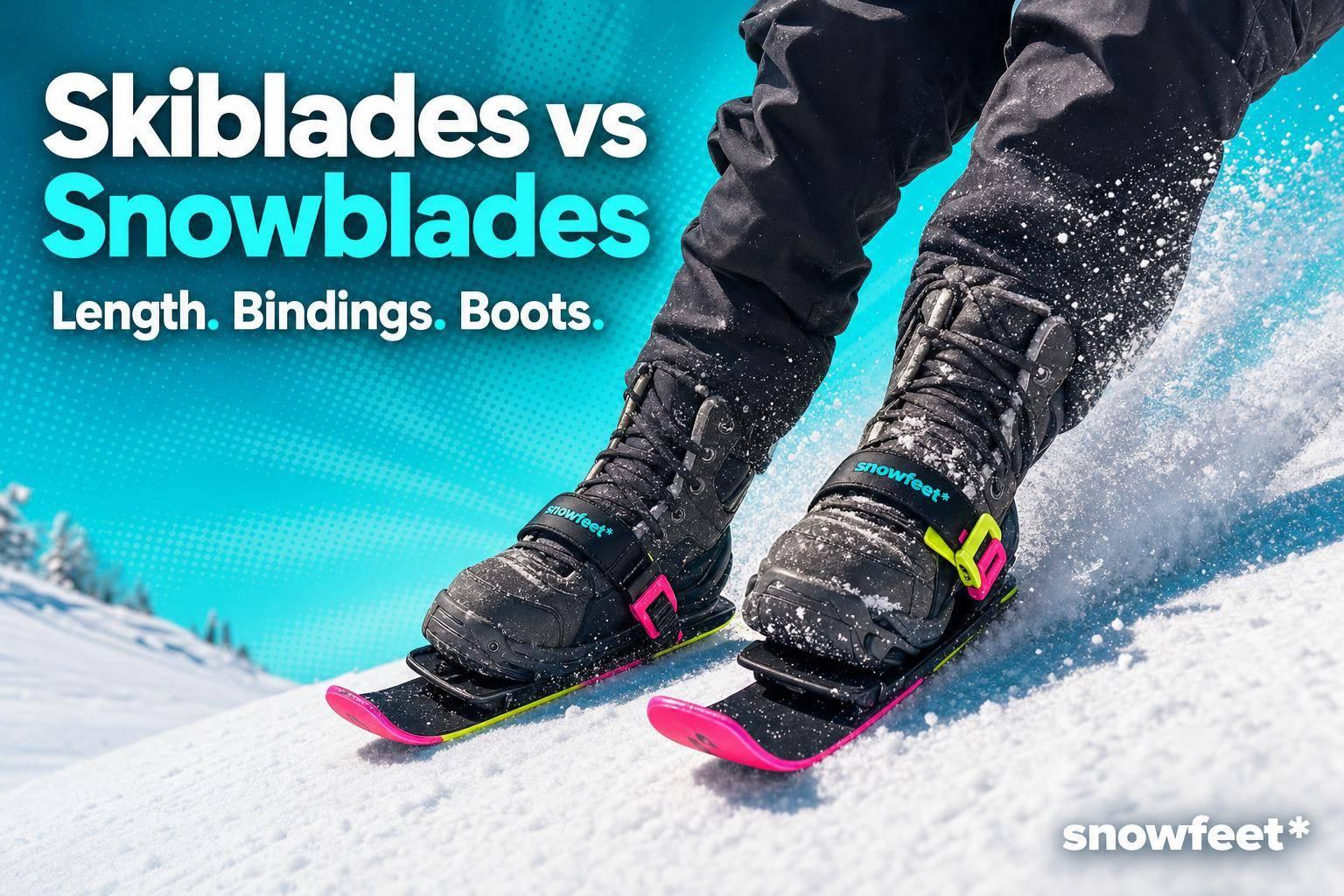
The Snowfeet* Skiskates at 44 cm (17 in) are the most skate-like of the three. They’re small enough to toss in a backpack, and they pivot almost the second you move your feet. On short green runs, that quick feel can be a blast. The downside? They give you less front-to-back stability. So if you start going faster on a longer slope, they can feel a bit twitchy.
The Snowfeet* Skiblades at 65 cm are the easiest place to start for most first-timers. That added length helps you stay on line and feel calmer when you’re heading downhill. A lot of beginners find 65 cm more forgiving than 44 cm, while still being simple to turn.
The Snowfeet* Skiblades at 99 cm are better for smoother turns, better edge hold at higher speeds, and a steadier feel on longer green runs or easy blues. They act more like skiboards, but they’re still faster to steer than full skis. That keeps them in skiblade territory while adding a lot more control. If you want to improve fast, that control makes a big difference. That’s why 99 cm is often the best fit for beginners who want the easiest route to stronger technique.
Who Learns Fastest on Skiblades
Ice skaters, hockey players, and rollerbladers often click with skiblades faster than almost anyone else. The 44 cm Skiskates feel most natural to skaters because they reward quick edge changes and side-to-side control.
Beginners who feel confident but don’t have a skating background often do well on 65 cm. It gives them a bit more room for mistakes while still turning much easier than full-length skis.
Snowboarders who are trying skis often lean toward 99 cm. It’s short enough to feel less intimidating, but stable enough to carve at normal resort speeds.
Skiblades: Pros and Cons for Beginners
Here’s the quick beginner view:
| Length | Best for beginners who… | Main benefit | Main limitation |
|---|---|---|---|
| 44 cm Skiskates | Skate, rollerblade, or play hockey; ride local hills or short slopes | Feels natural for skaters; ultra-portable; fits in a backpack | Less stable at higher speeds; more ankle fatigue over a full day |
| 65 cm Skiblades | Want easy turns with a bit more stability; ride green runs at full-size resorts | Strong mix of agility and control; intuitive stopping on most beginner terrain | Less edge grip than 99 cm if runs get longer or faster |
| 99 cm Skiblades | Plan to improve fast; ride larger resorts; want a ski-like feel | More stable at speed; teaches carving basics; bridges to skiboards | Less quick to turn than shorter options; slightly heavier |
Side-by-Side Comparison: Which Is Easier for Your First Days on Snow?
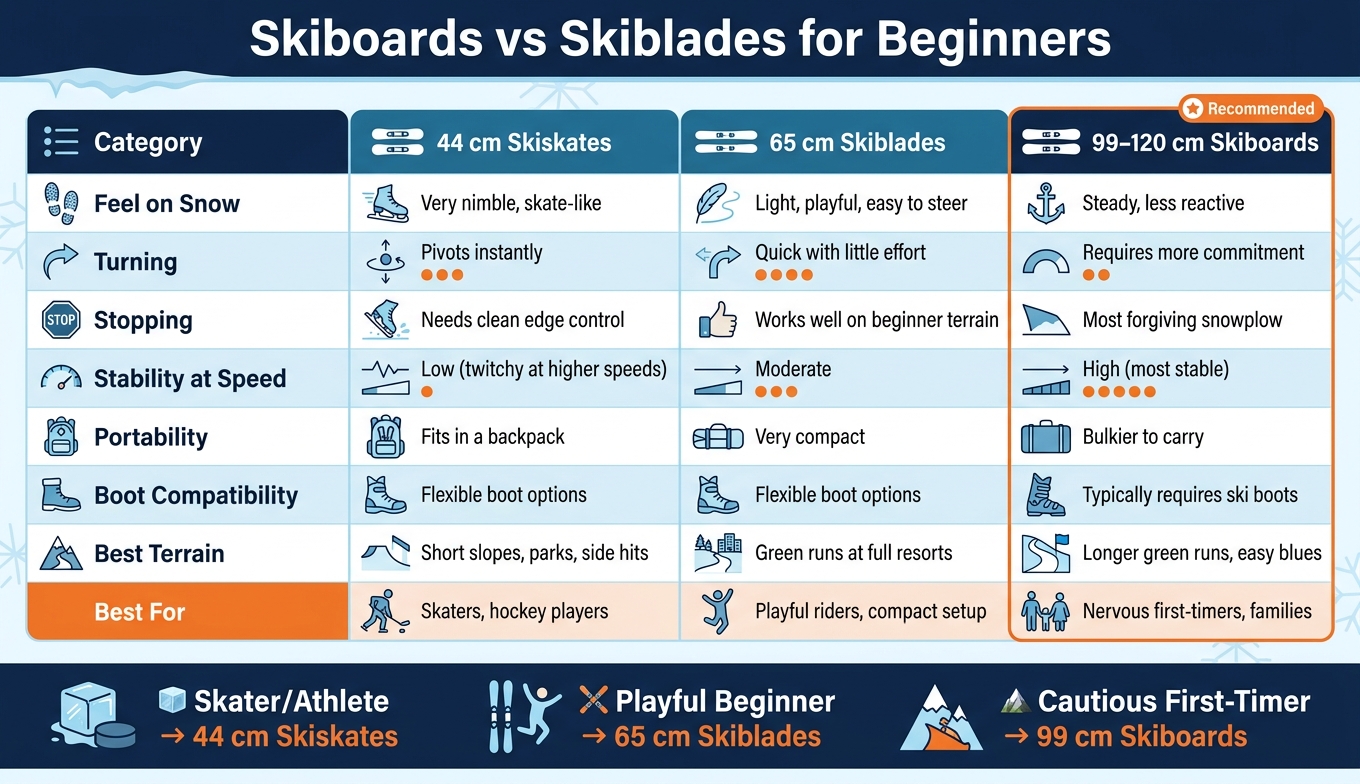
Skiboards vs Skiblades: Beginner Comparison Chart
Learning Speed, Turning, Stopping, and Confidence
Now that each option is clear, let’s compare how they feel on snow.
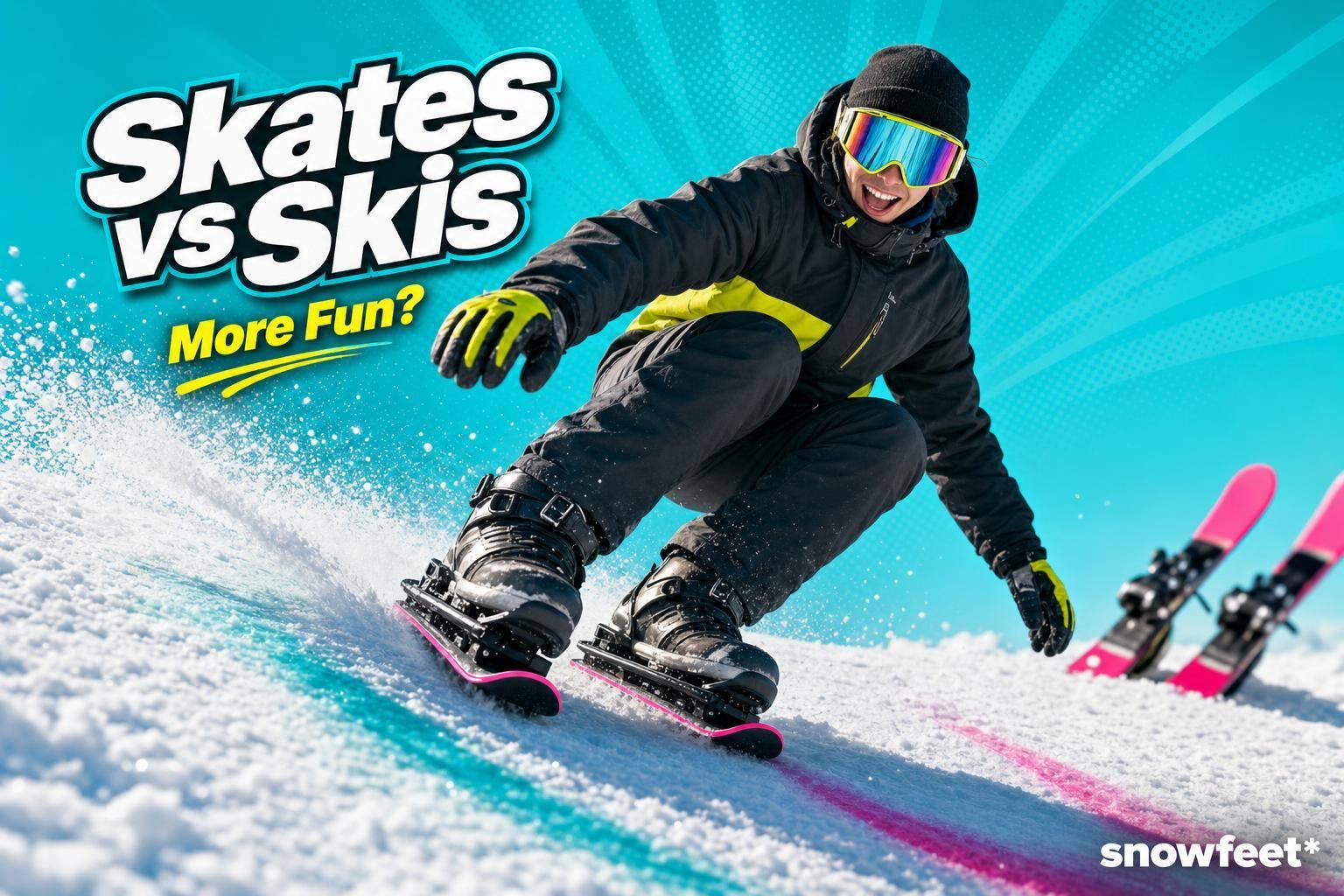
Here’s the short version: skiboards feel steadier, while skiblades feel quicker. And honestly, that one difference shapes most beginner choices.
Skiblades are easier to pivot. Skiboards are easier to trust. For someone in their first days on snow, that matters more than stuff like turning radius or edge angle. If you’re still trying to relax and not feel like your legs have a mind of their own, confidence comes first :) Shorter skiblades help you learn fast, while longer skiblades give you more control.
Skiboards also make snowplow stops feel more forgiving. Skiblades can do the same stop, but they ask for cleaner edge control. That’s not a deal-breaker. It just means skiboards tend to feel a bit more forgiving at the start.
Boot Setup, Terrain, and Portability
Snowfeet* skiblades work with flexible boot setups, which makes the gear side less of a hassle for new riders. Skiboards usually need a standard ski boot, so that’s one more rental item to deal with.
Terrain matters too.
Skiboards do well on longer green runs and easy blues, especially when speed starts to build. Skiblades - especially the 44 cm Skiskates - work best on shorter slopes, terrain parks, and side hits where quick pivots matter more than straight-line calm.
And then there’s portability, which people often ignore until they’re lugging gear across a parking lot. The 44 cm Skiskates fit in a backpack. The 99 cm Skiblades are also much easier to carry than full-length skis. Skiboards, by comparison, are bulkier to carry and store.
Comparison Table: Skiboards vs Skiblades for Beginners
| Category | Skiboards | Skiblades | Best pick for most beginners |
|---|---|---|---|
| Feel on snow | Steady, less reactive | Lighter, quicker | Skiboards for nervous first-timers |
| Learning curve | Easier first hour; builds confidence | Slightly steeper start; faster progression | Skiblades for riders who want quicker progression |
| Stopping | Snowplow is more forgiving | Snowplow works; needs cleaner edge control | Skiboards |
| Turning | Requires more commitment to initiate | Pivots quickly with less effort | Skiblades |
| Stability at speed | Higher - wider platform holds better | Lower at 44 cm; improves at 99 cm | Skiboards or 99 cm Skiblades |
| Portability | Bulkier to carry and store | Compact; 44 cm fits in a backpack | Skiblades |
| Boot compatibility | Typically requires ski boots | More flexible boot options | Skiblades |
| Best terrain | Longer green runs, easy blues | Short slopes, parks, side hits | Depends on your terrain |
If your main goal is to feel steady on day one, skiboards usually make that easier. If you want fast, nimble turns and an easier-to-carry setup, skiblades have a strong case.
Final Verdict: Best Beginner Picks by Rider Type
After looking at stability, turning, stopping, and how easy each option is to carry, the beginner answer gets pretty simple.
Best Pick for Total Beginners, Cautious Riders, and Families
For most first-timers, Snowfeet* 99 cm Skiboards are the safest all-around place to start: stable, easy to control, and still compact. The 99 cm model is also Snowfeet*'s bestseller for stability and carving.
If you're a cautious rider, 99 cm keeps things calm and predictable. That matters on day one, when you don't want your gear to feel twitchy or hard to manage.
If you want the easiest, most relaxed first day, this is the one to get. If you'd rather have a snappier, more playful feel, check the shorter picks below.
Best Pick for Skaters, Playful Riders, and Compact Setups
If you already skate, Snowfeet* Skiskates 44 cm will likely feel natural right away. They pivot fast and stay tiny, which makes them a good match for skaters.
If you want Snowfeet* Skiblades 65 cm, they carve fast on groomed beginner slopes and still feel steady enough for mellow blue runs as your confidence grows.
So now the choice gets clear: steadier skiboards or faster-feeling skiblades.
Key Points to Know Before You Buy
Use three simple filters for the final call: confidence, boot setup, and terrain.
Choose skiboards if you want more stability. Choose skiblades if you want faster turns and easier carrying.
| Your profile | Best starting pick |
|---|---|
| Nervous first-timer or family group | Snowfeet* Skiboards 99 cm |
| Skater or athletic beginner | Snowfeet* Skiskates 44 cm |
| Playful rider who wants one compact setup | Snowfeet* Skiblades 65 cm |
| Confident beginner on blue runs | Snowfeet* Skiboards 120 cm |
Skiboards are the better fit for stability. Skiblades lean more toward agility. Snowfeet* gives beginners a clean way into either style.
FAQs
Do I need ski boots for skiboards or skiblades?
No. For most Snowfeet skiboards and skiblades, you don’t need special ski boots.
Many models, including the 65 cm and 99 cm skiblades, work with regular winter boots or snowboard boots. That makes things a lot easier if you want to hit the snow without buying extra gear.
The 120 cm models are different. They do need ski boots because they need more support for higher-speed carving and better stability.
Can I use skiblades on blue runs as a beginner?
Yes. Snowfeet* skiblades are easy to turn and quick to respond, which makes them a solid pick for groomed blue runs.
The 99 cm and 120 cm models give beginners a nice mix of stability and control. That helps a lot when you're learning to link turns without feeling like the skis are fighting you.
Compared with longer skis, they usually feel less intimidating and take less work to learn. For a lot of first-time riders, that can mean more confidence and a smoother start on the mountain :)
How do I choose between 65 cm and 99 cm?
Choose 65 cm if you’re an absolute beginner and want the easiest learning curve. It also makes sense if you like a light, nimble board for basic turns, simple tricks, or more of a skate-like feel.
Choose 99 cm if you’ve already got the basics down and want more stability. It’s a better fit for faster carving and gives you more range as your skills grow.











Zostaw komentarz
Ta strona jest chroniona przez hCaptcha i obowiązują na niej Polityka prywatności i Warunki korzystania z usługi serwisu hCaptcha.