



















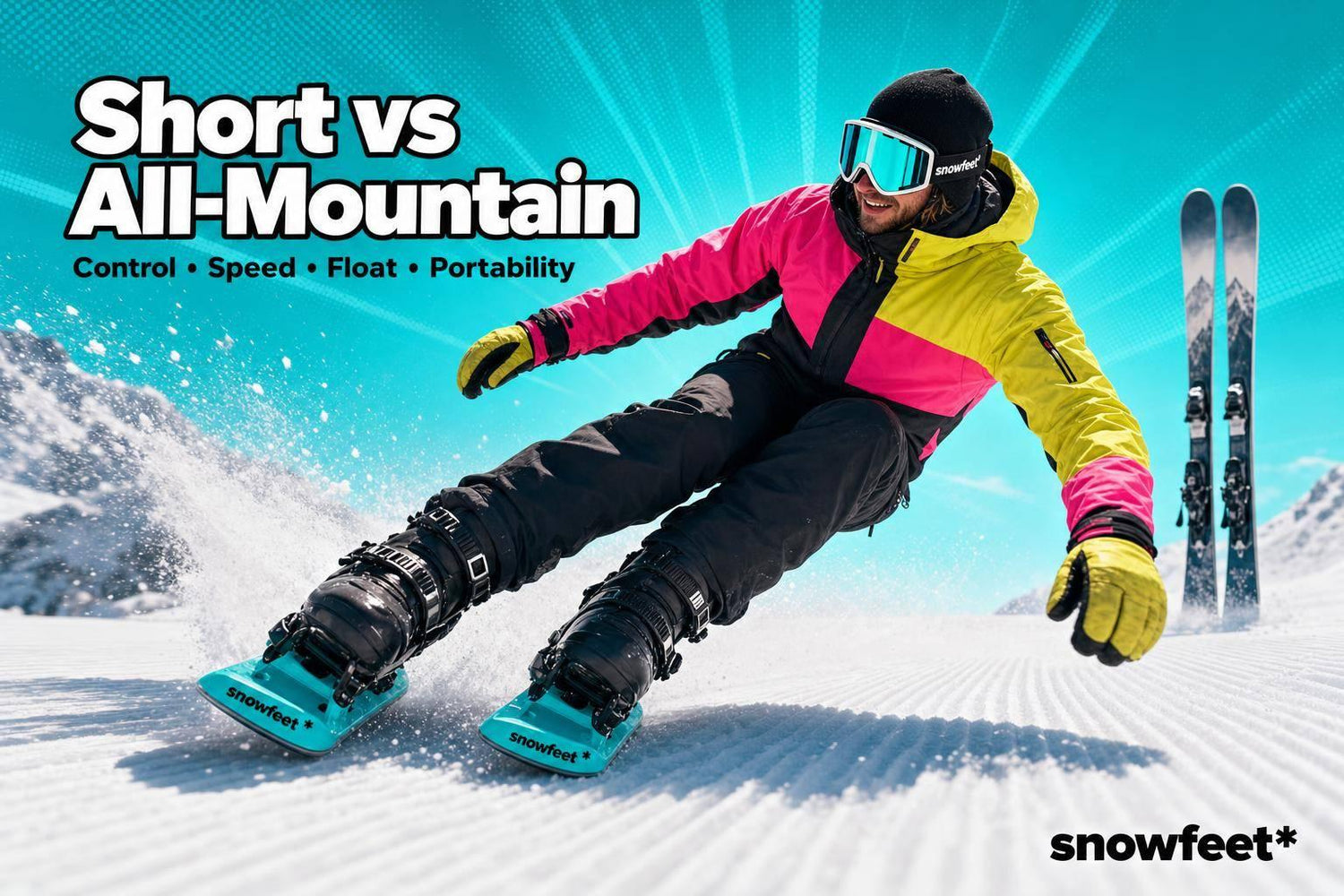
If you ski a few days a year on groomers, short skis will likely feel easier and more fun. If you ski fast, chase steep runs, or want more float in deep snow, all-mountain skis still make more sense.
I’d break it down like this:
- Short skis (44–120 cm / 17–47 in) are easier to turn, easier to stop, and much easier to carry.
- All-mountain skis (150–190 cm / 59–75 in) feel calmer at higher speeds and do better in deep snow and mixed conditions.
- For most casual U.S. resort riders, the big choice is easy control vs. top-end stability.
- Boot setup matters too: some short ski models work with winter boots or snowboard boots, while all-mountain skis need alpine ski boots.
That’s the whole story in plain English. If you want a setup for green runs, blue runs, moguls, park laps, travel, and low-stress ski days, go short. If you want long carves, steep terrain, and powder performance, go longer.
Quick comparison:
| Factor | Short Skis | All-Mountain Skis |
|---|---|---|
| Best for | Casual resort days, park, travel | Fast carving, steep terrain, powder |
| Learning | Easier at low speed | Takes more time |
| Turning | Tight, fast turns | Needs more space |
| High-speed feel | Less steady | More steady |
| Portability | Backpack or small bag on some models | Full ski bag |
| Boots | Some models use non-ski boots | Alpine ski boots only |
So, if you’re asking, “What should I buy for how I ski?” my short answer is simple: casual riders should lean short; hard-charging riders should lean long :)
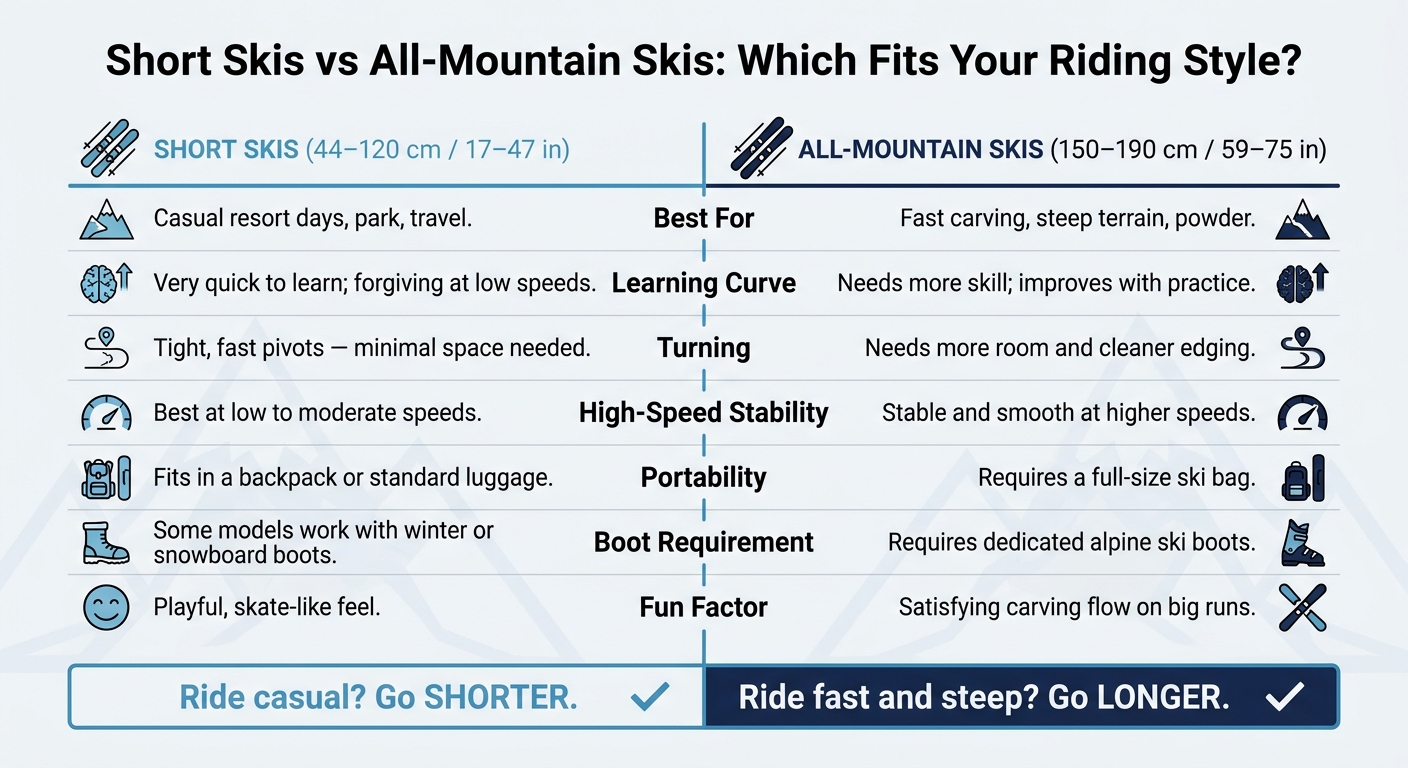
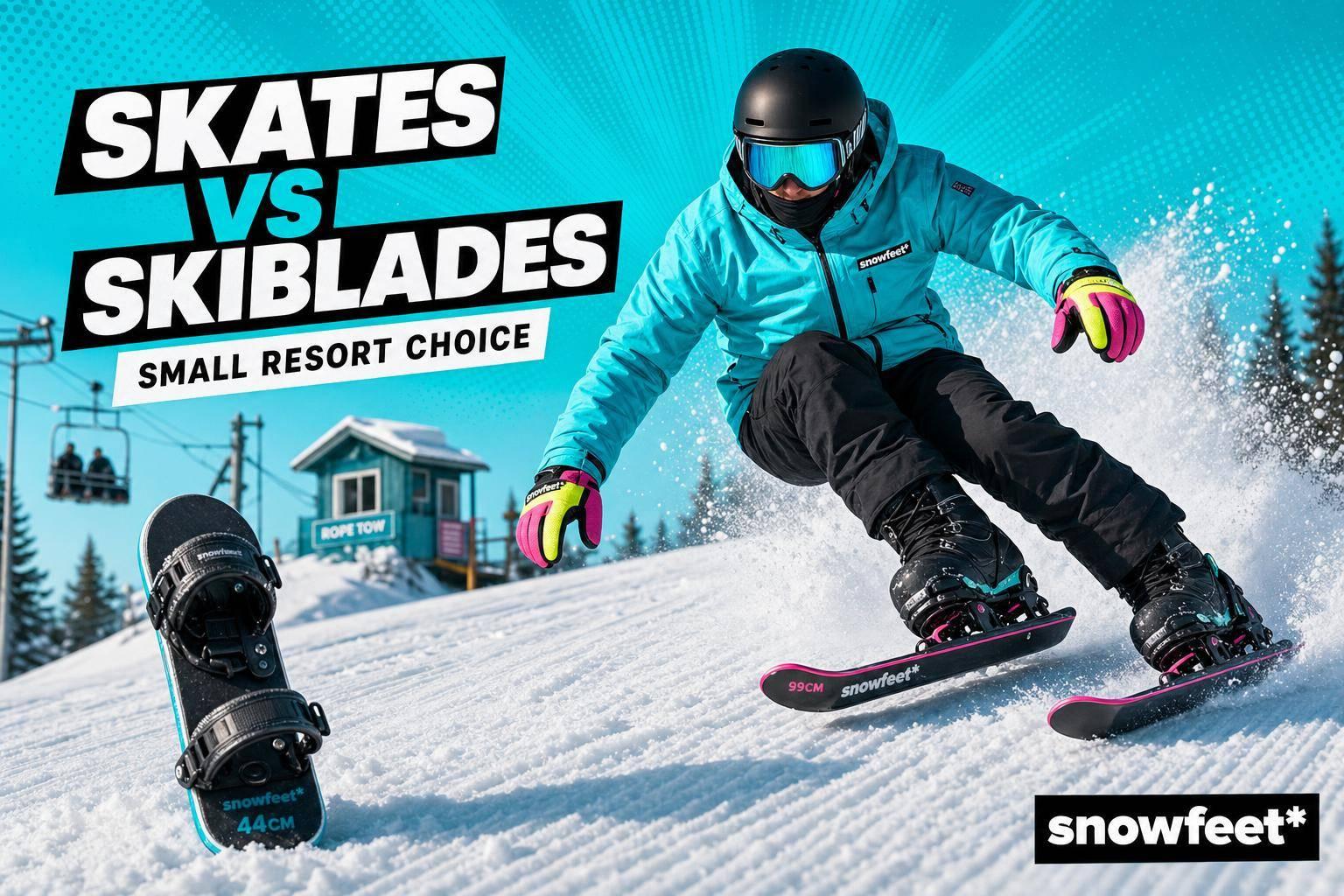
Short Skis vs All-Mountain Skis: Quick Comparison Guide
Snowboarder tries Snowfeet* | Which Snowfeet* Short Ski is the Best? | Snowblades 44, 65, 99 Review
Short skis vs all-mountain skis: the core differences on snow
Here’s the quick side-by-side for typical U.S. resort riders:
| Factor | Short Skis (Snowfeet*) | All-Mountain Skis |
|---|---|---|
| Learning Curve | Very quick to learn; forgiving at low speeds | Needs more skill; improves with practice |
| Turning Ease | Quick pivoting; minimal space needed | Needs more room and cleaner edging to turn |
| Speed Stability | Best at low to moderate speeds | Stable at higher speeds |
| Terrain Range | Groomers, moguls, park, tight spaces | Full mountain: groomers, steeps, light mixed snow |
| Portability | Fits in a backpack or standard luggage | Requires a full-size ski bag; bulky to transport |
| Boot Options | Some models work with winter boots or snowboard boots | Requires dedicated alpine ski boots |
| Fun Factor | Playful, skate-like feel at low to moderate speeds | Satisfying carving flow at higher speeds and on bigger runs |
So, what does that mean once you’re on snow? Let’s keep it simple.
Learning curve, turning ease, and control at slower speeds
Shorter skis give you less ski in front of and behind your boot. That sounds small, but it changes a lot. There’s simply less to manage, so stopping, pivoting, and changing direction tend to feel more natural right away.
That’s a big plus on green runs and mellow blue runs. The Snowfeet* Skiskates at 44 cm feel a lot like skating on snow. For many beginners, that means they can focus on balance first instead of fighting the skis. The Skiblades at 65 cm give you a bit more stability and more edge contact, but they still stay easy to steer at normal resort speeds.
All-mountain skis are a different animal. They ask for cleaner edging and better balance. You can learn that stuff, no problem, but it usually takes more time. That’s why first-timers on longer skis often feel a bit less in control at the start.
Speed stability, carving, and riding bigger terrain
This is the part where all-mountain skis pull ahead.
Because they have more ski on the snow, they feel calmer when speed picks up. They also hold a carved turn better on firm snow. If you like long blue runs, black runs, and wider terrain where you can open it up, that extra stability feels good. Very good.
Very short skis can start to feel twitchy when you push them faster. They’re playful, sure, but they don’t love being hammered down the hill.
If you want something in between, the Snowfeet* Skiblades 99 cm and Short Skis 120 cm land in a nice middle zone. They give you more edge contact and more directional stability than the 44 cm or 65 cm options. At the same time, they still feel shorter, lighter, and more playful than a standard all-mountain setup. Kind of like taking a sports car instead of a long-bed truck. Both work. One just feels a lot looser and easier to toss around.
Portability, boot options, and day-to-day convenience
This is where short skis win by a mile :) .
The Snowfeet* Skiskates (44 cm) and Skiblades (65 cm) fit into standard luggage or even a backpack. No full ski bag. No awkward airport shuffle. No trying not to whack someone in the parking lot.
Boot choice is another big split between these setups. Some Snowfeet* models work with winter boots or snowboard boots, so you may not need dedicated alpine ski boots at all. That can cut cost, bulk, and one of the least fun parts of ski days: the stiff boot walk from the car to the lift.
All-mountain skis, on the other hand, need alpine ski boots. Those boots add cost, take up space, and aren’t much fun once you’re off the snow. If you only ride a few times each season and want to keep things simple, that extra flexibility matters more than people think.
You’ll notice these tradeoffs most on groomers, moguls, park features, and powder.
How each ski type handles real terrain: groomers, moguls, park, and powder
| Terrain / Condition | Short Skis (Snowfeet*) | All-Mountain Skis |
|---|---|---|
| Groomers (low–moderate speed) | ✅ Better - quick pivots, easy control | Works fine, but more ski to manage |
| Wide groomers at high speed | Manageable up to moderate speed | ✅ Better - stable, smooth carving |
| Moguls and tight spaces | ✅ Better - less space to turn, easier threading | Can feel bulky; better for strong skiers at speed |
| Crowded slopes and narrow runs | ✅ Better - fast stops, easy direction changes | Needs more room to turn |
| Park: small–medium features | ✅ Better - low swing weight, quick spins | Overkill for small features |
| Park: large jumps and high-speed rails | Less landing stability | ✅ Better - more platform and edge support |
| Soft snow | Fun and playful at moderate speed | Smooth and stable |
| Deep powder / off-piste | Narrower models sink more | ✅ Better - more float and directional control |
| Variable resort snow | Nimble, but demands more balance adjustments | ✅ Better - more damping and edge grip |
That matters most when you match ski length to the terrain you ski most.
Groomed runs, moguls, and tight spaces
On busy U.S. resort slopes, tight turns and fast speed checks matter a lot. That’s where short skis shine. They let you change direction fast and scrub speed without needing much room. On a packed Saturday, that’s not a small thing :)
They also work well in moguls, trees, and narrow trail sections. Less ski means less space needed to turn, so threading through bumps feels easier and less clunky. All-mountain skis can still do the job, no doubt. But they tend to like more speed and a bit more room to breathe.
Recreational mogul skis often land around 70–90 mm underfoot because that shape helps with quick pivots and a more forgiving feel. Short Snowfeet* models line up well with that same idea.
Terrain park, playful riding, and trick-friendly setups
That quick-turn feel carries over into the park too. If you’re hitting small-to-medium features, lighter and shorter skis are often just more fun. They spin faster, feel less awkward, and don’t fight you.
Here’s how the Snowfeet* lineup stacks up:
- Skiskates 44 cm feel almost skate-like, which makes flat-ground tricks and tight spins easy to get into.
- Skiblades 65 cm give you a bit more edge hold for basic jumps and boxes, while still staying light.
- Skiblades 99 cm give you more platform on landings, but still feel much shorter and lighter than a standard park ski.
Longer park skis, usually 170–180 cm twin tips, still have the edge on big jumps and high-speed rails. More ski underfoot gives you more support when landing fast. That part is simple. But for riders lapping small-to-medium features or popping off side hits next to the groomer, Snowfeet* options are easier to spin, easier to get onto boxes, and easier to handle overall.
Powder days and mixed snow
Once the snow gets deeper, the tradeoff changes. At that point, float and stability start to matter more than quickness. Wider skis help you stay up in the snow instead of diving through it. Dedicated powder skis often sit around 110–120 mm underfoot, which helps keep turns smoother in deeper conditions.
Narrower short skis can sink more and start to feel a bit hooky when the snow piles up. That’s the downside. The Snowfeet* POWDER 99 cm helps close that gap with a wider tip and waist, plus a rockered tip shape that helps the ski rise instead of dive. Nice touch.
It still won’t match a wider, longer freeride ski in deep open powder. That’s just physics doing its thing. But if you split your day between groomers and the odd soft-snow lap, it’s a solid middle option. Good for softer days, just not the deepest ones.
Next, we’ll match these terrain strengths to beginner, travel, park, and fast-cruising rider types.
sbb-itb-17ade95
Which ski fits your riding style: Snowfeet* model guide by rider type
Pick ski length based on speed, terrain, and how you spend most days on snow.
| Rider Type | Usual Terrain and Speed | Recommended Snowfeet* Model | When All-Mountain Skis Make More Sense |
|---|---|---|---|
| Young kids | Gentle groomers, sledding hills, very low speed | MINI Kids 38 cm | Once they ski faster, steeper terrain |
| Beginner adults | Green and blue groomers, low speed | Skiskates 44 cm or Skiblades 65 cm | Once they ski faster, steeper terrain |
| Casual resort riders | Blue groomers, moderate speed | Skiblades 65 cm or 99 cm | For longer, faster groomer laps |
| Travelers & park riders | Mixed features, low to moderate speed | Skiskates 44 cm or Skiblades 65 cm | For bigger jumps and faster landings |
| Fast cruisers & big-mountain riders | Long groomers, steep bowls, high speed | Skiblades 99 cm or Short Skis 120 cm | For very high-speed carving or deep powder |
The table gives you the fast version. From there, it helps to line it up with how you ride day to day.
Beginners, families, and casual resort riders
For kids, the MINI Kids 38 cm is the easiest place to start. It’s made for U.S. shoe sizes 10 to 6 and uses durable fiberglass-reinforced material with metal ski edges for stopping.
For adult beginners, or parents cruising green runs with kids, the Skiskates 44 cm and Skiblades 65 cm are a nice fit. They’re easy to turn, light in the hand, and simple to deal with on a laid-back family day. That’s the big reason shorter Snowfeet* models often work better for casual riders than full-length skis.
Travelers, park riders, and skiers who want a playful setup
If you care more about convenience and a loose, playful feel than raw speed, shorter Snowfeet* models are the sweet spot. They pack easily for road trips and flights, which is a huge plus if you hate wrestling with long ski bags. Nobody misses that part :)
For park riders, plus skaters or snowboarders who want a crossover setup, the Skiblades 65 cm can work well as a second pair. They feel lighter and looser for jibbing, box slides, and spins on small-to-medium features. The Skiblades 99 cm are marketed for carving and park use, and they give you a bit more support without feeling like a full park ski.
Fast cruisers and big-mountain riders
If speed is the whole game, the tradeoff shifts. Riders who spend most days carving long groomers at 40+ mph or skiing steep, open terrain will still get more stability from full-length all-mountain skis.
That said, the Skiblades 99 cm and Short Skis 120 cm start to narrow the gap. At 120 cm, you get more directional stability and more dependable carving on moderate groomers. At the same time, they stay easier to pivot in trees or tighter terrain than full-length all-mountain skis.
Conclusion: Pick the ski that matches how you actually ride
After comparing the learning curve, speed, terrain, and portability, it comes down to one simple question: how do you spend your time on the mountain?
If most of your days are on green and blue groomers, family trips, park laps, or relaxed cruising, Snowfeet* Skiskates 44 cm and Skiblades 65 cm and 99 cm are the best fit. That only shifts when top speed and big terrain matter more than ease and convenience.
If you ski fast, hunt for open bowls, or spend time in deeper snow, longer all-mountain skis still come out ahead. They give you more stability, better float, and more control in hard carves.
So, here’s the simple version:
- Ride casual? Go shorter.
- Ride fast and steep? Go longer.
A quick gut check helps too: if you ski only a few times each season and stick to resort terrain, you’re probably in the first group.
For most casual riders, a compact Snowfeet* setup is the better match. For steep terrain and powder, longer skis still make more sense.
FAQs
Are short skis good for complete beginners?
Yes. Short skis are a great pick for complete beginners.
Unlike long skis, which can take weeks or even a full season to get used to, Snowfeet short skis are more forgiving. That means most people can build confidence after just a few runs, or even on day one.
Their shorter length also makes turning feel more natural and easier to control. And because they’re lighter and less bulky than standard skis, they can help cut down on fatigue and make the learning curve feel a lot less steep.
Can I use regular winter boots with short skis?
Yes. Many Snowfeet short skis work with regular winter boots because they use adjustable, universal bindings.
Mini Ski Skates and PRO models strap onto firm-soled winter boots, so you can skip the extra gear. That means no need for ski boots just to get out and have some fun.
Some longer Snowfeet models are built for ski or snowboard boots instead. Those setups give you more stability and better performance, which helps when you want more control on snow.
What ski length is best if I ride groomers but want some speed?
For groomers and a bit more speed, Snowfeet 120 cm Short Skis are the best pick. They give you the stability you want for carving and faster resort runs, but they still feel more nimble and easier to control than long skis.
Traditional skis in the 160–180 cm+ range are often built for high-speed riding. The trade-off? They take more work to handle and need specialized boots. The 120 cm model hits the sweet spot for most riders.











Legg igjen en kommentar
This site is protected by hCaptcha and the hCaptcha Privacy Policy and Terms of Service apply.