







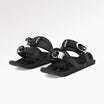












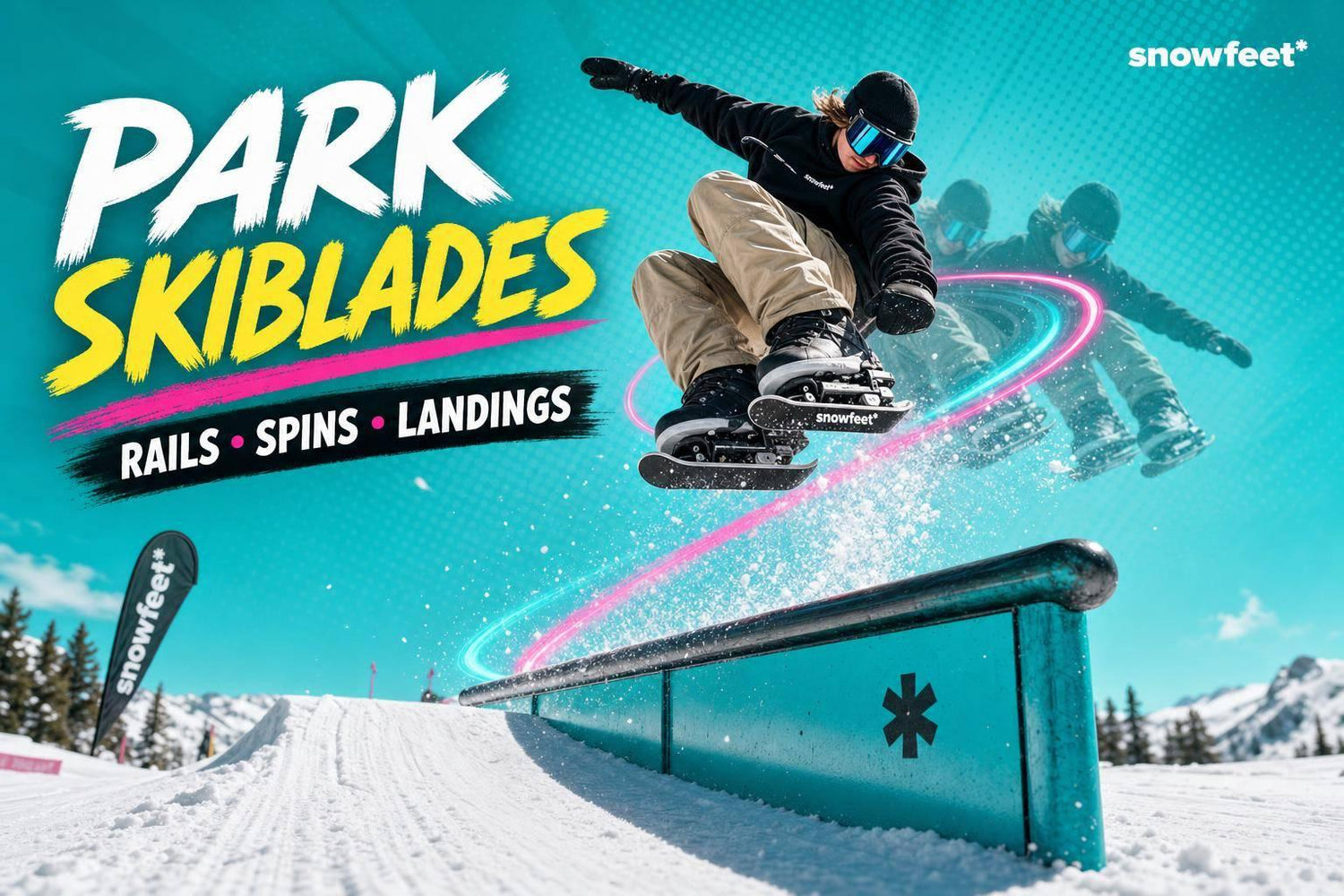
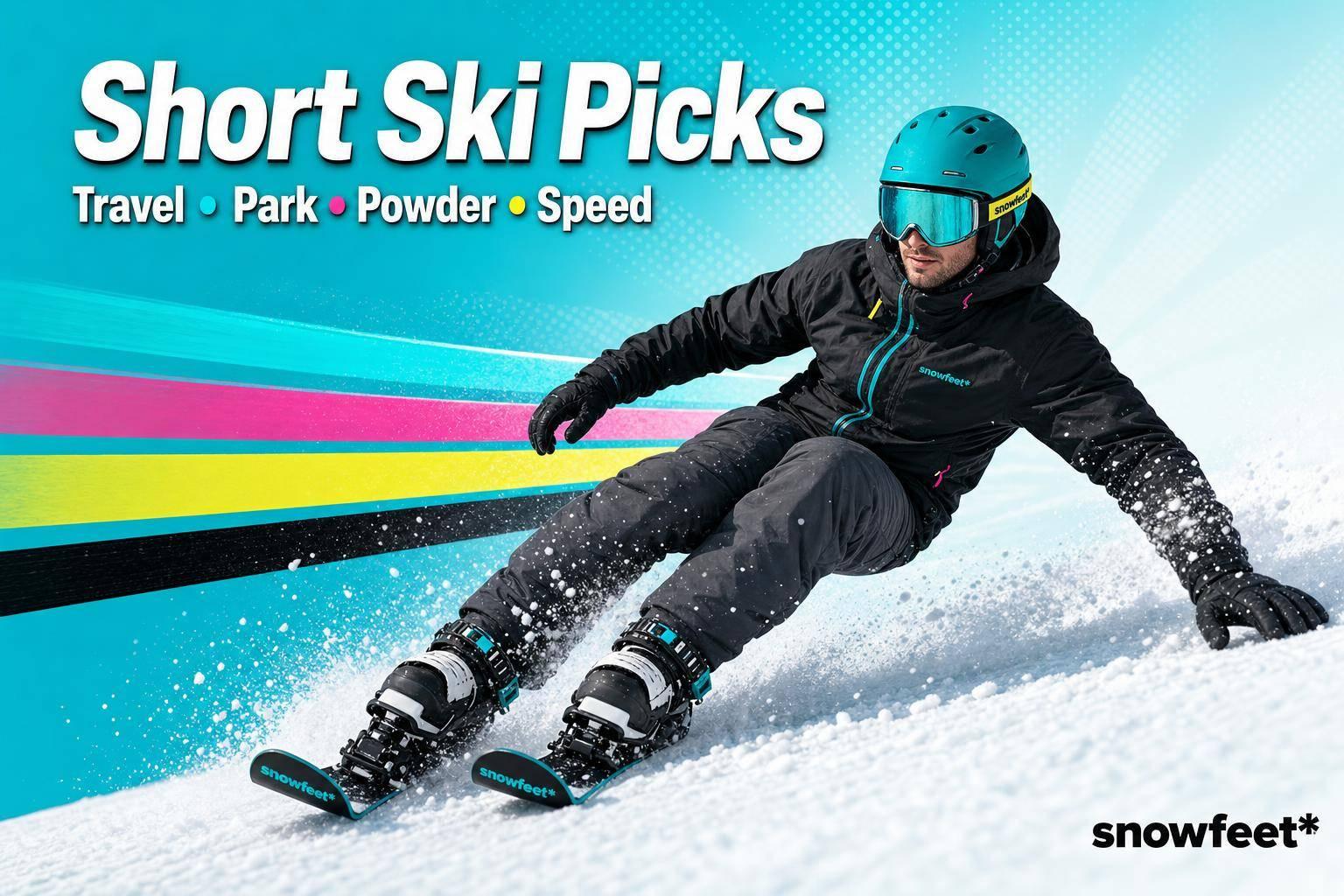
If you want park tricks to feel easier, go shorter. From this lineup, I’d put the 44 cm Skiskates first for rails, butters, and spins, the 65 cm Skiblades first for most riders, the 99 cm Skiblades first for more landing help, the POWDER 99 first for softer snow, and 170+ cm park skis first for big jumps and pipe.
Here’s the short take:
- 44 cm = lightest feel, easiest spins, least stable at speed
- 65 cm = best mix for many park riders
- 99 cm = more support on takeoffs and landings
- POWDER 99 = same length, more platform underfoot, softer-snow bias
- 170–180 cm park skis = most stable on big features, most work in the air
A few numbers jump out right away. The shortest option here is 44 cm (17.3 in). The longest benchmark is 170+ cm. That’s a huge gap in swing weight and landing feel. Price also ranges from about $299.90 to $690, not counting full-size park skis from other brands.
Snowboarder tries Snowfeet* | Which Snowfeet* Short Ski is the Best? | Snowblades 44, 65, 99 Review
Quick Comparison
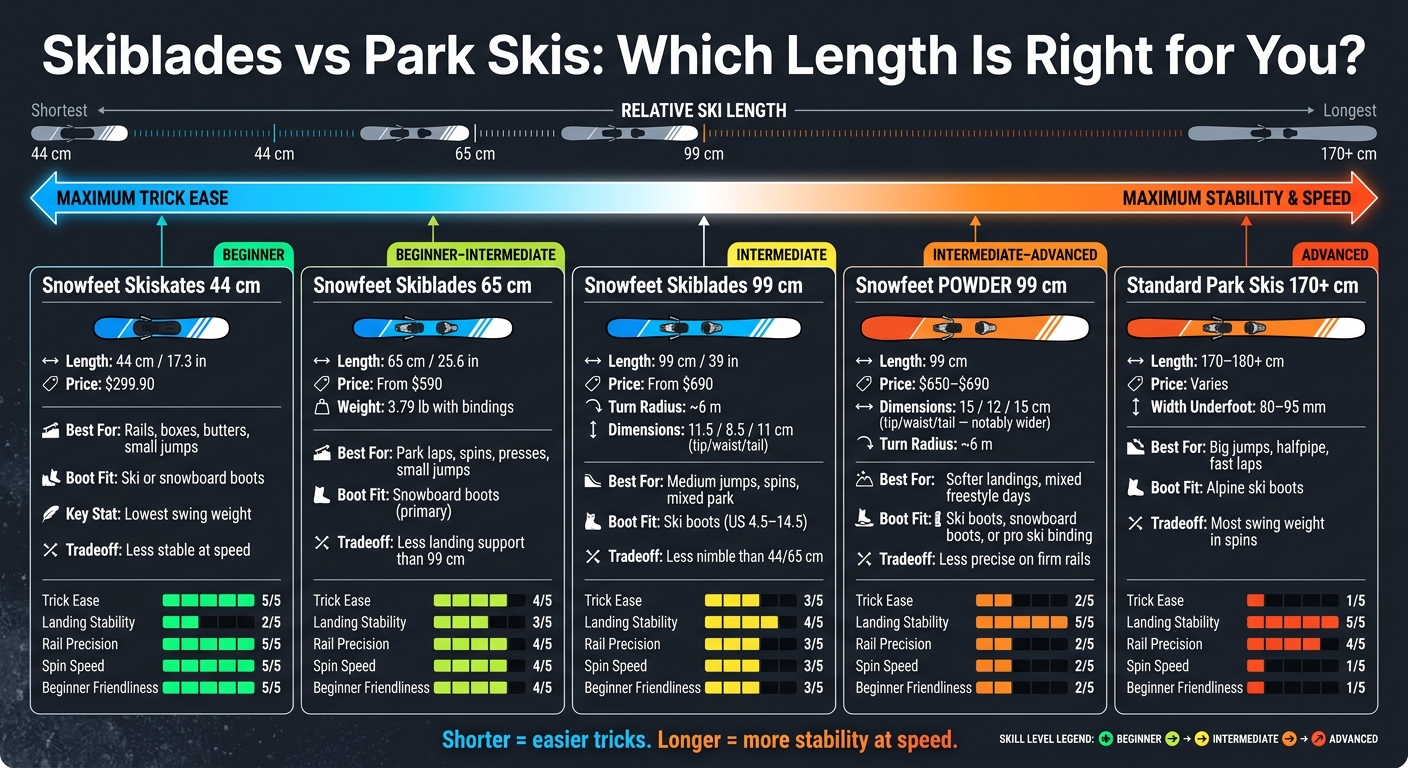
Skiblades vs Park Skis: Which Length Is Right for You?
| Option | Best Use | Main Tradeoff | Boot Fit | Price |
|---|---|---|---|---|
| Snowfeet Skiskates 44 cm | Rails, boxes, butters, small jumps | Less stable when speed climbs | Ski or snowboard boots | $299.90 |
| Snowfeet Skiblades 65 cm | Park laps, spins, presses, small jumps | Less support than 99 cm on landings | Snowboard-boot setup focus | From $590 |
| Snowfeet Skiblades 99 cm | Medium jumps, spins, mixed park riding | Not as loose as 44/65 cm | Ski boots | From $690 |
| Snowfeet POWDER 99 cm | Softer landings, mixed freestyle days | Less exact on firm rails | Ski boots, snowboard boots, pro ski binding option | $650–$690 |
| Standard Park Skis 170+ cm | Big jumps, halfpipe, fast laps | More swing weight for spins | Alpine ski boots | Varies |
My takeaway is simple: shorter setups help with tricks; longer skis help with speed and stomped landings. So if you’re buying for park fun first, I’d stay in the 44–99 cm range. If your day is all about larger jump lines, then full park skis still make more sense.
If you want, I can also turn this into a buyer’s guide intro, SEO intro, or affiliate-style intro with a slightly different angle.
1. Snowfeet* Skiskates 44 cm
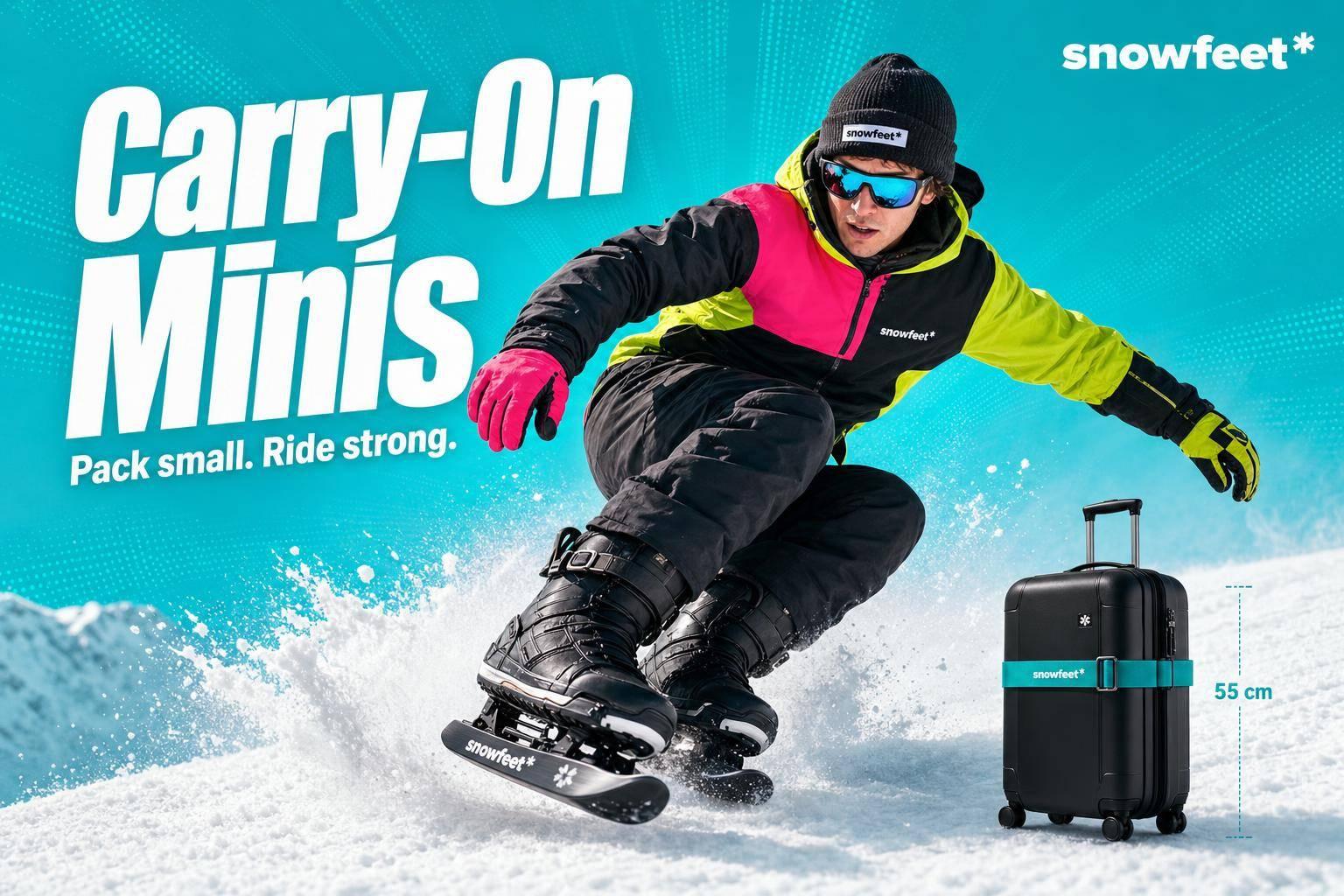
This is the most maneuverable pick in the group. At just 44 cm (17.3 in), Snowfeet* Skiskates have the lowest swing weight in this comparison. That means spins, butters, and fast edge changes feel easier here than with anything else on this list.
They work best on rails, boxes, and small jumps. If you want to hit larger jumps or charge at higher speeds, longer skis make more sense.
Snowfeet* says the Skiskates have a very short learning curve, including its "Learn in 5 Minutes" claim. And yeah, compared with 170+ cm park skis, they feel much lighter and easier to flick around. The tradeoff is simple: you get less stability once speed picks up.
Boot choice also changes how they feel in the park. Snowfeet* sells:
- a ski-boot version (US 4.5–14.5 / EU 36–49)
- a snowboard-boot version (US 6–14.5 / EU 38–49)
The bindings are adjustable, tool-free, and come with safety leashes plus an anti-slip surface. Ski boots give you more lateral support for edging. Snowboard boots feel more familiar if that's what you ride most days.
At $299.90, this is the most agile option here for riders who care more about tricks than speed and stability. So if you want the shortest, quickest setup on this list, this is the one to look at.
2. Snowfeet* Skiblades 65 cm
At 65 cm (25.6 in), these Skiblades hit a nice middle point. They feel more stable than the 44 cm Skiskates, but they’re still short enough for fast spins, presses, and quick edge changes. That’s a sweet spot for riders who want a playful park setup with a bit more room for takeoffs and landings.
This length makes the most sense for riders who want park-friendly agility without the twitchy feel of the 44 cm model. Compared with the 44 cm Skiskates, the 65 cm version gives up a little of that ultra-snappy feel, but in return you get better composure when you leave the lip and when you come back down. It sits right between the super-quick 44 cm option and the steadier 99 cm choice.
Snowfeet* markets the 65 cm Skiblades as a playful park ski for spins, rails, and smaller jumps. The pair weighs about 3.79 lb including bindings. The binding setup stays simple, which is nice if you want to focus on park laps instead of fiddling with gear. Pricing starts at $590.
3. Snowfeet* Skiblades 99 cm
At 99 cm (39 in), this model hits the sweet spot in the Snowfeet lineup. It’s still short enough for spins, fast fixes, and playful park laps, but it gives you more support on takeoffs and landings than the 44 cm or 65 cm models. If you’ve been riding the 65 cm version and want more help when you touch down, this is the clear next move.
Compared with the 65 cm option, the 99 cm model gives up a bit of snap. In return, it feels more planted on landings. That trade-off makes sense for riders who want to keep things playful without feeling twitchy every time they come in a little off.
The numbers line up with that feel. A ~6 m turn radius plus tip/waist/tail widths of about 11.5 / 8.5 / 11 cm give you a shaped platform that feels steadier when you land. It also has lower swing weight than full-size park skis, so spins and mid-air fixes feel easier. And if you land a little sideways? It’s less sketchy than the shortest models, while still feeling far lighter than 170+ cm park skis.
The flex is forgiving enough for presses and butters, but it still has the support you want on small-to-medium jumps. It fits ski boots from US 4.5–14.5 (EU 36–49).
Choose this one if you want:
- Easy spins and quick control
- More support on landings than the 65 cm model
- A light freestyle setup that doesn’t feel too nervous
Pricing starts at $690. It’s a strong pick for intermediate riders building park skills and for advanced riders who want a light, easy-to-ride freestyle setup. If you want the same 99 cm length with more of a soft-snow slant, the POWDER 99 comes next.
sbb-itb-17ade95
4. Snowfeet* POWDER 99 cm
At 99 cm, the POWDER 99 matches the length of the standard Skiblades 99. The big change is width.
Its tip/waist/tail dimensions are 15–12–15 cm, compared with 11.5–8.5–11 cm on the standard 99 cm. That gives you a wider platform underfoot, which feels more forgiving, especially on softer park landings. It keeps the same 6 m turn radius, but that extra width changes the feel a bit: it’s a little less exact on rails.
So, if you want the 99 cm option that feels easier and more forgiving for park laps, POWDER 99 has the edge. If you care most about a sharp, locked-in feel on technical rails, the standard park ski comparison next shows that trade-off.
Asymmetrical twin tips help with switch takeoffs and landings, and moderate camber adds pop and predictable tracking. Boot options cover a few setups:
- Ski boots for more control
- Snowboard boots if you want a more familiar feel
- Pro ski boot bindings for the most secure fit
Sizing spans EU 36–49 / US 4.5–14.5 for ski boots and EU 38–49 / US 6–14.5 for snowboard boots. Pricing is listed at $650–$690.
If rail precision matters more than forgiveness, the standard park ski comparison comes next.
5. Standard Park Skis (170+ cm)
Compared with the Snowfeet* options above, standard park skis are the stability-first pick. At 165–180+ cm, they trade easy spins and quick flicks for a more planted feel. Most park skis come in at 80–95 mm underfoot, which helps them stay sharp on takeoffs and steady on landings
That setup shines when the park gets bigger and the speed picks up. They grip well on pipe walls, big jumps, and fast laps. But they’re less forgiving than the shorter Snowfeet* models. If your form slips on long rails or tricky rail lines, tip catches can feel rough in a hurry
The main downside is spin effort. More length means more inertia in the air, so if you’re switching from Snowfeet*, you’ll notice that right away
For riders who spend most of their day in the pipe, hitting big jumps, and stacking fast laps, standard park skis still fit the job. The next section breaks down how ski length, flex, and boot type shape those differences.
How Length, Flex, and Boot Type Affect Park Performance
With the five options on the table, three things shape how each one feels in the park: length, flex, and boot fit.
Length is the biggest deal when it comes to park handling. Shorter skis or skiblades have less swing weight, so spins tend to feel faster and easier to rein in. Park-ski buying guides point out that going a bit shorter can improve maneuverability and cut swing weight during spins and flips. But there’s a catch: go too short, and landings can feel less stable on bigger features.
Flex shows up most on presses, butters, and landings. A softer flex makes nose and tail presses easier and gives you a looser, more playful feel on boxes and rails. A stiffer flex gives you better edge hold off the lip and more support when you’re landing at speed. If you want a middle ground, moderate flex usually gives the best mix of presses, pop, and landing support. Heavier or faster riders often do better on the 99 cm models, while lighter riders or people who care more about style and quick moves can often get more from the 65 cm format.
Boot compatibility also matters, and this is one spot where Snowfeet* has an edge for U.S. riders. Snowfeet* works with ski boots or snowboard boots, so you can use the boot style you already own. That changes your leverage and edge control based on what boot you pick, and yeah, you’ll feel that right away on rails and jumps.
The table below matches common rider types with the best fit based on skill level, boot type, and the park features they ride most:
| Skill Level | Boot Type | Preferred Features | Best Option |
|---|---|---|---|
| Beginner | Ski or snowboard boots | Small hits, flat boxes, tight rail lines | Snowfeet* Skiskates 44 cm |
| Beginner–Intermediate | Snowboard boots | Rails, small jumps, local park laps | Snowfeet* Skiblades 65 cm |
| Intermediate | Ski or snowboard boots | Medium jumps, rails, park laps | Snowfeet* Skiblades 99 cm |
| Intermediate–Advanced | Ski boots | Soft landings, wider platform, mixed park laps | Snowfeet* POWDER 99 cm |
| Advanced | Alpine ski boots | Big jumps, halfpipe, high-speed laps | Standard Park Skis 170+ cm |
These fit rules set up the pros and cons in the next section.
Pros and Cons of Each Option
Here’s the blunt park trade-off for each setup. If you look at length, flex, and boot fit, this is how each one actually stacks up. Short version. No fluff :)
| Option | Main Pros | Main Cons | Best For | Who Should Skip It |
|---|---|---|---|---|
| Snowfeet* Skiskates 44 cm | Maximum agility; easiest to flick, spin, and press | Not great for speed or big landings; not a good choice if you want to build full-length ski technique | Riders who want quick, fun park play and very easy handling | Riders who want to hit larger jump lines |
| Snowfeet* Skiblades 65 cm | Quick edge changes; more stable than 44 cm; still light for rails and presses | Less locked-in than longer skis on fast, icy landings | Intermediate park riders focused on rails, presses, and quick direction changes | Riders who regularly hit large kickers or want maximum edge grip on firm, icy snow |
| Snowfeet* Skiblades 99 cm | Best balance of spin control, landing support, and easy handling | Less nimble than the 44–65 cm options in very tight jib setups | Riders who want a shorter, playful setup with a better balance of agility and landing support | Skip if you want maximum agility above all else |
| Snowfeet* POWDER 99 cm | Wider platform adds forgiveness on soft park landings and natural features | Less precise on firm rails and icy park landings | Riders who split time between mixed-surface freestyle and softer park laps | Riders who lap groomed parks almost exclusively |
| Standard Park Skis 170+ cm | Reliable edge hold and pop on firm snow; purpose-built for competition-level or serious park riding | More swing weight in spins and flips than the shorter Snowfeet* options | Big-park riders and halfpipe riders | Skip if you want portability or a fast learning curve |
The core trade-off is pretty simple: shorter Snowfeet* setups feel easier, lighter, and more playful. Standard park skis do better when speed picks up and landings get bigger.
If you want the fast, slashy, park-lap feel, the shorter options make a lot of sense. If your day is all about bigger jump lines, icy takeoffs, and more support underfoot, longer park skis still hold the edge.
Conclusion
For most U.S. park riders, the choice comes down to one thing: how much stability you want.
So, here’s the short version. If you want the loosest, quickest setup, go with the 44 cm Skiskates. If you want the best all-around pick for the park, the 65 cm Skiblades are the sweet spot. Want more support on landings but still like that short-ski feel? The 99 cm Skiblades make a lot of sense. And if you ride softer snow and want a bit more margin for error, the POWDER 99 cm is the better fit.
Once you move to bigger park features, the trade-off changes. At that point, stability starts to matter more than quick trick handling. That’s where 170+ cm park skis still have a place, especially for bigger jump lines and faster laps through the park. Long skis are more of a niche choice for riders who care more about speed than trick ease.
If your main goal is tricks, shorter setups still come out on top for ease and control.
For most riders, Snowfeet* is the better park choice: easier to learn, lighter to carry, and more responsive for tricks.
FAQs
Which length is best for beginners in the park?
For park beginners, the 65 cm Snowfeet Skiblades* are the best pick. They’re short, easy to move, and make rail slides, small jumps, and spins feel less awkward than on long skis. That shorter shape just makes the whole learning process click faster.
If you want even tighter control, take a look at the 38 cm or 44 cm Mini Ski Skates too. They have a very easy learning curve and take less physical effort than heavier, bulkier park gear. For someone who wants to keep things simple and fun, that’s a pretty sweet setup :)
Can I use snowboard boots with Snowfeet* skiblades?
Yes. Snowfeet* offers a specialized non-release binding built to hold snowboard boots in place.
The binding is tool-free and adjustable. It uses a baseplate, highback, and two-strap setup to give you solid control and a stable feel, especially during tricks.
It works with most models, including:
- 44 cm Skiskates
- 65 cm Skiblades
- 99 cm Skiblades
And compared with ski boots, snowboard boots give you more comfort, more freedom to move, and way better walkability. That means less clunky boot-waddling in the parking lot and a better time on snow :)
Are 99 cm skiblades stable enough for jumps?
Yes. 99 cm Snowfeet skiblades are stable enough for jumps, but they still feel playful and agile for tricks and spins. That length sits in a sweet spot. You get more stability on landings than you would with shorter models, which is a big help when things get a little sketchy.
They work well for park features, jumps, and rails without the bulk of long skis. Ski boot bindings give you more stability, while snowboard bindings let your ankles move more freely for freestyle tricks.











Legg igjen en kommentar
This site is protected by hCaptcha and the hCaptcha Privacy Policy and Terms of Service apply.