



















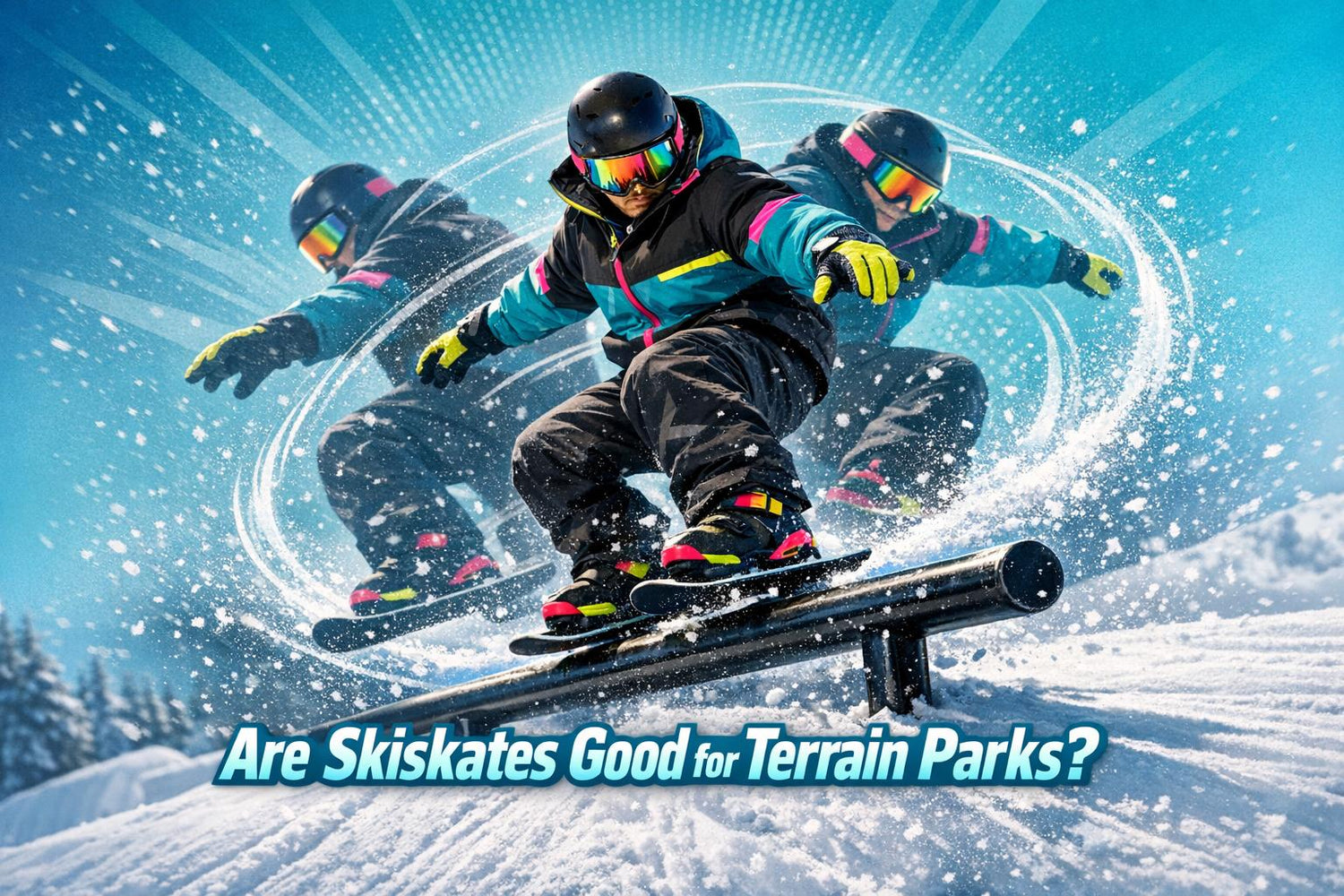
Skiskates are a fun, compact alternative to skis and snowboards, especially in terrain parks. At just 17 inches long, they’re lightweight, portable, and perfect for quick spins, rails, and small jumps. If you’ve got a skating background, they’ll feel natural right away. But they’re not ideal for high speeds, icy landings, or all-mountain use. Here’s the quick rundown:
- Best for: Low-to-medium speed park tricks, rails, and small jumps.
- Advantages: Easy to carry, fast learning curve, and precise control on tight features.
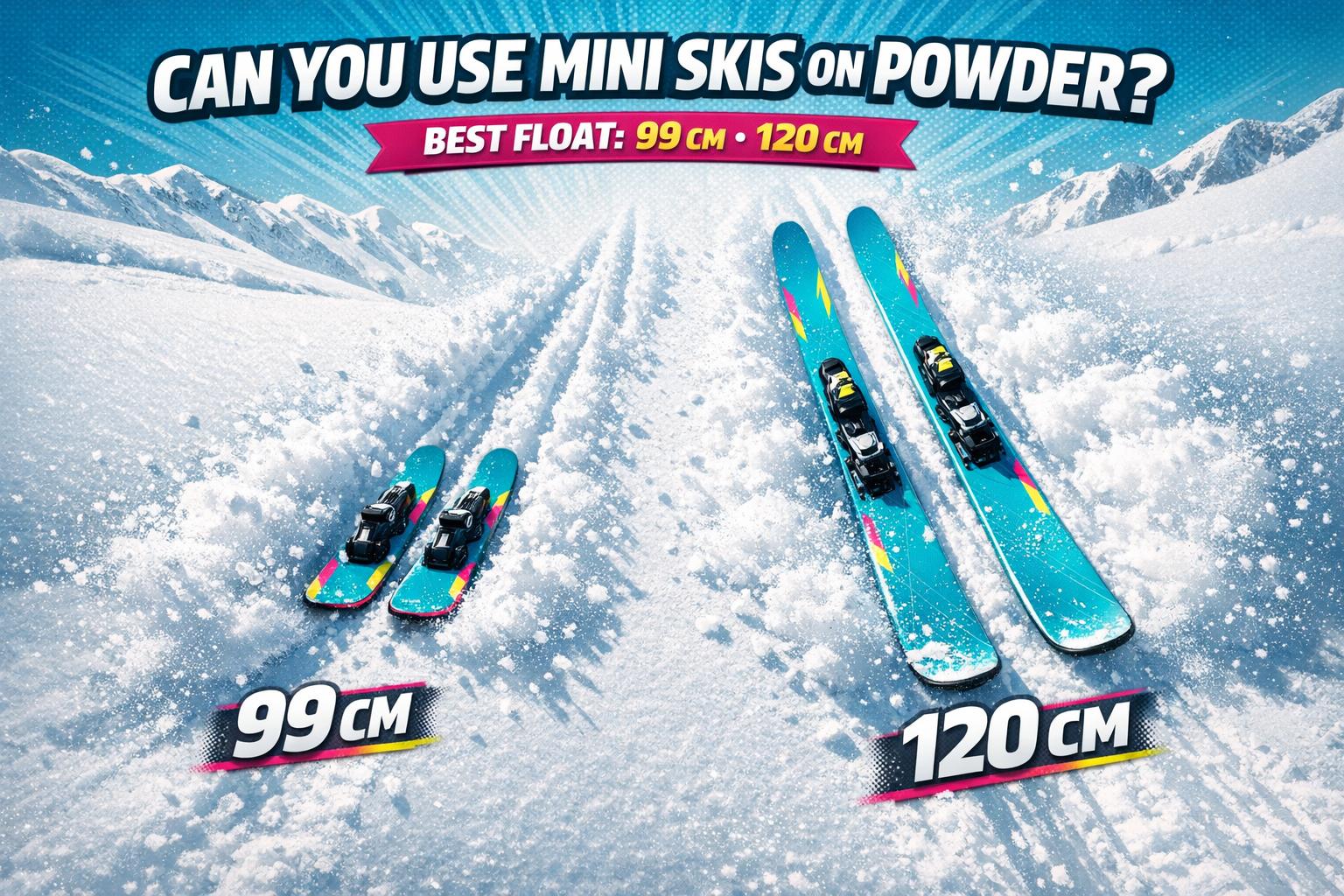
- Limitations: Less stable at high speeds, tricky on icy landings, and not built for powder or off-piste.
If your focus is playful park laps and freestyle moves, Skiskates could be a great addition to your gear. But for big jumps, speed, or versatility, skis or snowboards are still the better option.
Snowfeet* Skiskates TUTORIAL - Skiskating Technique & Tricks
What Makes Skiskates Different?
Snowfeet* Skiskates aren’t just mini skis - they’re a whole new way to experience the slopes. With their compact 44 cm length and skate-inspired design, they deliver a ride that feels completely different from traditional skis.
Compact Size and Lightweight Design
Most skis range from 150–180 cm long and can weigh over 10 lbs. Snowfeet* Skiskates? They’re a whopping 70–75% shorter and much lighter. That means they’re super portable - easy to carry and way less of a hassle when you’re heading to the mountain or traveling.
"A lot easier to haul around the hills & on vacation than traditional skis!" - heyjerz, Verified Customer
In terrain parks, their lightweight design is a game-changer. Spins feel effortless, and moving between features doesn’t leave you drained like lugging around full-length skis would. This nimbleness also makes them beginner-friendly, helping you pick up skills faster.
Fast Learning Curve
If you’ve ever ice skated or used inline skates, you’ll feel right at home with Skiskates. Their design mirrors skating movements, making it easy for experienced skaters to get the hang of them in just one session. Even if you’re new to the slopes, you’ll adapt quickly on groomed runs.
"Super easy to control, quick to turn, and way more forgiving than traditional skis. I felt comfortable on them within just a few runs." - Brad Tolin, Verified Customer
This quick learning curve is especially handy in terrain parks. You’ll spend less time figuring out the gear and more time hitting features. Plus, they pair well with a variety of boots and perform beautifully on different types of terrain.
Boot and Terrain Compatibility
Skiskates are designed with flexibility in mind. Their tool-free adjustable bindings fit standard ski or snowboard boots (US men's sizes 6–14.5).
- Ski boots: Offer better ankle support and precise edge control, making them ideal for rails and small jumps.
- Snowboard boots: Provide a looser, more skate-like feel, perfect for casual jibbing and laid-back sessions.
No matter your boot choice, Skiskates shine on firm, groomed park runs. Their short length and tight sidecut make them perfect for navigating park features with precision and ease.
Why Skiskates Work Well in Terrain Parks
Terrain parks are all about gear that’s quick to respond, easy to control, and forgiving when things don’t go perfectly. Snowfeet* Skiskates hit all those marks, making them a natural fit for park riders.
Better Maneuverability on Park Features
Skiskates are just 17 inches (44 cm) long, giving them way less edge contact than traditional skis. What does that mean? Lightning-fast edge-to-edge transitions - exactly what you need for navigating narrow rails and boxes.
Unlike full-length skis, skiskates don’t require big adjustments to regain your balance. If you’re slightly off-center when hitting a rail, you can correct it almost instantly, staying locked in instead of slipping off. This quick response gives you incredible control on tight park features, making tricks feel more precise and natural. It’s almost like inline skating, but on snow - and that precision makes all the difference when it comes to clean execution.
Easier Spins, Twists, and Jumps
Thanks to their lightweight design, skiskates make spins and twists feel effortless. The low swing weight means you don’t need a ton of effort to initiate a spin, and keeping your upper body centered helps you land with confidence, avoiding over-rotation.
Flat-ground tricks like 180s, 360s, and pivots? They’re a breeze. Skiskates respond quickly to even small movements, so you can pull off rotations without overthinking. On smaller jumps - the kind you’d find at U.S. progression parks (5–20 ft tabletops and step-downs) - you can experiment with grabs and tweaks without worrying about the challenges of longer, heavier skis. And if your landing isn’t perfect? Their short tails make it easy to recover, which is a huge plus for intermediate riders fine-tuning their skills.
A Skate-Like Feel on Snow
Skiskates are more than just a mix of skis and skates - they ride like one too. With a natural shoulder-width stance and control driven by your ankles, carving on skiskates feels a lot like inline skating or sliding on ice.
"Skiskates are super fun for downhill skiing, riding backwards, spinning, jumping and all kinds of tricks in snow parks and on the slopes." - Snowfeet*
This skate-like vibe encourages a playful, freestyle approach to the terrain park. Instead of committing to one big line, you can lap features, hit side jumps, and experiment with quick tricks. If you’ve got a background in skating or hockey, you’ll probably feel right at home after just a couple of runs. That familiar feel makes learning park basics way easier and way more fun.
Tricks and Moves You Can Do With Skiskates
Snowfeet* Skiskates aren't just about cruising down the slopes - they open up a whole world of tricks, even for those just dipping their toes into terrain parks. Thanks to their lightweight design, pulling off cool moves feels surprisingly doable, even for beginners.
Freestyle Tricks
Flat ground is the perfect starting point. Moves like surface 180s and 360s are beginner-friendly because the compact size of skiskates makes spinning easier. You can focus on nailing your landing without the added challenge of managing long skis. Butter moves, like nose presses, tail presses, and pivots, are also a natural fit. The shorter length means you can shift your weight forward or backward without worrying about catching an edge. Keep your knees soft and stay centered, and you can smoothly transition from a press into a spin or a quick pivot. Riding switch (backward) is another skill that feels more intuitive on skiskates, making 180-in and 180-out moves more accessible. These flat-ground tricks are the building blocks for more advanced rail and box moves.
Rail and Box Moves
In the terrain park, skiskates really shine on rails and boxes. Their short length means there’s no awkward overhang in front of or behind your boots, giving you better control on narrow features. Start simple with wide, low boxes. Approach with a flat base, keep your knees bent, and focus your eyes on the end of the feature. Once you’ve got straight slides and 50-50s down, you can experiment with pivots and surface swaps. A slight weight shift or a tiny hop can rotate your skiskates 90° or 180°. Since each leg moves independently, the motion feels closer to inline skating than traditional skiing. Mastering these moves on rails and boxes will give you the confidence to tackle small jumps next.
Small Jumps and Landings
When it’s time to hit jumps, the trick is to use your ankles and knees to generate pop. Unlike full-length skis, skiskates don’t have the flex to store energy, so the lift-off comes entirely from your body. Start small - side hits and little rollers are great for practice. Once you’re comfortable, move up to beginner tabletops in the 5–10 ft range. In the air, the lightweight design helps you stay compact, making it easier to bring your feet back under you for a clean landing. Bend your knees and hips on impact to absorb the force - with less ski underfoot, your legs will need to do more work. After getting the hang of straight airs, you can start adding tricks like 180s or simple grabs.
"I love how easy they are to ski and skate and how many different kinds of tricks I can perform without much effort and almost no restrictions." - Zbyněk, Founder, Snowfeet*
sbb-itb-17ade95
Where Skiskates Fall Short
Skiskates are fantastic in terrain parks, but they do have their limitations. They’re designed with specific conditions in mind, so it’s important to understand where they might not perform as well.
Stability at High Speeds
Because of their short length, skiskates can feel less stable at higher speeds. This can lead to some chattering on the snow, especially compared to the smooth ride of full-length skis. As Brad Tolin, a verified buyer, explained:
"Only trade-off is at higher speeds, where longer skis still feel more stable - but for overall fun and maneuverability, these are hard to beat."
In a terrain park, where speed is usually controlled, this isn’t a major issue. But if you’re someone who likes to pick up the pace between features or carve down longer slopes, you’ll notice the difference.
Rough or Icy Landings
Landing precision is another area where skiskates can be tricky. Their compact size means they don’t have the same surface area as traditional skis to absorb impacts. This becomes especially noticeable on hard-packed or icy landings, where even a slight misstep can throw you off balance. If you’re new to skiskates, start small and work your way up to bigger features to get a feel for their quirks.
Limited All-Mountain Performance
Skiskates are best on groomed trails and in parks - they’re not built for tackling deep powder or rugged backcountry terrain. Their 44 cm length doesn’t provide the float or edge grip needed for off-piste adventures. Sunshine Straiges, another customer, summed it up well: "Although not meant for deep powder, it's wonderful on groomed trails."
So, if your perfect day includes both park laps and exploring untouched snow, you’ll need something else for those off-trail moments.
Knowing these limitations helps set realistic expectations and makes it easier to compare skiskates with traditional skis or snowboards when it comes to park riding.
Skiskates vs. Skis and Snowboards in the Park
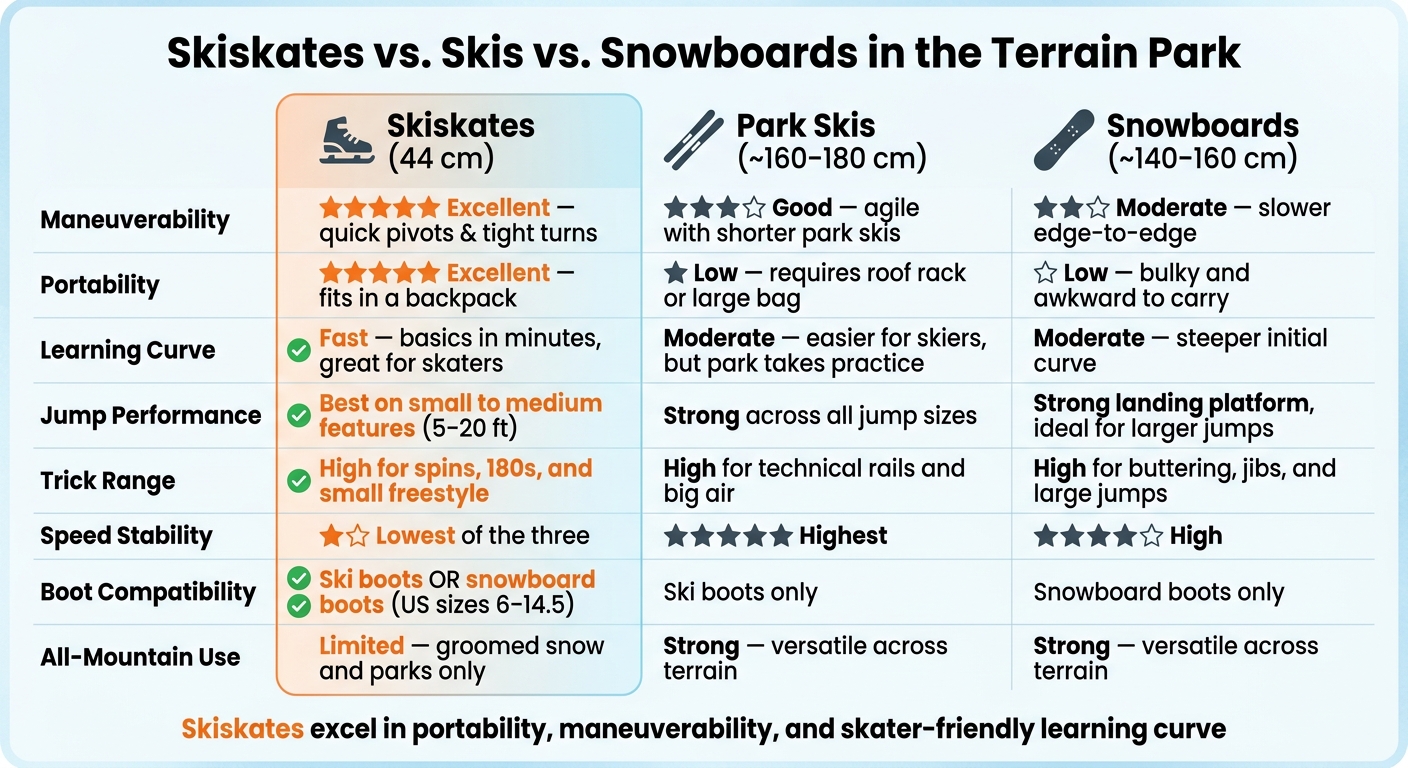
Skiskates vs. Skis vs. Snowboards: Terrain Park Comparison
Let’s break down how Skiskates compare to traditional skis and snowboards when it comes to performance in the terrain park. Here's a closer look at the key factors that matter most.
Side-by-Side Comparison Table
| Factor | Skiskates (44 cm) | Park Skis (~160–180 cm) | Snowboards (~140–160 cm) |
|---|---|---|---|
| Maneuverability | Excellent - quick pivots and tight turns | Good - agile with shorter park skis | Moderate - slower edge-to-edge |
| Portability | Excellent - fits in a backpack | Low - requires roof rack or large bag | Low - bulky and awkward to carry |
| Learning curve | Fast - basics in minutes, great for skaters | Moderate - easier for skiers, but park takes practice | Moderate - steeper initial curve |
| Jump performance | Best on small to medium features | Strong across all jump sizes | Strong landing platform, ideal for larger jumps |
| Trick range | High for spins, 180s, and small freestyle | High for technical rails and big air | High for buttering, jibs, and large jumps |
| Speed stability | Lowest of the three | Highest | High |
| Boot compatibility | Ski boots or snowboard boots | Ski boots only | Snowboard boots only |
| All-mountain use | Limited to groomed snow and parks | Strong | Strong |
This table shows where Snowfeet* Skiskates have the edge, particularly in portability and ease of learning, making them a standout option for certain park scenarios.
Where Skiskates Shine
Portability is a game-changer. At just 17 inches long, Snowfeet* Skiskates fit in a standard backpack. No need for a roof rack, oversized ski bag, or the hassle of lugging around bulky gear. This convenience makes them ideal for quick park sessions or spontaneous trips.
The learning curve is another big plus. If you’ve spent time skating, the movement patterns will feel natural almost instantly. On small park features like low rails, narrow boxes, or side hits, Skiskates excel with their quick edge-to-edge transitions. Their compact size (44 cm) allows for effortless spins, pivots, and redirections, making tricks on tight features feel smooth and intuitive.
In short, Skiskates thrive in the park when agility and convenience are key. But they do have limitations.
Where Skis and Snowboards Still Lead
When it comes to speed and stability, traditional skis and snowboards take the win. Their longer length makes them better for handling fast approaches and absorbing rough landings, especially on larger jumps. This extra stability also gives you more room for error, which can be crucial when trying bigger tricks. As Brad Tolin, a verified buyer, pointed out earlier, longer skis simply feel more stable at higher speeds - and that difference becomes even more noticeable as the jumps get bigger.
Another advantage is versatility. Skis and snowboards aren’t just for the park. If you want to mix in groomer runs or explore off-piste terrain, they’re up for the challenge. Skiskates, on the other hand, are laser-focused on park riding, which is both their strength and their limitation.
So, while Skiskates bring something fresh to the park scene, traditional gear remains the go-to for all-around mountain adventures and high-speed performance.
Conclusion: Should You Use Skiskates in a Terrain Park?
The short answer: yes - if your focus is on low-to-medium speed freestyle.
As highlighted earlier, the compact 44 cm design of Snowfeet* Skiskates makes them incredibly nimble in terrain parks. They’re perfect for quick spins and sharp pivots. Brad Tolin sums it up well: "Only trade-off is at higher speeds, where longer skis still feel more stable - but for overall fun and maneuverability, these are hard to beat."
That said, skiskates aren’t a one-size-fits-all solution. If you’re aiming for big jumps, high-speed runs, or need a setup that works across the whole mountain, traditional skis or a snowboard will be a better fit. Skiskates shine in playful, freestyle park sessions but aren’t designed for all-mountain versatility. Your riding style is the real deciding factor here.
How to decide if skiskates are for you:
- Casual rider: Use them as a fun, secondary setup. Stick with your usual skis in the morning, then switch to skiskates for some relaxed park laps in the afternoon.
- Skater crossover: If you’re comfortable with inline or ice skating, skiskates will feel like a natural extension of those movements.
- Park enthusiast focused on small-to-mid features: Skiskates are ideal for progression on rails, boxes, and smaller jumps.
Think about how you like to ride and use these tips to decide if skiskates fit your style. If you’re ready to give them a shot, check out the Snowfeet* Skiskates (44 cm) - they’re specifically designed for this type of riding. Just remember to start slow, control your speed, and wear proper safety gear like a helmet and pads for protection during landings.
FAQs
Are skiskates allowed in most U.S. terrain parks?
Skiskates, like Snowfeet* Skiskates, are typically allowed in most U.S. terrain parks. Built for tricks, jumps, and plenty of fun, they pair effortlessly with ski or snowboard boots. Their small size and flexibility make them a fun alternative to traditional skis or snowboards, adding a fresh twist to your terrain park adventures.
What safety gear should I wear with skiskates in the park?
For staying safe while using skiskates in the park, make sure to gear up with a helmet, wrist guards, knee pads, and elbow pads. This gear is crucial for protecting yourself during tricks, jumps, or other fun activities. Better safe than sorry!
Do skiskates need a different waxing or edge tune than skis?
Skiskates, much like Snowfeet, skip the hassle of waxing or edge tuning that traditional skis demand. Built to be lightweight and easy to maneuver, they’re ideal for terrain parks and don’t require any extra maintenance to keep them in top shape.











Laat een reactie achter
Deze site wordt beschermd door hCaptcha en het privacybeleid en de servicevoorwaarden van hCaptcha zijn van toepassing.