



















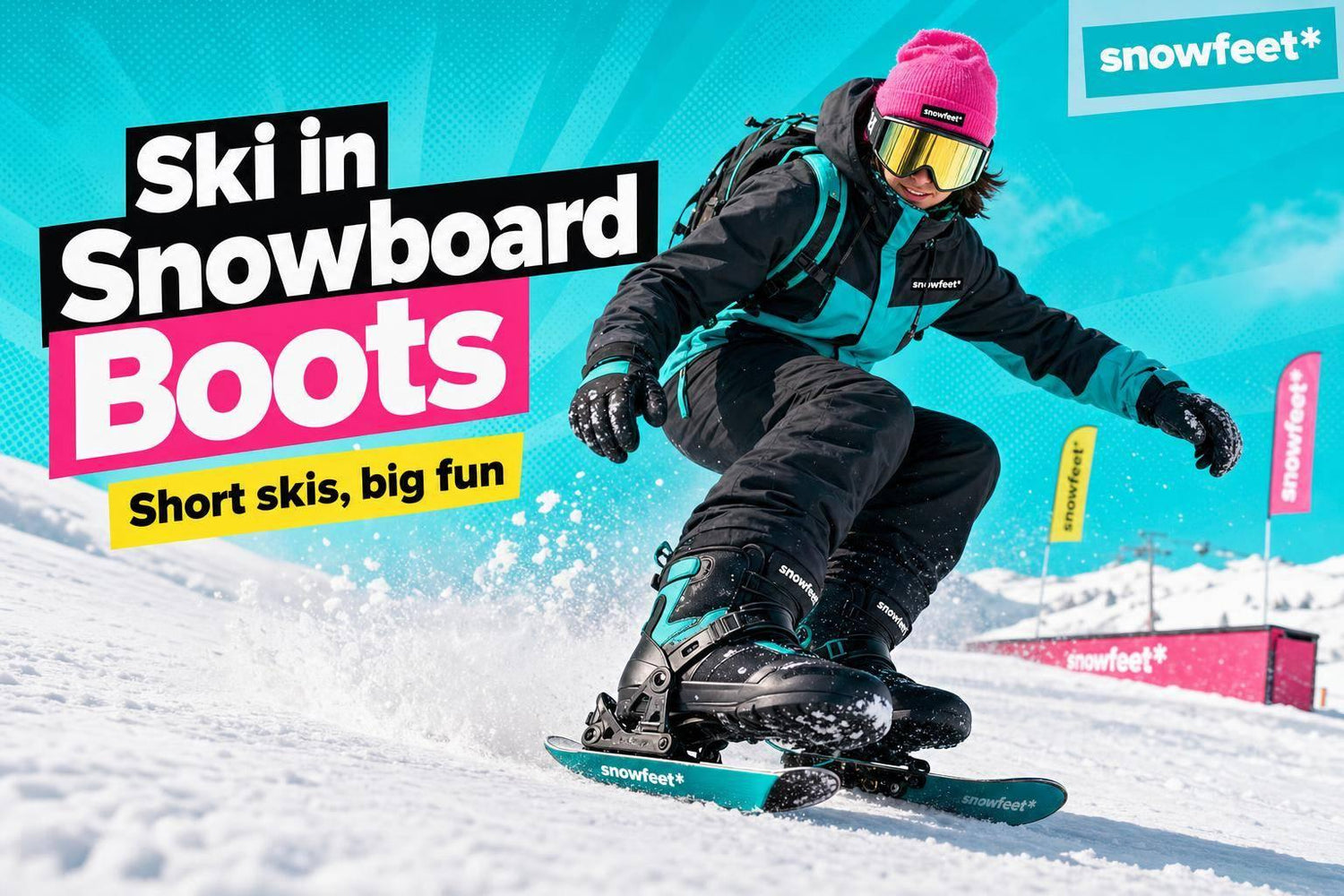
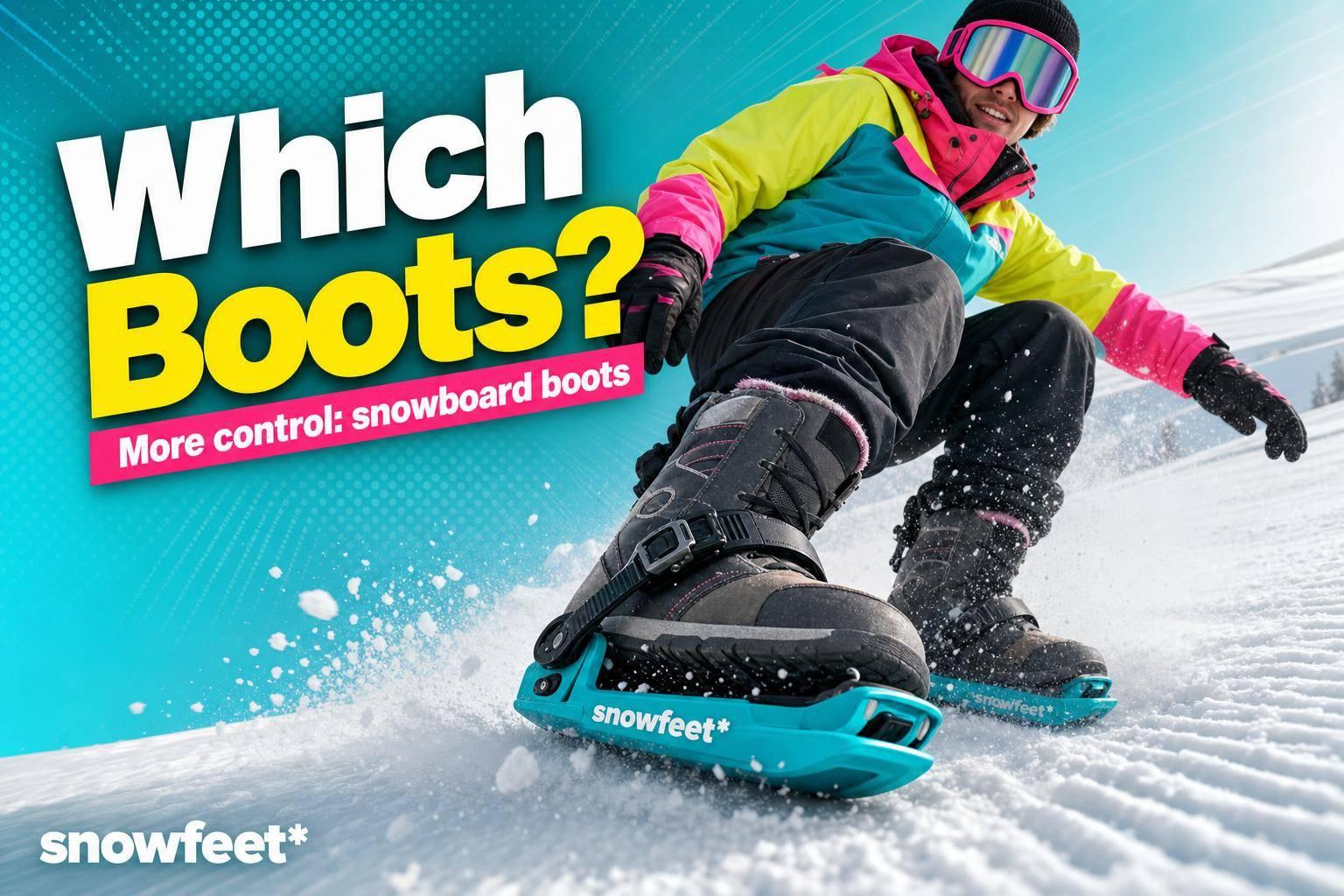
Yes - you can ski in snowboard boots, but not on standard alpine skis. The problem is the binding, not the boot. Regular ski bindings are made for hard ski boots, while snowboard boots are soft, bulkier, and won’t lock in or release the right way.
If I wanted the short version, here it is:
- Standard long skis + snowboard boots = no
- Snowfeet* short skis + snowboard boots = yes
- Best use = casual riding, park laps, mellow groomers, travel, and family fun
- Bad fit = high-speed carving, steep icy runs, and riders who want max edge power
So, if you want comfort and don’t want to clomp around in stiff ski boots like a robot in a parking lot, this setup makes sense :) .
What matters most is boot-to-binding fit. Snowfeet* models use bindings made for snowboard boots, and their short length helps keep things easier to control. That said, softer boots still give you less edge precision than ski boots. In plain English: you gain comfort, but give up some hard-charging performance.
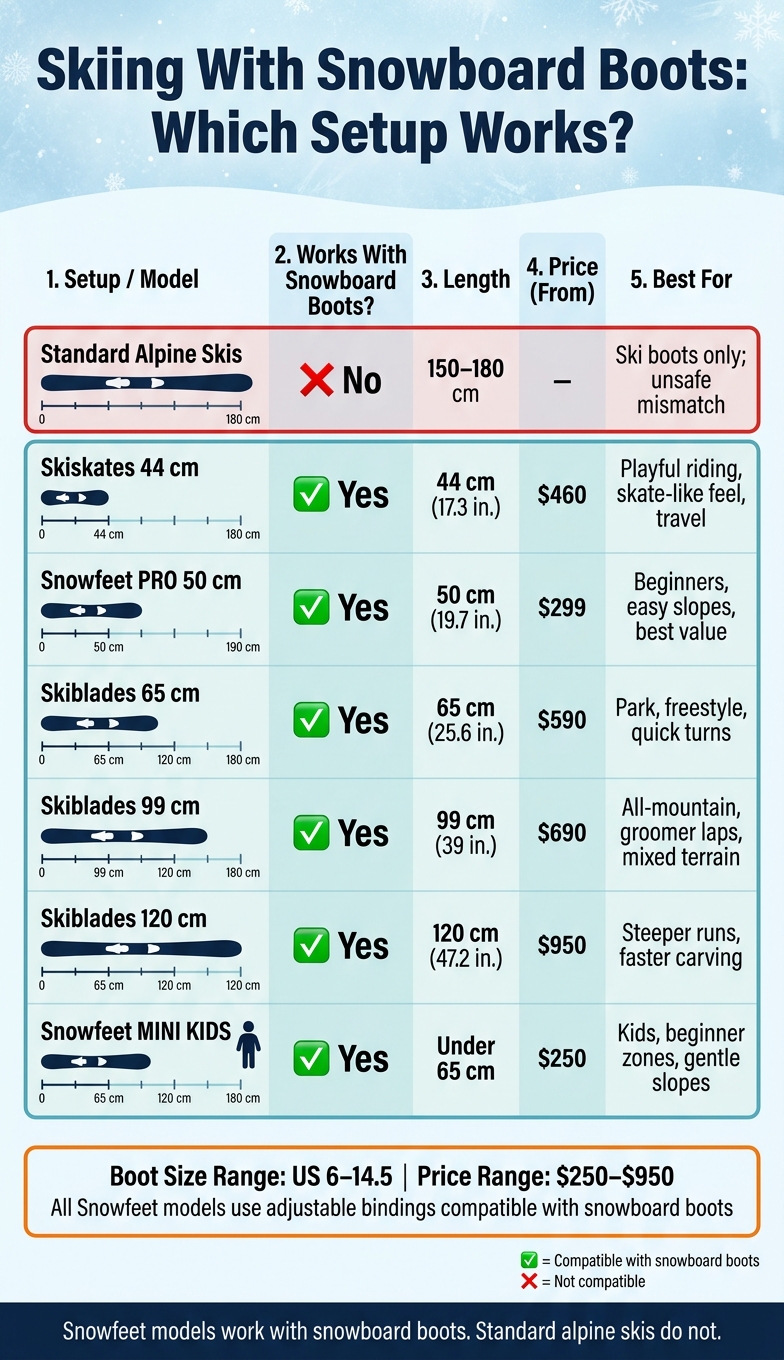
Snowfeet Models vs. Standard Skis: Which Works With Snowboard Boots?
Bindings for Short Skis | All You Need to Know
Quick comparison
| Setup | Works with snowboard boots? | Best for | Main downside |
|---|---|---|---|
| Standard alpine skis | No | Ski boots only | Unsafe boot/binding mismatch |
| Snowfeet PRO 50 cm | Yes | Beginners, travel, easy slopes | Less stable at higher speed |
| Skiskates 44 cm | Yes | Playful riding, skate-like feel, short trips | Best at low to mid speed |
| Skiblades 65 cm | Yes | Park, short turns, freestyle | Less planted than longer models |
| Skiblades 99 cm | Yes | Mixed resort use, groomers | Not the top pick for hard charging |
| Skiblades 120 cm | Yes | Faster carving, steeper groomers | Costs more, still not like full skis |
| MINI KIDS | Yes | Kids, beginner zones, backyard use | Limited to small riders and easy terrain |
A few numbers help paint the picture:
- 44 cm to 120 cm: Snowfeet* lengths that work with snowboard boots
- From $250 to $950: price range in the article
- U.S. boot sizes about 6 to 14.5: fit range for some adult models
If I had to sum it up in one line: Snowfeet* is the clean way to ski in snowboard boots if you care more about fun, comfort, and easy setup than top-speed power.
Why Standard Long Skis Do Not Work With Snowboard Boots
Alpine bindings, boot standards, and why they are not compatible
The main issue is simple: standard alpine bindings are made for ski boots, not snowboard boots.
Alpine bindings need a rigid ski boot sole with exact toe and heel lugs. That’s how the binding holds the boot in place and releases it when it should. Snowboard boots don’t have that setup. They’re soft or semi-rigid, and they connect to snowboard bindings with straps or step-in systems that hold the boot shell and highback instead.
So the two systems don’t match. At all.
Because of that mismatch, a snowboard boot can’t engage a standard alpine binding in a safe way. And if the binding can’t hold or release the boot as designed, the risk of injury goes up in a fall. That’s the point where standard skis stop making sense for snowboard boots, and Snowfeet* starts to look like the smart workaround.
Even bindings built to fit more than one ski-boot standard still don’t work with snowboard boots. The alpine boot-and-binding setup just wasn’t made for snowboard footwear.
If you want to keep your snowboard boots and still have good control on snow, short skis are the path that makes sense.
Where long skis still have the edge
To be fair, long skis still do some things better, as long as you’re using proper ski boots.
Their longer running length gives you more contact with the snow. That helps them feel smoother and more planted in fast, sweeping turns. Stiff alpine boots also pass small leg movements straight to the ski edge, which gives you sharp response on icy groomers and steep runs.
That said, most casual skiers don’t need that kind of dialed-in precision. For them, Snowfeet* short skis are often the more practical pick.
Next, the question becomes which Snowfeet* model fits your boots and riding style.
sbb-itb-17ade95
Snowfeet* Models That Work With Snowboard Boots
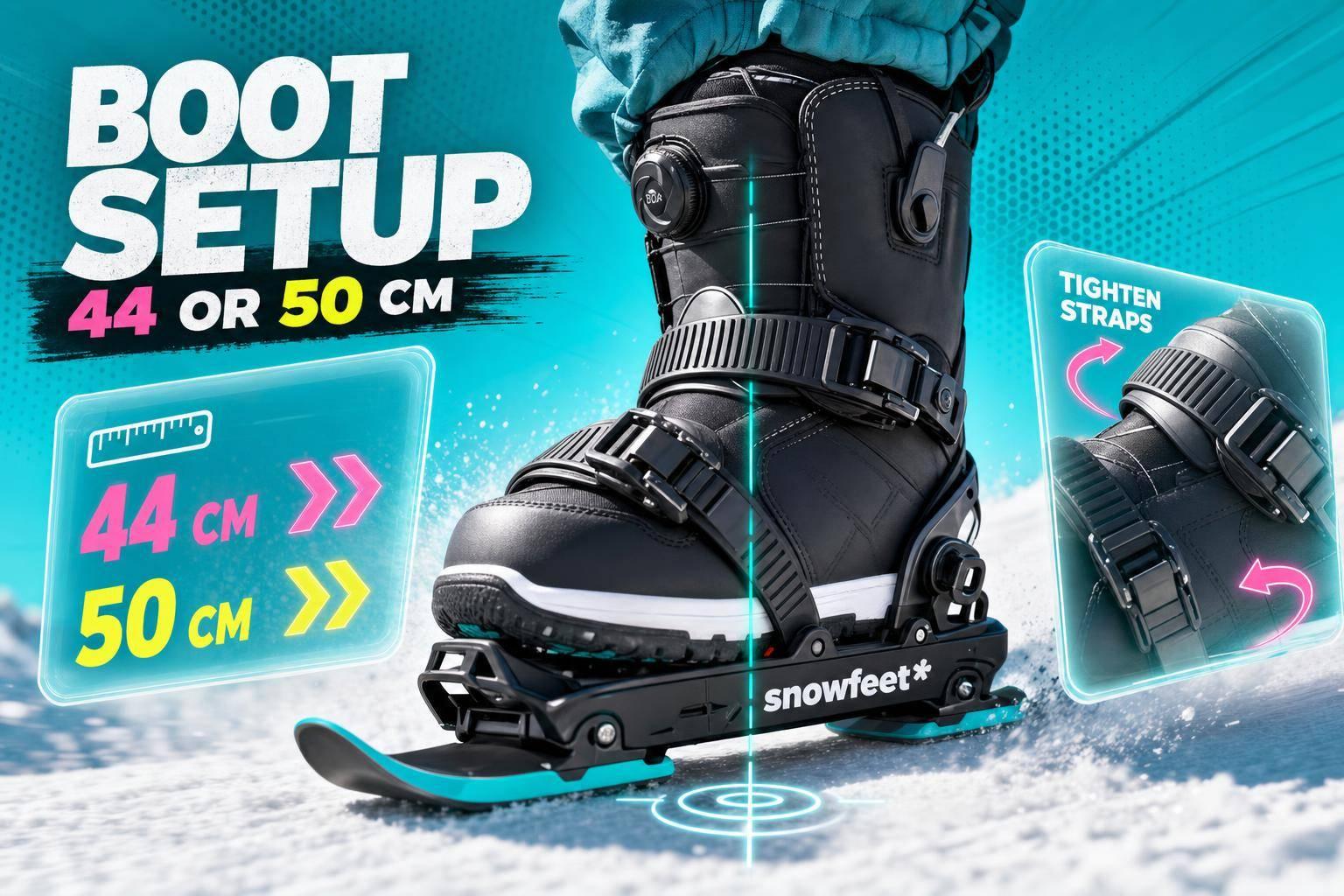
Snowfeet* models use adjustable bindings that fit snowboard boots. Some also work with winter shoes. So, if you want to use snowboard boots on snow without forcing them into a ski setup they weren’t made for, this is the workaround. It’s not a standard ski system. It’s its own thing, built for that job.
Here’s how each Snowfeet* model lines up with different riders and terrain.
Skiskates 44 cm and Snowfeet PRO 50 cm: the most compact options
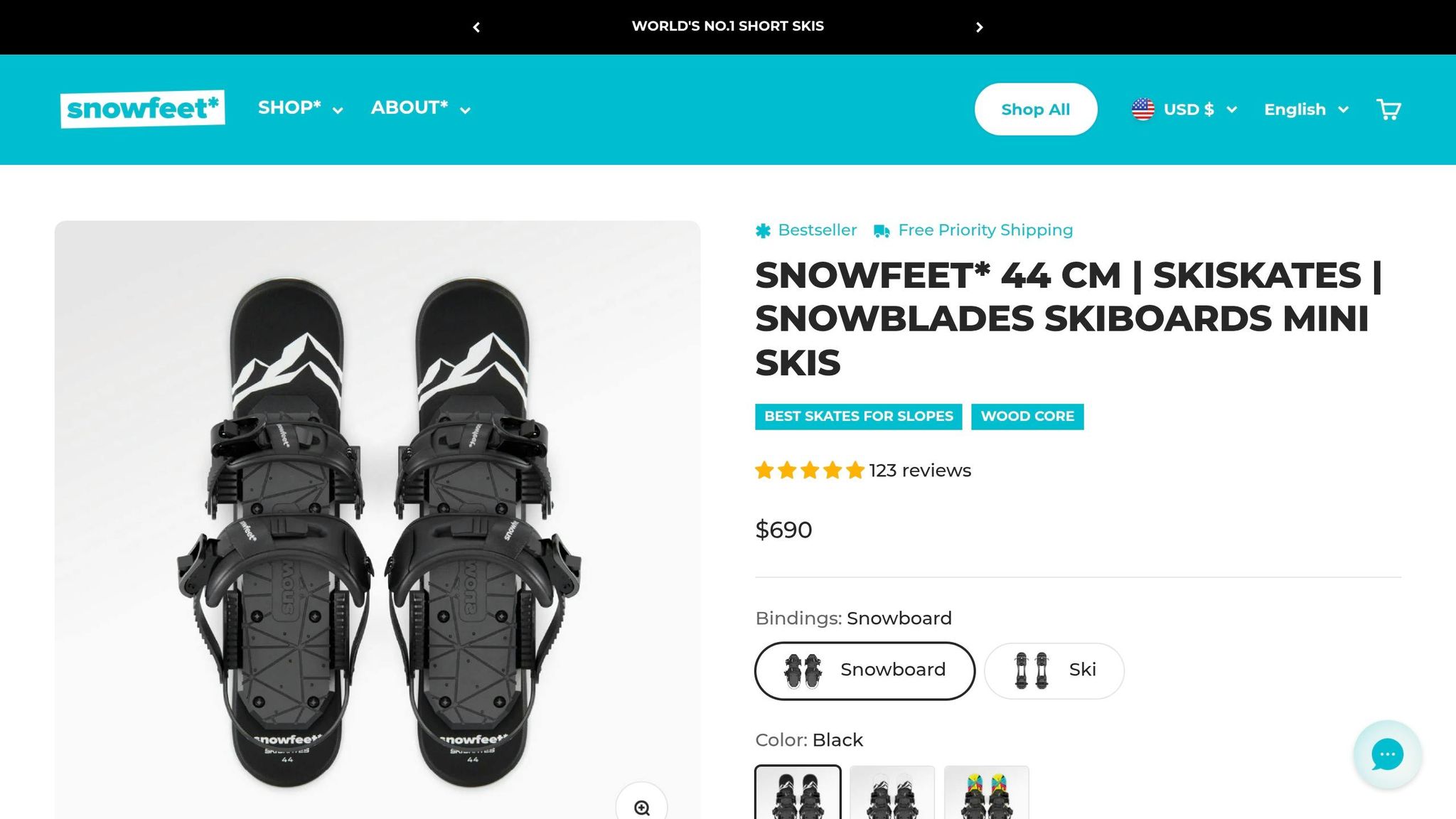
Skiskates 44 cm (about 17.3 in.) fit snowboard boots from about U.S. size 6 to 14.5 and start at around $460. They feel a lot like skates on snow. You get quick turns, easy spins, and fast edge changes. They’re small enough to toss in a backpack or carry-on, which is a nice perk if you’re doing resort laps or flying with gear.
There is a catch, though. They work best at low to moderate speeds. On steep or icy terrain, they’re not the best tool for the job.
Snowfeet PRO 50 cm (about 19.7 in.) fits boot sizes U.S. 6–13 and starts at around $299. That extra length gives you a bit more stability than the 44 cm Skiskates. Not night and day, but enough to notice.
Both models fit confident beginners and snowboarders who want a playful, skate-like feel on groomers, side hits, and park features. Think quick, loose, and fun - less charging, more messing around :) .
If you want more stability and still want to keep your snowboard boots, the Skiblades line is the next step up.
Skiblades 65 cm, 99 cm, and 120 cm: more stability as length increases
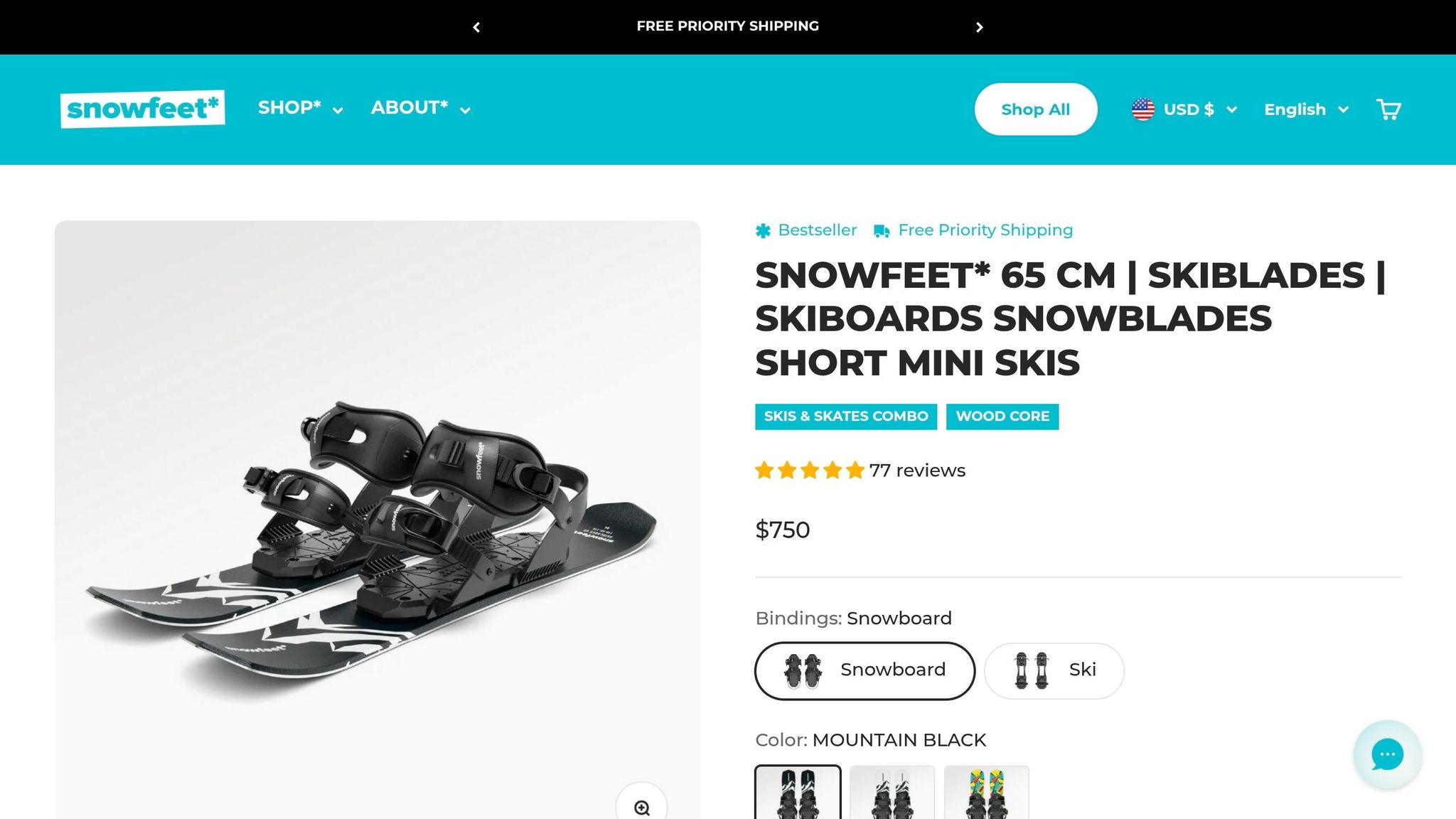
Skiblades come in 65 cm, 99 cm, and 120 cm. The choice is pretty simple: shorter gives you more agility, longer gives you more stability.
| Model | Length | Price (from) | Best for |
|---|---|---|---|
| Skiblades | 65 cm (~25.6 in.) | ~$590 | Park use, quick turns, freestyle |
| Skiblades | 99 cm (~39 in.) | ~$690 | All-mountain, mixed terrain, groomer laps |
| Skiblades | 120 cm (~47.2 in.) | ~$950 | Steeper runs, carving, higher speeds |
The 65 cm model is the playful one. It suits jumps, spins, and fun resort laps where you want fast movement and easy turning.
The 99 cm gives you more edge hold and more stability for longer runs and moderate speeds. If you want something that feels less twitchy and more settled, this is where things start to calm down.
The 120 cm feels closest to a ski. It’s more directional, more planted, and better on steeper terrain. It’s still shorter than standard alpine gear, but it leans more toward carving and higher-speed riding.
A simple way to think about it:
- Shorter = quicker turns
- Longer = more stability
- All of them work with snowboard boots
For families, Snowfeet* also has a smaller option for kids.
Snowfeet MINI KIDS for children in winter shoes or small snowboard boots
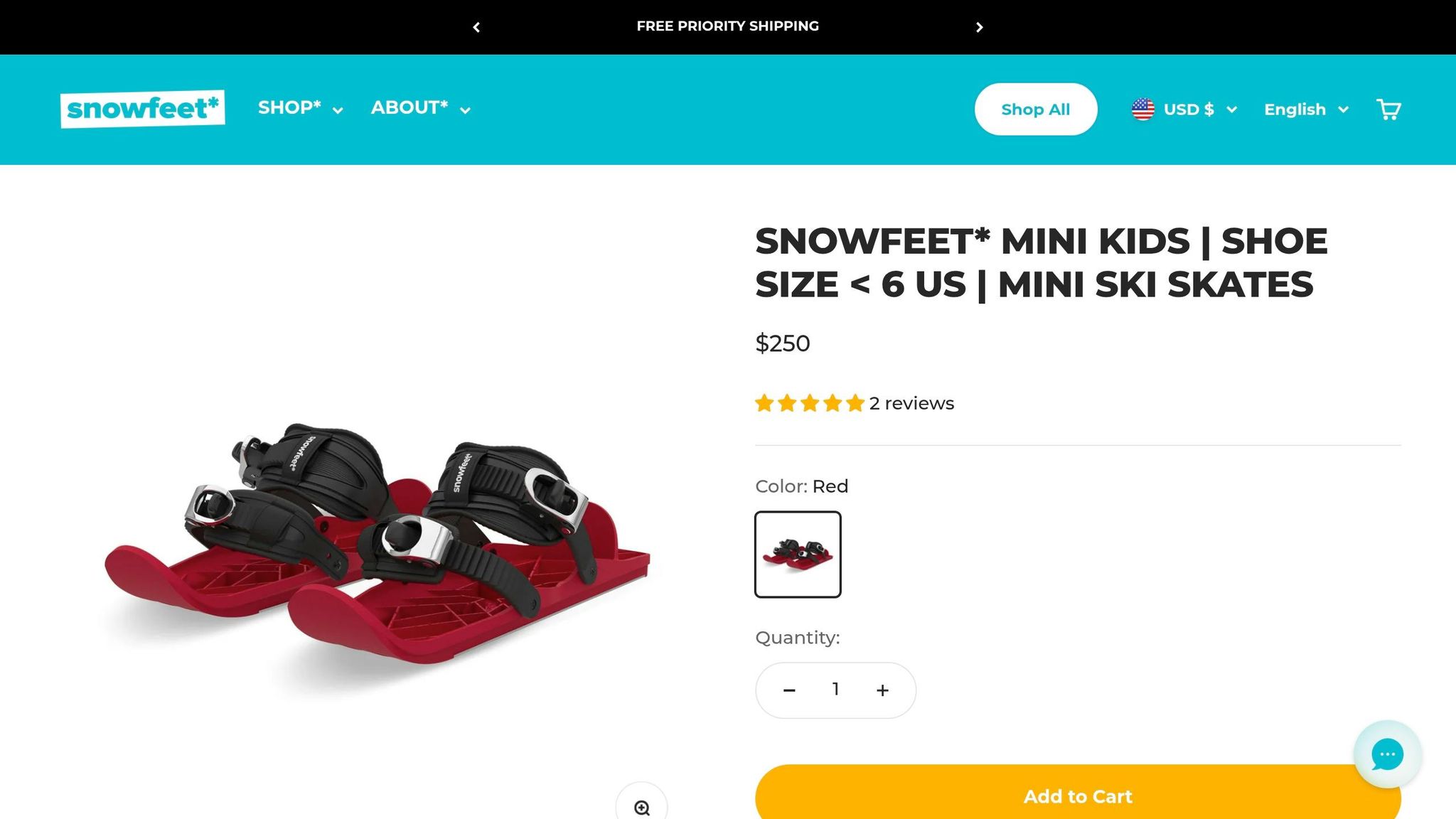
Snowfeet MINI KIDS are made for children with shoe sizes under about U.S. 6 (EU 27–38). They work with winter boots or small snowboard boots using the same adjustable strap system. At $250, they give kids a lower-cost way to slide on snow without buying stiff ski boots or renting a full ski setup.
They work well on beginner slopes and for casual backyard use. The short length and kid-focused shape make it easier for young riders to find their balance and learn basic steering without the big, awkward feel of full ski gear.
Next: how these setups feel in actual use, and when snowboard boots stop making sense.
Comfort, Control, and Trade-Offs
What beginners, snowboarders, and casual riders notice first
Now that the compatible Snowfeet* models are clear, the next thing people want to know is simple: what do they feel like on snow?
The first thing most riders notice isn’t even the ride. It’s the boots.
Ski boots are stiff, clunky, and kind of awkward to walk in. Snowboard boots, on the other hand, have rubber soles, more ankle flex, and feel a lot closer to normal footwear. For a laid-back day at the resort, that difference is hard to ignore. It matters most for beginners, snowboarders, and casual riders who want gear that feels easy from the parking lot to the lift.
On snow, shorter Snowfeet* setups usually feel less intimidating than long skis. There’s less edge to catch when you mess up, less leverage fighting against you, and small mistakes are easier to save. That can make the learning curve feel a lot less harsh.
Snowboarders and skaters often get the hang of them fast because the balance and stance feel familiar. The big switch is moving from a sideways snowboard stance to a forward ski stance. Even so, the edging feel tends to carry over pretty well.
One thing that matters a lot: boot stiffness.
Very soft beginner snowboard boots can feel too loose on Snowfeet* models and can cut down control. A mid-stiff snowboard boot usually hits the sweet spot. You still get comfort for walking, but you also get enough support for solid edge response.
So, if you strip it down, the trade-off looks like this:
- Snowfeet* wins on comfort, portability, and ease of learning
- Long skis win on top-end speed and edge power
When snowboard boots are the wrong choice
The main trade-off is pretty simple: comfort and ease vs. maximum speed and precision.
If you want aggressive carving or plan to ride steep, icy runs, ski boots still do a better job. Their stiff cuff and direct power transfer make small edge adjustments feel sharper and more exact. A softer snowboard boot just can’t match that same level of control.
At higher speeds on hard pack, that gap gets a lot more obvious. That’s where ski boots and long skis still have the upper hand.
Snowfeet* with snowboard boots works best for playful, moderate-speed runs. Think groomers, beginner and intermediate terrain, park features, and easy resort laps. That’s the zone where the setup feels fun, simple, and natural.
For high-speed downhill riding, though, long skis with ski boots still come out on top.
Those trade-offs are what separate the best Snowfeet* setup for each type of rider.
Best Snowfeet* Setup by Rider Type and Final Verdict
Top picks for beginners, snowboarders, travelers, and families
There’s a trade-off here: comfort vs. precision. So let’s keep this simple and get you to the right pick fast.
Choose by rider type:
| Rider Type | Recommended Model | Boot Choice | Best Terrain | Approx. Price (USD) |
|---|---|---|---|---|
| Beginner | Snowfeet PRO 50 cm or Skiskates 44 cm | Snowboard boots | Green runs, beginner resort groomers, small local hills | From $299–$460 |
| Snowboarder | Skiblades 65 cm or 99 cm | Snowboard boots | Blue groomers, park features, moderate-speed carving | From $590–$690 |
| Traveler | Skiskates 44 cm or Snowfeet PRO 50 cm | Snowboard or winter boots | Resort groomers, easy to pack for road trips or air travel | From $460 |
| Family / Kids | Snowfeet MINI KIDS | Kids' winter shoes or junior snowboard boots | Beginner areas, gentle slopes | $250 |
| Advanced resort rider | Skiblades 120 cm | Snowboard boots | Blue and black groomers, faster carving | $950 |
Beginners: Go with PRO 50 cm if you want the better value. Pick Skiskates 44 cm if you want the easiest start and the fastest learning curve.
Snowboarders: You already know how to use edges, so Skiblades usually feel pretty natural. Go with Skiblades 65 cm for a more loose, playful ride. Choose 99 cm if you want more stability.
Travelers: If pack size is the big deal, stick with 44 cm or 50 cm. They’re much easier to bring on road trips or flights. Less gear drama. More mountain time :)
Families with kids: MINI KIDS is the go-to pick for young riders on mellow slopes and beginner zones.
Conclusion: the simplest way to ski in snowboard boots
Here’s the short version.
If you want to stay in snowboard boots, Snowfeet* is the cleanest option. These models are made to work with snowboard boots or winter boots, depending on the version. That makes the setup more comfortable and much easier to deal with.
For most casual riders, that comfort and convenience beat the hassle of ski boots and long skis. That said, long skis with ski boots still do better at high-speed carving and tighter control on hard terrain. No point sugarcoating it.
But if your goal is fun, flexibility, and a low-stress day on the mountain, Snowfeet* short skis and Skiskates are the simplest way to ski in snowboard boots.
FAQs
Are snowboard boots safe in ski bindings?
No. Snowboard boots are not safe or compatible with regular ski bindings. Those bindings are built for the stiff shape of hard plastic ski boots so they can release the right way in a fall.
If you want a safe option, go with specialized short skis like Snowfeet. Models under 100 cm - like Skiskates (44 cm) and Skiblades (65 cm or 99 cm) - come with integrated non-release bindings made to hold snowboard boots or winter shoes in place.
It’s a bit like trying to fit hiking boots into road bike pedals. Close enough doesn’t cut it when safety is on the line :)
Which Snowfeet* length is best for me?
It depends on your skill level and how you want to ride.
- 38 cm Mini Ski Skates or 44 cm Skiskates work best if you want max portability and a more skating-like feel on groomed slopes or hiking trails.
- 50 cm Snowfeet PRO is a strong all-around pick for beginners.
- 65 cm Skiblades are best for tricks, rails, and quick carving.
- 99 cm Skiblades give you a nice mix of stability and easy turning.
- 120 cm Short Skis are best for speed and all-mountain stability. Models over 100 cm need traditional ski boots.
Can beginners learn faster with Snowfeet*?
Yes. Beginners often learn faster with Snowfeet* than with traditional skis or snowboards. Many riders get the basics down in just five minutes or within one to two runs.
The short, light design feels intuitive, kind of like ice skating. And it helps cut out common beginner problems, like crossing ski tips. That makes it easier to balance, recover after a mistake, and build confidence fast.











Laat een reactie achter
Deze site wordt beschermd door hCaptcha en het privacybeleid en de servicevoorwaarden van hCaptcha zijn van toepassing.