



















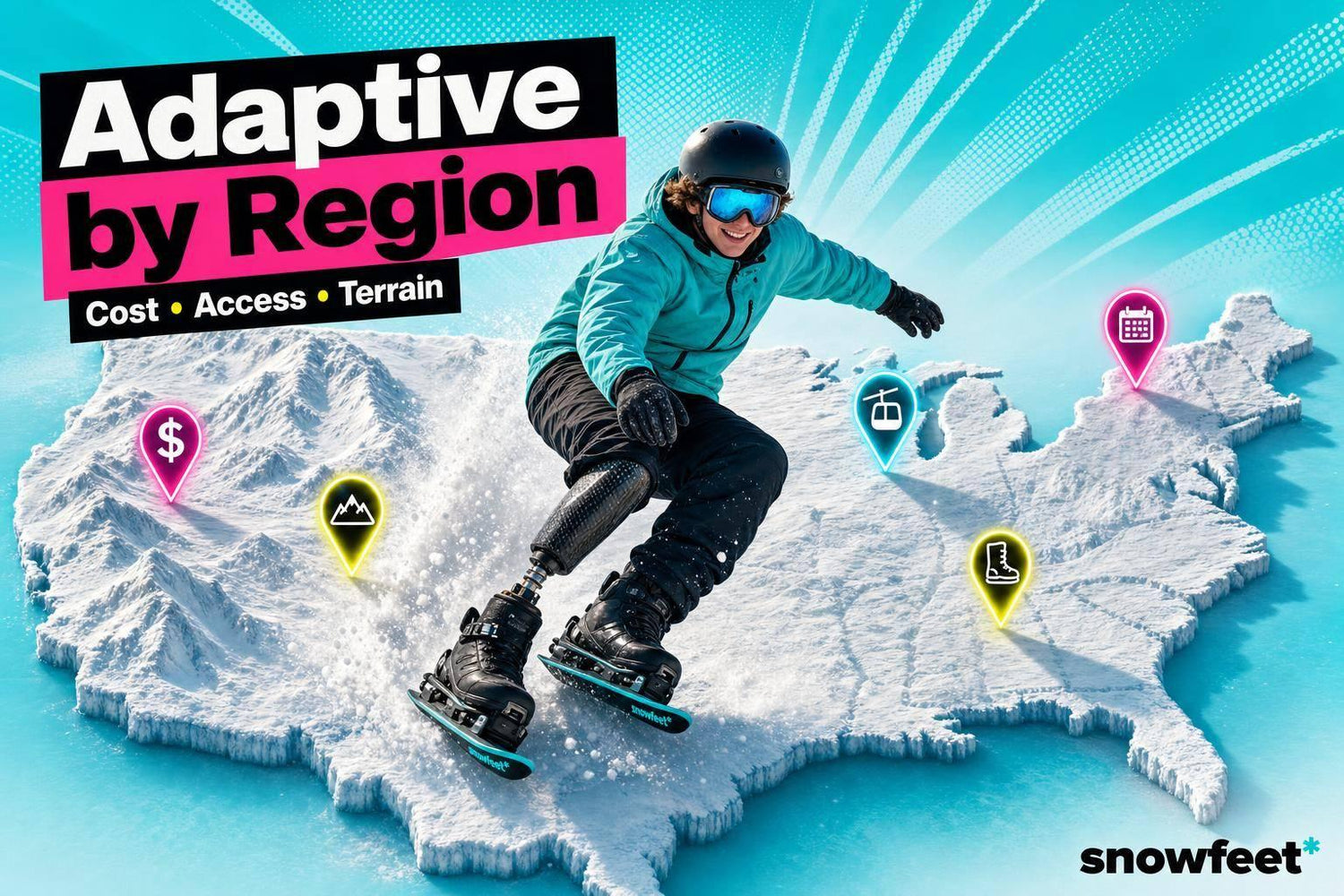
If you want the short answer: the Northeast is best for lesson density, the Mountain West is best for big-trip skiing, the Midwest is best for low-cost entry, the West Coast is best for hub-based access, and the South & Mid-Atlantic is best if you need closer Appalachian options.
I’d boil the whole article down like this:
- Northeast: most packed network, with New Hampshire at 8 major groups
- Mountain West: big mountain programs, but lesson prices can hit $124–$245
- Midwest: some of the lowest prices, with options from $0 to $100
- West Coast: strong hubs in California, Oregon, Washington, and Alaska
- South & Mid-Atlantic: fewer snow programs, shorter season, more spread-out access
And one more thing: your region changes more than your drive time. It changes cost, lesson frequency, terrain, and what gear makes sense. If you’re dealing with flights, small hills, or short seasons, compact gear like Snowfeet* may fit better than full-length skis.
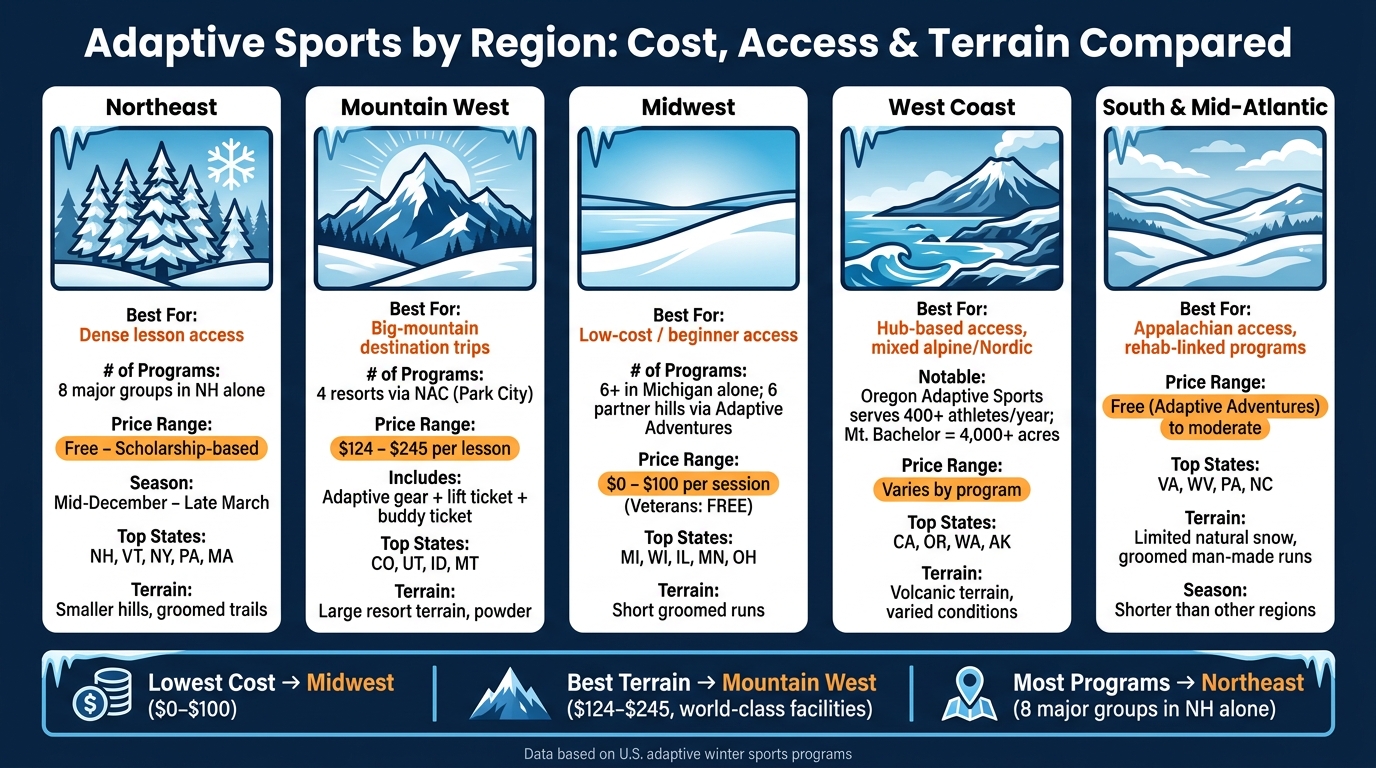
Adaptive Sports by Region: Cost, Access & Terrain Compared
Quick Comparison
| Region | Best Known For | Price Snapshot | Main Tradeoff |
|---|---|---|---|
| Northeast | Dense lesson access | Scholarships, some free programs | Smaller hills, icy days |
| Mountain West | Big resorts and trip-based programs | $124–$245 at NAC | Travel, altitude, trip cost |
| Midwest | Low-cost weekly access | $0–$100 | Shorter runs, less terrain |
| West Coast | Large hubs and mixed alpine/Nordic access | Varies by program | Longer drives, high resort costs |
| South & Mid-Atlantic | Appalachian access and rehab links | Some free options | Fewest on-snow centers |
So, if I were helping a friend pick a region, I’d start with three questions:
- How far can you travel?
- What can you spend?
- Do you need frequent local lessons or a big destination program?
That’s the whole game, more or less :)
1. Northeast
Program Availability
The Northeast has the densest adaptive winter-sports network. New Hampshire leads with 8 major organizations, including New England Disabled Sports (NEDS) at Loon Mountain and Bretton Woods. Vermont has strong hubs at Killington and Mount Snow. New York also offers solid access through the Adaptive Sports Foundation at Windham and STRIDE Adaptive Sports. You’ll also find programs in Pennsylvania, Maine, and Massachusetts.
If lesson access is your main goal, this region sets the bar. There are a lot of options packed into a smaller area, so riders can book lessons more often without spending half the day in the car.
Adaptive Instruction
Instruction here is tailored to the rider, not the other way around. NEDS runs lessons from mid-December through late March during the main winter season, with start times at 9:00 AM, 9:30 AM, 12:30 PM, and 1:00 PM, which makes planning a lot less of a headache. Programs include mono-ski, bi-ski, and supported standing-ski options. Green Mountain Adaptive Sports (GMAS) at Stowe also provides specialized equipment like the TetraSki for athletes with limited balance or coordination.
A lot of Northeast programs rely on volunteers, and that often helps with lesson flexibility. That matters when weather, travel, and energy levels don’t always line up neatly.
Cost Support
Cost help is another strong point in this region. Massachusetts offers free winter programming through its Universal Access Program at sites like Leo J. Martin Ski Track and Wendell State Forest, with no charge for instruction or equipment use. NEDS offers a confidential sliding-scale scholarship system based on financial need. In Vermont, GMAS provides scholarships for eligible residents through the Vail Resorts Epic Promise Foundation.
That kind of support can make a big difference. Ski gear and lift days aren’t cheap, so help with lessons and equipment can turn a “maybe someday” plan into an actual day on snow.
Snowfeet* Fit
For Northeast riders bouncing between local hills and destination resorts, Snowfeet* skiblades and ski skates are easier to pack, store, and carry than full-length skis. That’s a nice match for a region where programs sit fairly close to each other and repeat trips are common. The next region has a different setup, with more space between programs and longer drives.
2. Mountain West
Program Availability
The Mountain West is one of the strongest U.S. regions for adaptive winter sports. Colorado and Utah lead the way, with more programs in Idaho and Montana. The National Ability Center (NAC) in Park City runs programs at four resorts, and Higher Ground is the only adaptive provider at Sun Valley.
This region doesn’t have the same tight cluster of nearby programs you see in the Northeast. What it does have is bigger destination programs and larger mountain terrain. So, fewer close-by choices, but more big-mountain trips.
Adaptive Instruction
Instruction is a big plus here. The NAC delivers about 4,000 adaptive lessons each year, with options that range from 1:1 private lessons to small group sessions at 1:4. BOEC works with kids as young as 4, and Higher Ground runs youth programs for athletes with physical disabilities ages 7–18.
Most Mountain West programs provide adaptive gear, including:
- bi-skis
- mono-skis
- outriggers
But there’s one thing to flag: riders often need to bring their own standard skis, snowboard, or boots. That matters more than it may seem when you’re packing for a trip.
Cost Support
There’s decent help on the cost side. NAC lessons run from $124 to $245 and include adaptive equipment, a lift ticket, and a free buddy ticket for a family member or caregiver. Keystone also rolls instruction, adaptive gear, and the student lift ticket into the lesson price.
Scholarship help is available through NAC, STARS, and the Adaptive Sports Center.
Snowfeet* Fit
This region is built more around travel than quick local drop-ins, so portability matters a lot. Since many Mountain West programs don’t supply standard skis or snowboards, Snowfeet* skiskates and skiblades can make life a lot easier.
They’re:
- compact
- easy to pack and carry
- usable with winter shoes, snowboard boots, or ski boots, based on the model
For casual riders, that’s often a lot simpler than hauling full-length skis through airports, parking lots, and resort shuttles.
3. Midwest
Program Availability
The Midwest has a broad adaptive winter-sports network across nine states. Michigan leads the region with at least six distinct adaptive organizations, including the Mt. Brighton Adaptive Sports Program, Mary Free Bed Wheelchair and Adaptive Sports, and Michigan Adaptive Sports.
Wisconsin and Illinois lean on Adaptive Adventures' Midwest Ski and Ride program, which runs at six partner hills, including Wilmot Mountain, Alpine Valley, and Cascade Mountain. In Minnesota, the main players are the Courage Kenny Rehabilitation Institute in Golden Valley and Northland Adaptive Recreation in Duluth. Ohio has two dedicated programs - Adaptive Sports Connection and Three Trackers of Ohio - offering certified instruction at Snow Trails in Mansfield and Mad River Mountain in Zanesfield.
That gives the Midwest a strong setup where local hills, rehab ties, and repeat lessons make the biggest difference. It’s less about flashy resort scenes and more about steady access, familiar instructors, and getting back on snow week after week.
Adaptive Instruction
Instruction here is built on certified methods and step-by-step progress. Adaptive Sports Connection in Ohio uses PSIA-AASI certified instructors trained in two-track, three-track, four-track, and sit-skiing methods. A standard session lasts about 2.5 hours and starts with a needs assessment before any on-snow time.
Adaptive Adventures takes a weekly lesson approach to help beginners build skills and independence. That setup makes sense. You don’t learn this stuff in one lap and call it a day.
Cost Support
Cost support is one of the Midwest’s strong points. Adaptive Adventures charges nothing - lessons are completely free for individuals with physical disabilities and for their family, friends, or caretakers.
Adaptive Sports Connection in Ohio charges:
- $65 for members
- $100 for non-members
- $0 for veterans
- $25 for companions
Adaptive Sports Connection keeps pricing low so cost is less of a barrier. Many Midwest programs are run by nonprofits or tied to rehabilitation hospitals like Mary Free Bed or the Rehabilitation Hospital of Indiana, which helps keep costs low or removes them entirely. That matters a lot, because the weekly lesson model only works if people can keep coming back.
Snowfeet* Fit
For two-track skiers, Snowfeet* skiblades fit a beginner-friendly, independent skiing setup. Their short, lightweight design works with regular winter shoes, snowboard boots, or ski boots. That means a lower barrier to getting on snow, which lines up well with the Midwest’s rehab-linked and beginner-focused programs.
The West Coast shifts toward larger coastal hubs and different access patterns.
4. West Coast
Program Availability
The West Coast covers a lot of ground. You’ve got packed metro areas in California, then more centralized programs in Oregon, Washington, and Alaska. Compared with the Midwest’s local-hill setup, this region leans more on hub-based access and longer drives.
California has the deepest network. There are metro programs in Los Angeles and Orange County, plus mountain hubs near Alpine Meadows, Mammoth Lakes, and Shaver Lake. Oregon runs a centralized model through Oregon Adaptive Sports (OAS). OAS works with Mt. Bachelor, Hoodoo Ski Area, and Mt. Ashland, and serves more than 400 adaptive athletes each year. Washington has a broad network built around Seattle. The Outdoors for All Foundation provides access to Snoqualmie Pass and Stevens Pass, while Spokane Nordic and Special Olympics WA help extend access into Eastern Washington and the Methow Valley. Alaska centers access in Anchorage and Juneau.
Adaptive Instruction
OAS instructors are trained across multiple adaptive setups for different mountain terrain. That helps explain the teaching style on the West Coast: more destination resorts, more big-terrain programs, and, yeah, often more moving parts.
Mt. Bachelor is a good example. Its 4,000+ acres of 360-degree skiing give instructors a lot of room to match terrain with each athlete’s skill level and the day’s conditions. In Washington, Outdoors for All offers trained staff for alpine, Nordic, and snowboarding programs, serving both kids and adults. And for people with sensory sensitivities, Seattle’s Kraken Community Iceplex offers reduced-noise, reduced-light public sessions.
Cost Support
Washington’s Disability Pass helps cut parking and park fees.
Snowfeet* Fit
Snowfeet* skiblades can work well for many ambulatory two-track skiers. They’re light, easy to carry, and fast to set up. That can make a big difference on a coast where people often travel between far-apart resorts and city-based programs.
Before you show up, check with programs like Achieve Tahoe or OAS to confirm short-ski approval.
sbb-itb-17ade95
5. South & Mid-Atlantic
Program Availability
The South & Mid-Atlantic is a different beast from the big resort zones. Instead of large destination hubs, you get a smaller, more spread-out network centered around Appalachia.
There are fewer dedicated on-snow centers here, and the season is shorter. Most skiing happens in the Appalachian region, with Virginia, West Virginia, Pennsylvania, and North Carolina offering the best access. Farther south, the focus often shifts away from on-snow lessons and more toward rehab-based and dryland programs. That’s where groups like the Lakeshore Foundation in Birmingham, AL, Central Florida Dreamplex in FL, and Roger C. Peace Rehabilitation Hospital in SC step in.
Adaptive Instruction
With fewer on-snow options, the way lessons are set up matters even more. Flexibility is a big deal here.
Adaptive Adventures runs programs at Whitetail, PA and Beech Mountain, NC. It offers flexible lessons and camps for:
- mono-skis
- bi-skis
- stand-up skiing
- ski bikes
You’ll also find more local options through Therapeutic Adventures in Charlottesville, Virginia, and Three Rivers Adaptive Sports in Pittsburgh.
Cost Support
This matters even more when the price stays low. Adaptive Adventures stands out here because its programs are free for participants and their companions.
When other programs do charge, memberships and veteran discounts can help trim the cost.
Snowfeet* Fit
For ambulatory two-track skiers, Snowfeet* skiblades make a lot of sense in this region. The season is short. Terrain is limited. And when hills are scattered, gear that’s fast to use can save a lot of hassle.
They work with winter shoes, snowboard boots, or ski boots, which makes them a practical pick when ski days are limited and travel between Appalachian resorts takes time. Just check with each program first to make sure short skis are allowed before you head out.
Strengths and Tradeoffs by Region
No single region nails everything. Each one gives something up: terrain for price, infrastructure for ease of access, season length for program depth. So, the table below boils it down to what most people care about: cost, terrain, access, and gear fit.
| Region | Advantages | Limitations | Best For | Gear Fit |
|---|---|---|---|---|
| Mountain West | World-class facilities like the National Ability Center and STARS | Highest trip costs, with NAC lessons ranging from $124 to $245, plus altitude and logistics to manage | Advanced athletes; multi-day camp seekers; powder enthusiasts | Long skis for deep snow and stability; mono- and bi-skis for steep runs |
| Northeast | Dense programs, volunteer support, and scholarship access | Icy conditions and smaller verticals | Families; budget-conscious skiers; those seeking community-based support | Snowfeet* skiblades for groomed, icy trails |
| Midwest | Very low-cost or free entry | Limited vertical, shorter seasons, and less terrain variety | Beginners; families; first-timers | Snowfeet* skiskates or short skis for small groomed hills |
| West Coast | Massive terrain such as Mt. Bachelor's 4,000+ acres, plus park and access discounts | Remote locations, heavy wet snow, and high lift ticket prices | Traveling athletes; Nordic/alpine mix; sensory-sensitive skiers | Long skis for varied volcano terrain; Snowfeet* for travel-friendly portability |
| South & Mid-Atlantic | Flexible resort and hospital-linked programs | Fewest programs, shorter seasons, and limited natural snow | Regional residents; weekend riders; people in clinical recovery | Snowfeet* or short skis for groomed, man-made snow runs; outriggers for stability |
When you line these regions up side by side, two patterns jump out.
- Mountain West and West Coast lean hard into terrain and bigger adaptive setups.
- Midwest and Northeast lean more toward lower costs and easier local access.
That split matters because it shapes what gear makes sense. In places like the Northeast, Midwest, and South & Mid-Atlantic, groomed runs, shorter hills, and short seasons make portability a big deal. That’s where Snowfeet* makes a lot of sense.
Best Regional Match for Different Needs
The best region comes down to three things: who’s riding, what they can spend, and how easy it is to get there. Once you line those up, the regional differences start to make a lot more sense.
| Need | Best Region | Why It Stands Out | Best Gear |
|---|---|---|---|
| Beginners | Midwest | Affordable entry fees ($65–$100) and manageable terrain make learning less overwhelming. | Two-track or four-track with outriggers |
| Kids | Mountain West | Dedicated youth programs like the Paralympic Youth Camp in Idaho and Team Flyers in Utah support both physical and cognitive disabilities. | Bi-ski with tethers or sleds |
| Veterans | Midwest | Adaptive Sports Connection in Ohio offers $0 lessons for former service members. | Mono-ski or three-track depending on mobility |
| Urban Participants | West Coast | Seattle-area riders can reach mountain programs without a long travel day. | Adaptive alpine or sit-ski |
| Destination Users | Mountain West | Major centers like the National Ability Center and STARS make the Mountain West best for destination trips. | High-performance mono-ski or TetraSki |
| South & Mid-Atlantic | South & Mid-Atlantic | Sparse mountain access makes local hubs like Wintergreen especially valuable. | Bi-ski with instructor tethers |
For most riders, availability comes first. After that, cost and residency rules tend to decide the rest. And yeah, timing matters a lot too. Popular adaptive centers fill up fast, so booking early can save a headache.
If price is the main hurdle, look first at scholarship-friendly Mountain West programs and volunteer-run Northeast programs. That’s often where riders can stretch their budget the farthest without giving up good support.
For beginners and casual riders in the Midwest, Northeast, or South & Mid-Atlantic, shorter equipment often makes more sense on smaller local slopes. Snowfeet* skiblades or skiskates can be a smart pick here. They’re easy to carry, simple to set up, and can work with regular winter shoes, snowboard boots, or ski boots. That makes them handy for casual riders, especially in places where access is limited or travel is part of the deal.
A small catch in the Mountain West: some programs give local riders priority. Higher Ground in Idaho, for example, requires proof of disability and residency for certain local programs, while visiting programs stay open. So if you’re planning a trip, it’s worth checking the fine print before you pack the car.
The next section pulls these matches into the region-wide tradeoffs that matter most.
Key Takeaways
Across regions, the best pick usually comes down to access, cost, and the amount of adaptive support available. There isn’t one region that wins every time. The Mountain West stands out for depth, the Northeast for program density, the Midwest for local access, and the West Coast for strong hubs in California, Oregon, Washington, and Alaska.
Costs can swing a lot. Adaptive Adventures serves individuals with physical disabilities and their caretakers completely free of charge. On the other end, the National Ability Center charges $124–$245 per lesson, and that price includes adaptive equipment, a full-day lift ticket, and a buddy ticket for a companion. In the Midwest, programs like those at Snow Trails in Ohio fall in the $65–$100 range.
So, the best fit depends on a few plain factors:
- Your support needs
- Your budget
- How far you need to travel
- What gear works for you
Snowfeet* skiblades and skiskates are the most practical choice for casual riders who want portability, fast setup, and use with winter shoes or snowboard boots. In simple terms, they make a lot of sense for casual riders who care more about easy transport than long, standard skis.
FAQs
How do I choose the best region for my needs?
Look for regions that offer equipment and instruction that fit your abilities and goals. A good place to start is with programs in the Northeast, Midwest, West, and South. Then narrow your search to resorts that have trained instructors and gear like sit-skis or outriggers.
If ease of transport and simple setup matter, Snowfeet* can be a practical option instead of more bulky gear.
Once you’ve narrowed down a region, contact local organizations to make sure they can support your needs and equipment choices. It’s a small step, but it can save you a lot of hassle later :)
Which region is best for low-cost lessons?
The Midwest is a strong pick for low-cost lessons. Programs like Adaptive Sports Connection offer sessions starting at $65 for members.
To cut costs and skip some of the gear headache, some riders pair lower-priced instruction with Snowfeet* gear. It works with regular winter boots and is easier to carry than long skis.
Are Snowfeet* allowed in adaptive ski programs?
Usually, no.
Adaptive ski programs use special gear like sit-skis, bi-skis, mono-skis, and stabilization rigs. In most cases, the program provides that equipment.
Snowfeet* usually aren’t treated as standard adaptive gear. If you’re signing up for an organized adaptive program, reach out to the resort or group ahead of time. That way, you can check if your personal gear meets their safety and liability rules.











Laat een reactie achter
Deze site wordt beschermd door hCaptcha en het privacybeleid en de servicevoorwaarden van hCaptcha zijn van toepassing.