



















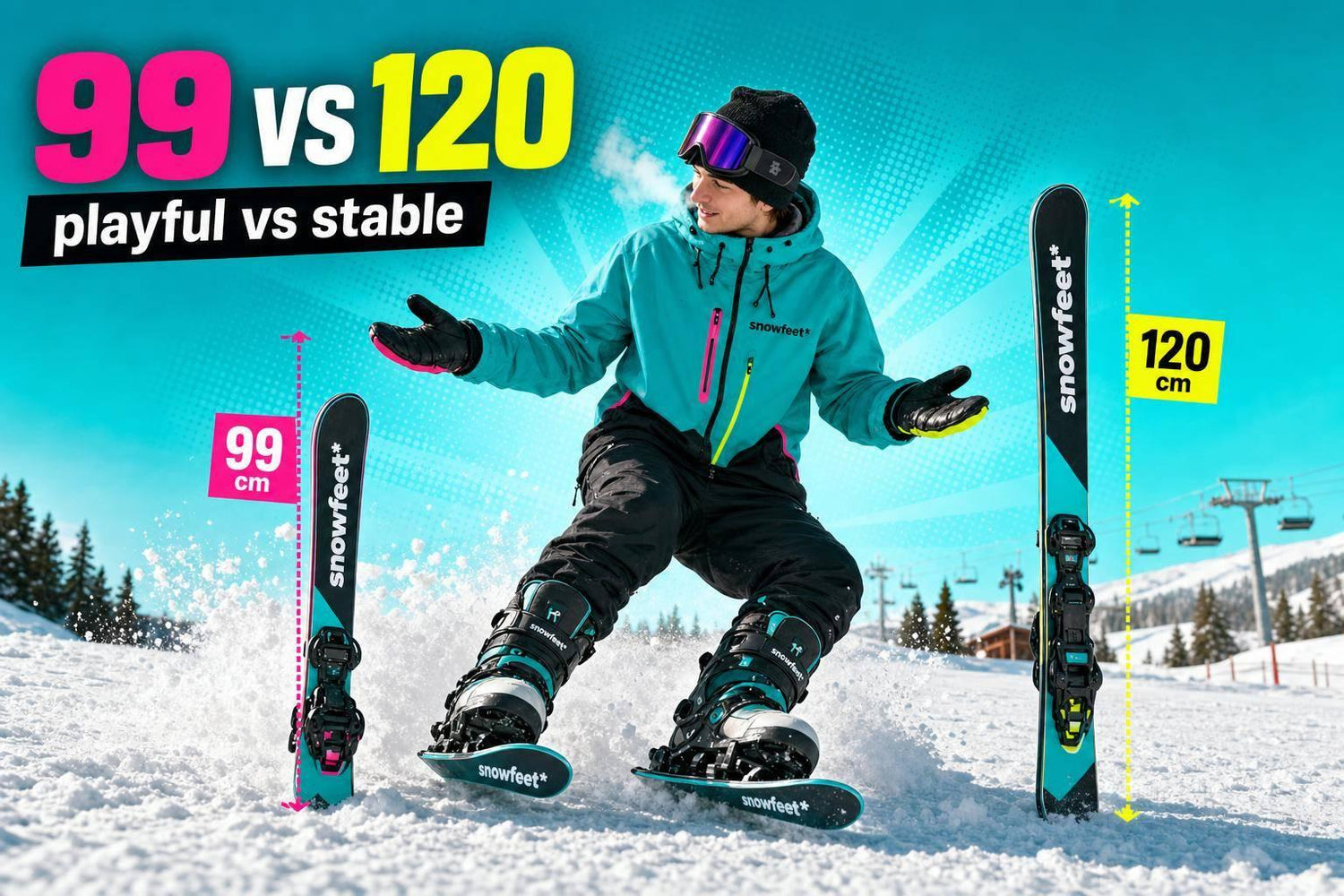
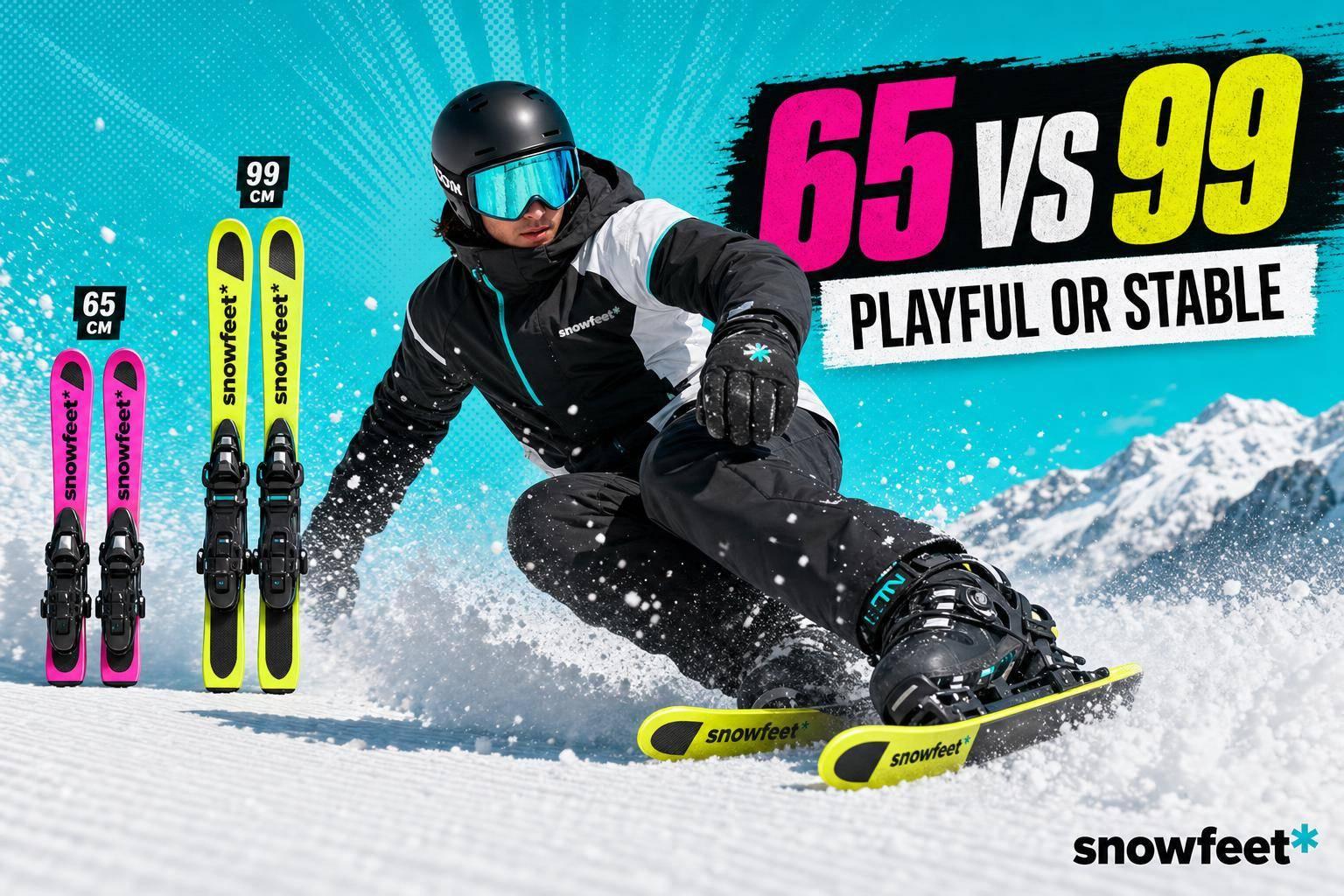
If you want easy turns and a playful ride, I’d pick 99 cm. If you want more calm on longer, faster runs, I’d pick 120 cm. That’s the whole call in one line.
Here’s the short version:
- 99 cm = lighter feel, tight turns, park laps, travel, green/blue runs
- 120 cm = more support, smoother carving, less chatter, longer groomers
- The gap is 21 cm (about 8.3 inches), and you can feel it fast
- Both are still much shorter than common rental skis at 160–180 cm
If you’re a beginner, casual rider, or you ski short local hills, 99 cm makes more sense for most days.
If you’re a stronger skier, a bigger rider, or heading to places with long open runs like Colorado or Utah, 120 cm gives you more confidence.
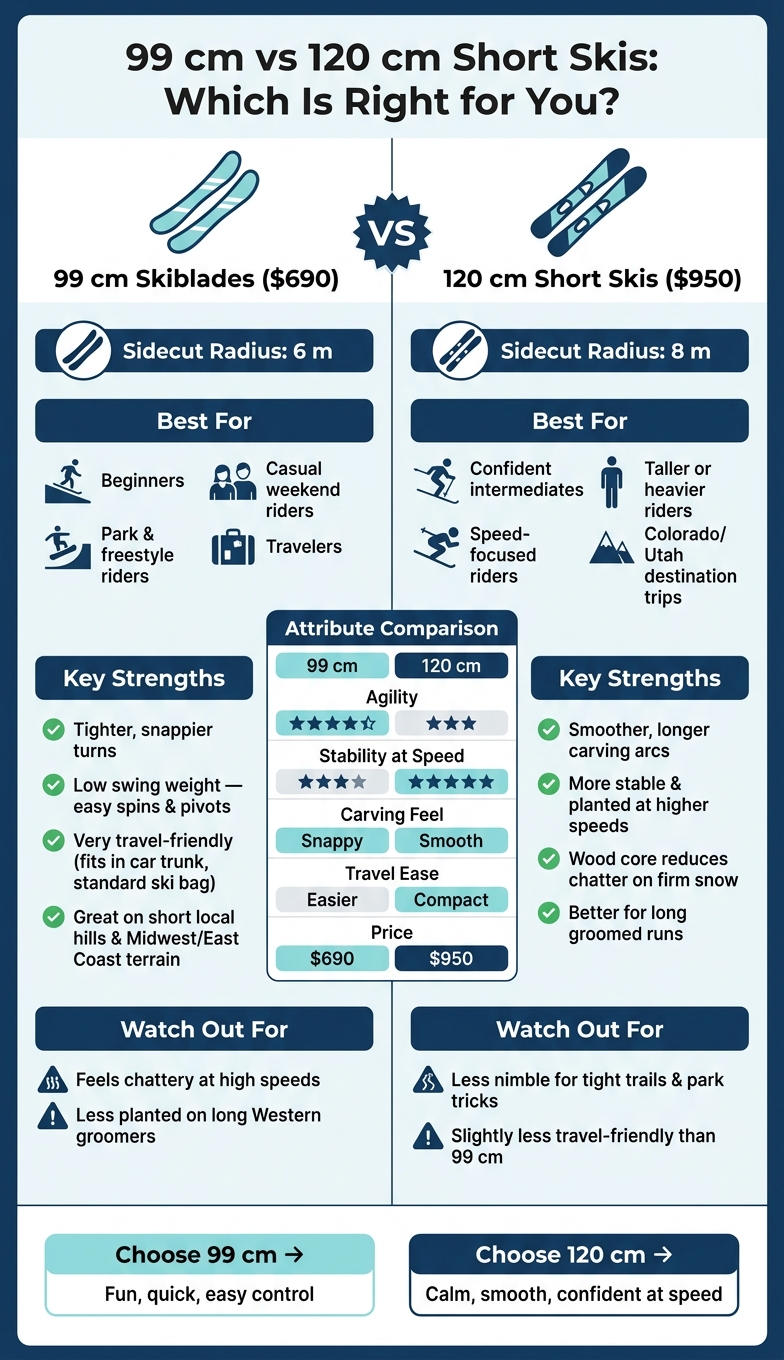
99 cm vs 120 cm Short Skis: Side-by-Side Comparison
Snowfeet* Short Skis | Snowblades Skiboards 120 cm
Quick Comparison
| What matters most | 99 cm | 120 cm |
|---|---|---|
| Turn feel | Tighter | Smoother |
| Sidecut radius | 6 m | 8 m |
| Speed feel | Good at medium speed | Better at higher speed |
| Park and spins | Better pick | Fine, but less easy |
| Travel and storage | Easier | Still compact |
| Beginner ease | Strong pick | Good, with more support |
| Price | $690 | $950 |
So, if you’re stuck, I’d keep it simple:
- Choose 99 cm if you want fun, low-effort skiing
- Choose 120 cm if you want a ride that feels more planted
That’s the call without the ski-shop ramble, though, uh, I do love a ski-shop ramble :)
Snowfeet* Skiblades 99 cm: fast turns, playful feel, easy control
How the 99 cm model feels on snow
The 99 cm Skiblades feel quick the second you click in. Small moves from your ankles and knees are enough to steer them. You don’t have to fight the ski to get it where you want it to go.
At 39 inches (99 cm) long with a 6-meter turning radius, they’re built for short, snappy turns. The parabolic sidecut helps them carve clean lines on groomed snow, but they don’t feel stiff or locked-in like a full-length carving ski. The ride stays loose, light, and playful. At low to medium speeds, they feel easy to read. Speed checks, fast line changes, and those little lift-line pivots? No drama.
The metal edges hold well on hardpack, and the graphite base slides smoothly on groomers. The asymmetrical high twin tips also make skiing switch feel natural.
Best for beginners, park laps, and travel
The 99 cm sits in a nice middle ground. It gives you more edge contact and a bit more stability than super-short mini skis, but it still feels friendly for beginners on green runs. That shorter tail helps too. It cuts down on crossed tips and edge catches, which are two of the most common rookie headaches on rental skis.
For Midwest and East Coast hills, this size makes a lot of sense. Shorter runs, tighter trails, and busy weekends usually reward quick control more than straight-line speed. That’s where the 99 cm shines.
That fast, easy response is also why it works so well for learners, mellow park laps, and short getaways. If you like to play around on snow, the low swing weight is a big plus. Quick 180s, 360s, butters, and smears feel easier here. It’s also happy on casual park laps and side hits.
Here’s the trade-off: that same nimble feel means it’s at its best when control matters more than staying calm at high speed.
On the day-to-day side, the 99 cm is easy to live with:
- It can fit across the back seat of most sedans or inside a standard trunk
- You likely won’t need a roof rack
- It stores easily in a closet or behind a door
- For flights to Colorado or Utah, it can fit in a shorter, lighter ski bag and may help you skip oversized baggage fees tied to full-length ski bags. Just check your airline’s rules first.
Where the 99 cm falls short
Let’s be straight about it: the 99 cm isn’t the best pick for every mountain day. Once speeds climb on long, steeper Western resort runs, it starts to feel more lively and less planted. On hard, icy groomers, you’ll notice more chatter than you would on the 120 cm model or a full-length alpine ski. If your plan is to spend all day bombing long Western groomers, this ski can start to feel a bit busy.
If you want more calm at speed, the 120 cm version is the next step.
sbb-itb-17ade95
Snowfeet* Short Skis 120 cm: more stability, smoother carving, more confidence
If the 99 cm felt twitchy, the 120 cm is the calmer move up.
How the 120 cm model feels on snow
The 120 cm feels calm and planted. Turns come out smoother, and you get more room to pick up speed without feeling like the skis want to dart around.
At 47 inches (120 cm) long with an 8-meter sidecut radius, it holds a carve longer instead of snapping into a turn all at once. On groomed runs, that gives you a lot more confidence. It stays locked in longer and feels less nervous underfoot. The wood core helps cut down chatter on firm snow, which is a big deal when the surface gets a bit harsh. On chopped snow, hardpack, and wind-buffed groomers, the 120 cm tracks cleanly without making you babysit every turn. Full metal edges and a graphite base help it hold that line.
That’s the sweet spot of the 120 cm. It suits riders who want a calmer ride on longer runs.
Best for confident intermediates and longer runs
This length tends to fit confident intermediates, bigger riders, and people who spend more time on longer groomed runs.
Taller and heavier riders often lean toward the 120 cm, mainly on faster terrain. Camber underfoot and rocker at the tips and tails give it more of that familiar ski feel, just without the bulk of a full-length ski. So, yeah, it’s still short enough to feel easygoing, but it rides more like a bigger ski than you’d guess from the size.
Where full-length skis still do better
To be fair, full-length skis still have the edge if you're charging steep groomers or going after deep backcountry powder. That’s just the job they’re built for. But for most resort riders, the 120 cm handles groomers, light off-piste, and moderate powder without the bulk of full-length skis.
Next, compare the two lengths side by side for turning, stability, tricks, and portability.
99 cm vs 120 cm: side-by-side comparison by performance and rider type
After the on-snow feel breakdown, this side-by-side makes the choice a lot faster. If you want the short version, here it is: 99 cm leans fun, quick, and easy. 120 cm leans calmer, smoother, and better at speed.
Performance comparison table: turning, stability, carving, tricks, portability
| Attribute | Snowfeet* Skiblades 99 cm | Snowfeet* Short Skis 120 cm |
|---|---|---|
| Turning and edge response | Very tight, 6 m radius - fast and snappy edge-to-edge | Wider, smoother arc, 8 m radius - smoother and more stable |
| Stability at speed | Good at moderate speeds; can feel chattery when pushed hard | Strong - more planted and settled at higher speeds |
| Carving feel | Quick, playful short-radius turns | Longer, flowing carves with better edge hold |
| Agility | Best choice - low swing weight, easy spins, pivots, and tight-trail weaving | Works fine, but less nimble for technical moves and crowds |
| Travel convenience | Very travel-friendly; easy to pack and store | Still compact for a ski, but less convenient to pack than 99 cm |
The gap is pretty simple. The 99 cm feels like the ski that wants to dart, pivot, and play around. The 120 cm feels more settled once the run opens up and your speed starts to build.
Which length fits which rider
Use the table above to match the ski to your top goal.
| Rider Profile | Better Option | Why |
|---|---|---|
| Beginner adult | 99 cm | Easiest to control; low risk of catching edges |
| Casual weekend rider | 99 cm | Fun and effortless on local hills |
| Park / freestyle rider | 99 cm | Short enough for spins, side hits, and quick pivots |
| Traveler | 99 cm | More travel-friendly and easier to pack, carry, and store |
| Confident intermediate | 120 cm | More stability and a bigger-ski feel on longer runs |
| Taller or heavier rider | 120 cm | More support and balance from the longer platform |
| Speed-focused rider | 120 cm | Holds a line cleanly at higher speeds with less chatter |
If you're stuck between the two, this rule of thumb helps: pick 99 cm if you care more about tight turns, park laps, and easy handling. Go with 120 cm if you want more support under you on longer groomer runs.
US riding scenarios: local hills, park sessions, and Colorado trips
For shorter local hills - think a busy Midwest ski area on a weekend - the 99 cm is the natural fit. Runs are short, crowds are real, and being able to snap through quick turns and slip around other skiers matters more than top-end stability. It just makes that kind of hill more fun.
For terrain park sessions, the 99 cm stays the better call. Its lighter swing weight makes 180s and 360s easier to manage, and it's more forgiving when you're testing things out on small jumps or side hits. In plain English: less work in the air, less stress on the landing.
For a Colorado destination trip, the 120 cm earns its spot. Runs are longer, speeds tend to climb on wide-open groomers, and the extra length helps you stay composed instead of wrestling the ski. The 120 cm's 8 m radius and more planted feel make it a strong match for longer, more varied runs.
Next, the final recommendation turns these differences into a clear pick.
Final recommendation: 99 cm for agility or 120 cm for stability
After comparing them side by side, the call is pretty simple. Go with 99 cm if you want snappier turns and a more playful feel. Go with 120 cm if you want a smoother ride at speed and more stability underfoot.
Choose 99 cm for easy control and playful riding
The Snowfeet* Skiblades 99 cm ($690) are the best fit for beginners, casual weekend riders, and park riders. They’re easy to handle, fun to mess around on, and simple to pack in a car trunk or ski bag. If that sounds like your kind of day on the mountain, this is the one to get.
Choose 120 cm for more stability and a bigger-ski feel
If you want more calm when speed picks up, step up to 120 cm. The Snowfeet* Short Skis 120 cm ($950) are a better match for riders who can already ski parallel turns with confidence. The longer platform feels more stable, especially for taller or heavier riders. On longer groomed runs in Colorado or Utah, the 120 cm stays calmer as you pick up speed. At about $260 more, it’s the better buy if you want short skis that feel closer to a full ski - just shorter.
FAQs
Can I learn on 120 cm skis?
Yes - you can learn on 120 cm skis.
That said, they’re usually a better fit for people with a bit more experience, or for riders who want more speed and stability.
The 120 cm Snowfeet Skiblades* tend to take about 1 to 2 days to get used to. They feel more stable and closer to regular skis than the 65 cm or 99 cm models. At the same time, they’re still easier to handle and more forgiving than full-length skis.
So, if you want something that feels more like skiing but doesn’t go full send into long-ski territory, 120 cm sits in a nice middle spot.
Is 99 cm too short for taller riders?
No. The 99 cm Snowfeet Skiblades work well for most average-height adults, including riders from 5'4" to 6'2". They give you a nice mix of balance, agility, and control.
If you're taller or heavier and want more stability at higher speeds or on steeper terrain, the 120 cm model may be a better fit. But for most adults, the 99 cm version is still a capable, popular pick.
Do short skis work in powder?
Yes, but the model matters.
Snowfeet 120 cm Skiblades* give you more surface area, which helps with flotation and control in light powder and off-piste terrain. They’re the better pick if you want a bit more support when the snow gets soft.
For deeper snow, the 99 cm Powder model is the better fit. It has a wider shape built for deep conditions. That said, neither option will perform like dedicated powder skis.
What they do offer is something a lot of riders want: a more manageable, portable option than standard ski gear. Easier to carry, easier to handle, and a lot less of a hassle :)











Laat een reactie achter
Deze site wordt beschermd door hCaptcha en het privacybeleid en de servicevoorwaarden van hCaptcha zijn van toepassing.