







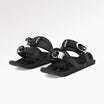












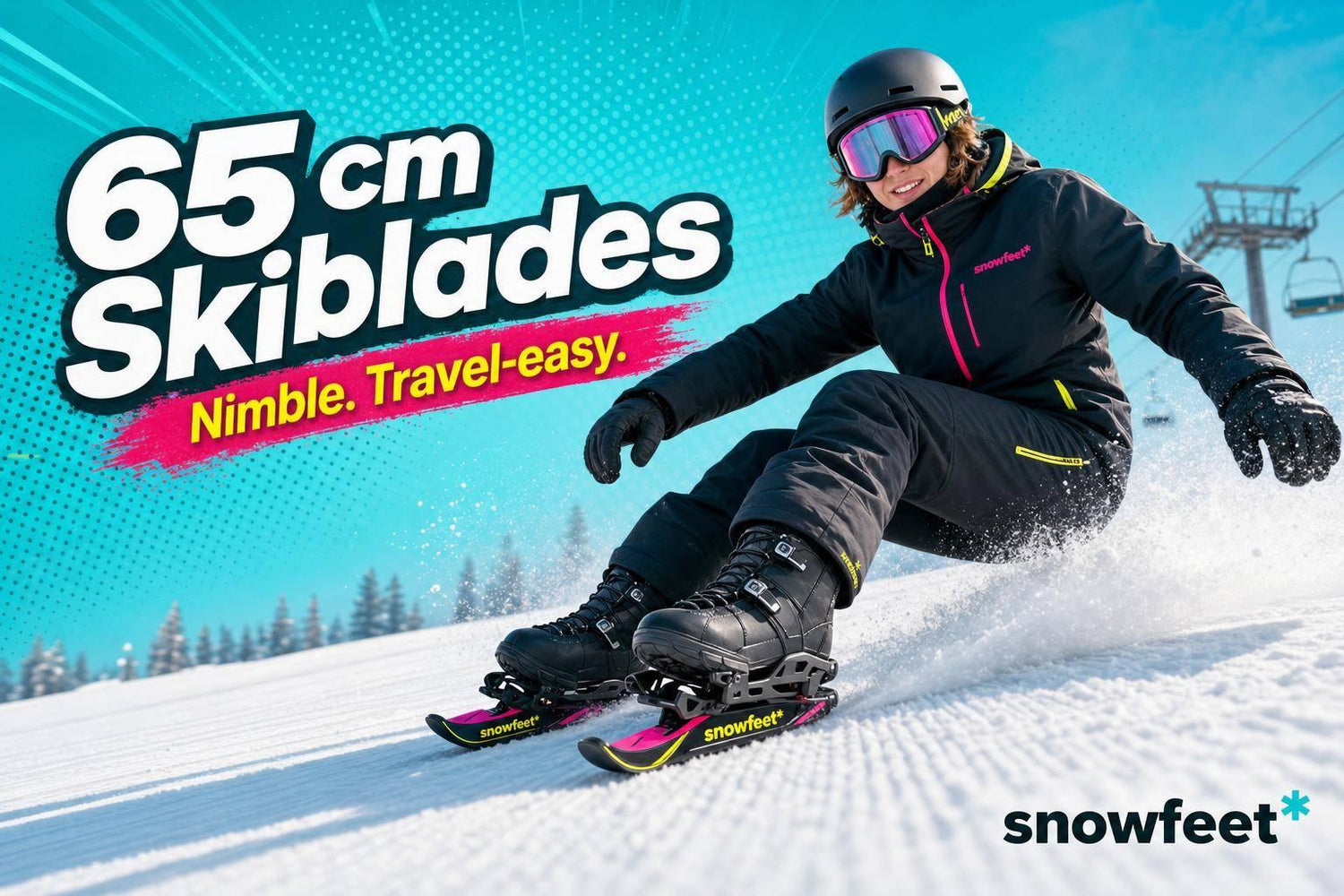
Yes - for the right rider, 65 cm skiblades can be worth the $590 price. If I wanted easy turns, small size, and a more playful day on groomers, I’d put them on my shortlist fast.
Here’s the short version:
- Best for: beginners, casual resort riders, families, travelers, and snowboarders trying skis
- Less ideal for: high-speed skiing, deep powder, and rough or steep terrain
- Main upside: easy control and simple transport
- Main downside: less stability once you start skiing fast
- Best fit in the lineup: a middle ground between 44 cm skiskates and 99 cm short skis
So, if you want a setup that feels less like work and more like fun, 65 cm is a smart middle pick. You get more support than tiny skiskates, but you skip the bulk of longer skis. That’s the whole deal in one line.
Snowboarder tries Snowfeet* | Which Snowfeet* Short Ski is the Best? | Snowblades 44, 65, 99 Review
Quick Comparison
| Option | Length | Best For | Main Strength | Main Weak Spot |
|---|---|---|---|---|
| Snowfeet* Skiskates | 44 cm | Riders who want a skate-like feel | Tiny and easy to pack | Harder balance, less support |
| Snowfeet* Skiblades | 65 cm | Beginners, casual riders, travel | Easy turns, easy to carry | Less calm at speed |
| Snowfeet* Longer Skiblades | 99 cm | Riders who want more ski feel | Better stability | More bulk |
| Standard skis | 150 cm+ | Faster skiing, powder, steeper runs | Best stability and float | More work to carry and turn |
A few numbers help tell the story:
- Price: $590
- Turn radius: 4 m
- Weight: about 3.8 lb per pair with ski bindings
- Boot options: works with ski boots or snowboard boots
My take? If your ski days are mostly green runs, easy blues, park laps, and travel weekends, 65 cm skiblades make sense. If you want to bomb black runs like you’re late for lunch, uh, go longer :)
For a fast visual before the full read, this video helps show how short skis ride on snow:
Who Should Buy 65 cm Skiblades
Beginners, Casual Resort Riders, and Families
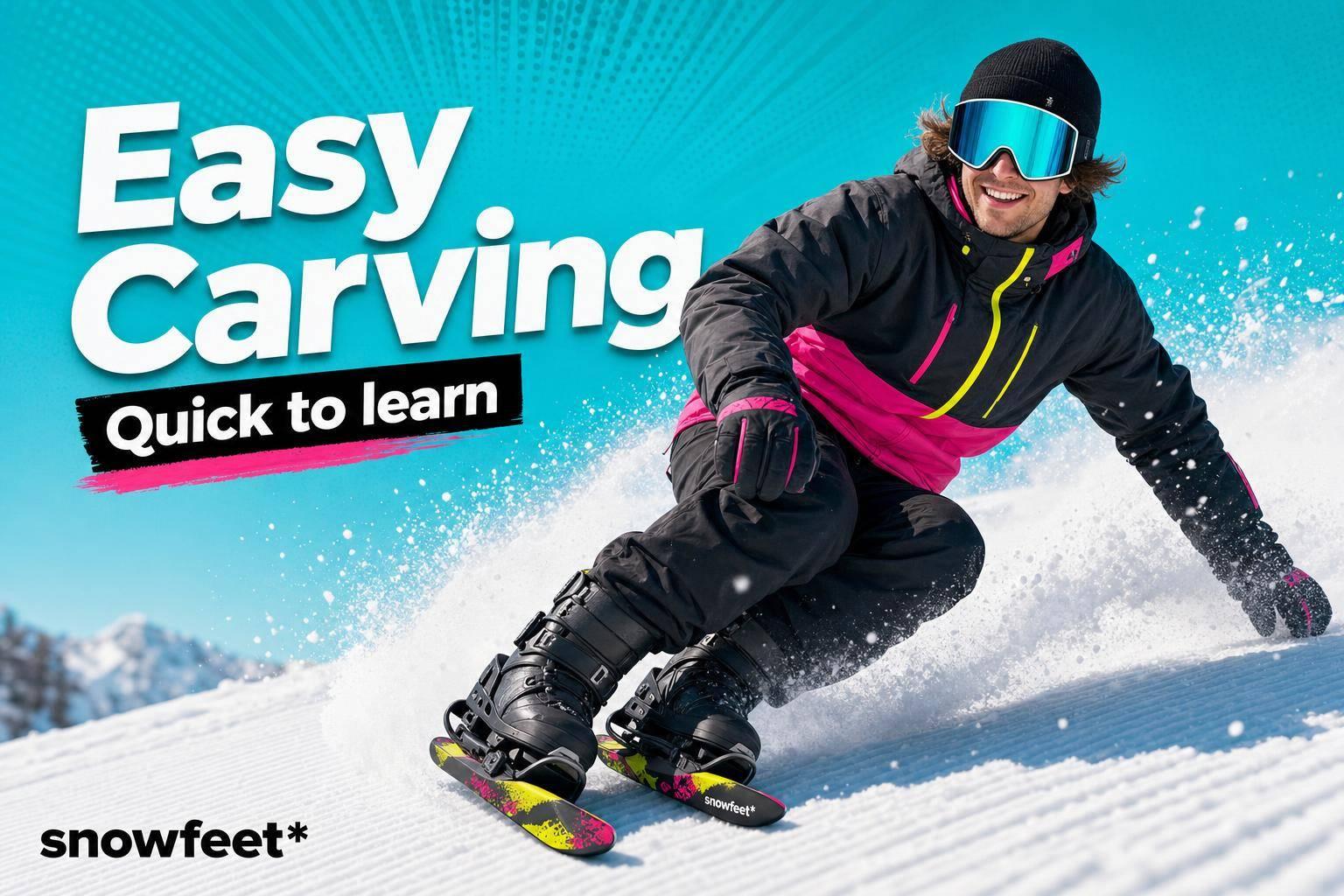
65 cm skiblades make the most sense for beginners, casual resort riders, and families. The short length makes turns feel easier and stopping less intimidating. Snowfeet* lists a 4 m turn radius for the 65 cm model, which lines up with that quick, snappy feel.
They shine on green runs, easy blues, and busy resort slopes where tight turns matter more than speed. If your thing is high-speed carving, deep powder, or big-mountain laps, full-length skis will do the job better. But if the goal is a fun, low-stress day on the hill, 65 cm skiblades can make skiing feel a lot less like work and a lot more like play.
Park Riders, Snowboarders, and Skaters
Snowboarders and skaters often get comfortable on them fast because the short platform feels familiar. And compared with 44 cm skiskates, 65 cm skiblades give you more support on landings for small jumps, boxes, and jibs while still staying nimble.
Travelers and Riders With Limited Storage
This is where 65 cm skiblades are kind of a no-brainer. They fit in checked luggage or a car trunk, so hauling them around is way easier than dealing with full-length skis. That makes them a good match for college students, apartment dwellers, and weekend travelers who don’t have much room to spare.
They can also help you skip rental lines on the occasional ski trip since you can just bring your own setup. Snowfeet* sells 65 cm skiblades with both ski-boot and snowboard-boot bindings, which is handy if you already own one or the other.
That said, easy transport and simple fun come with limits in stability and speed. Those are the upsides. Next comes the trade-off.
sbb-itb-17ade95
65 cm Skiblades vs Standard Skis: Key Trade-Offs
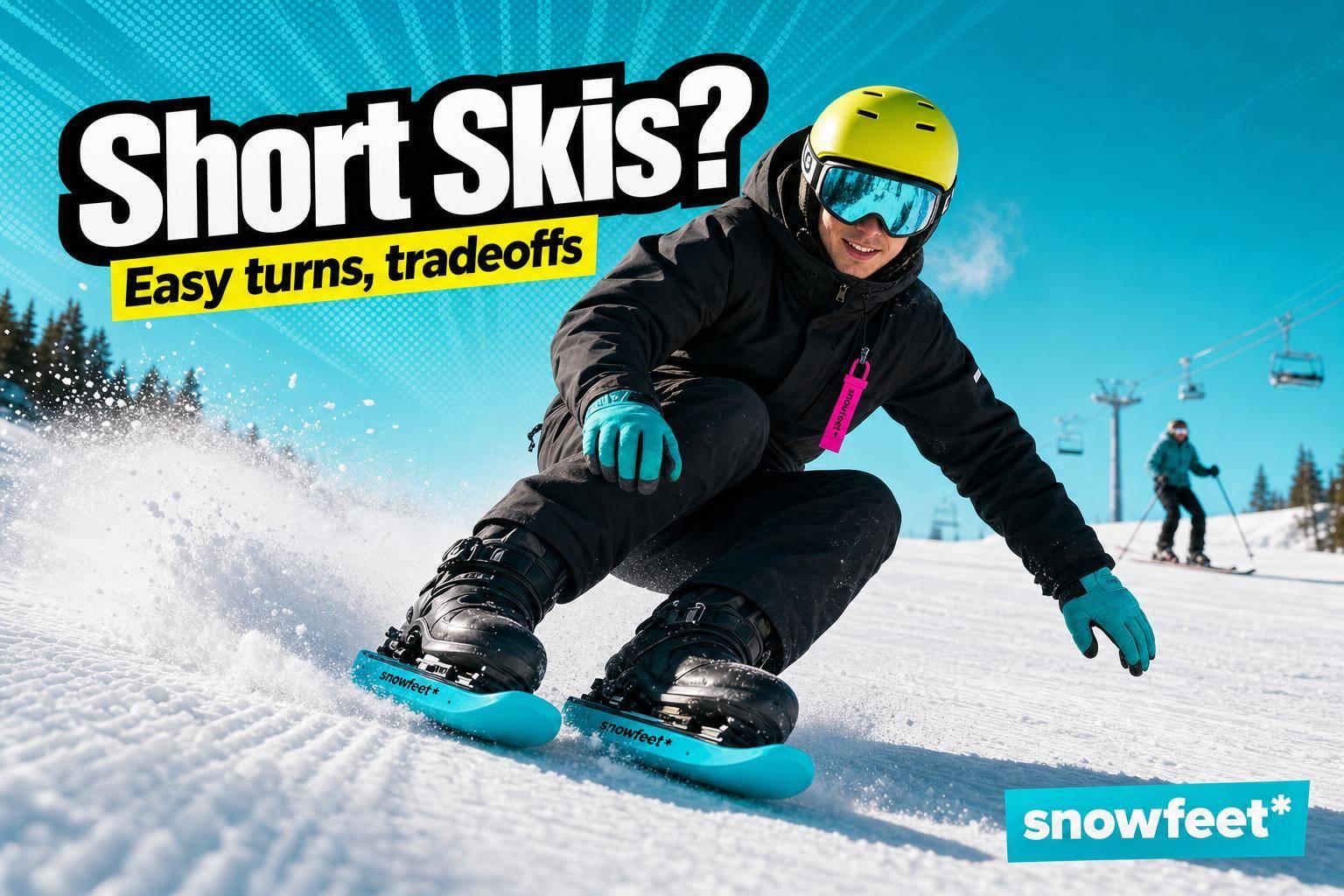
Choosing between 65 cm skiblades and standard skis comes down to a simple trade-off: top-end speed and float or quick control and easy handling. Put them side by side, and the difference gets pretty clear.
| Category | Standard Skis | Snowfeet* 65 cm Skiblades |
|---|---|---|
| Stability at speed | ✅ Better at high speeds | ⚠️ Less stable at speed |
| Powder / deep snow | ✅ Better flotation | ❌ Not ideal |
| Steep, rough terrain | ✅ More confidence on challenging terrain | ⚠️ Better on easier steeps |
| Turn quickness | ⚠️ Slower to turn | ✅ Very quick |
| Park / tricks | ⚠️ Less nimble | ✅ More nimble for small jumps and jibs |
| Price | ⚠️ Usually higher total setup cost | ✅ From $590 |
Where Long Skis Perform Better
Standard skis still have a clear edge in a few spots. If you like to ski fast, charge through chopped-up snow, or spend time in powder, long skis are still the better tool.
They give you better edge hold at speed, more float in deep snow, and a steadier feel when the surface gets rough or icy. On steep terrain, that extra length can also give you more confidence. It’s the classic “bigger platform, calmer ride” deal.
Where 65 cm Skiblades Win for Everyday Use
For everyday resort riding, 65 cm skiblades shine in the places most people spend a lot of time: busy runs, tight spaces, and sections where you’re turning all the time. They make short turns easier and can take some strain off your legs when the hill gets crowded.
The 4 m sidecut radius on Snowfeet* 65 cm helps the skis snap into short, controlled turns with very little effort. That’s a big plus when you’re weaving through traffic and making constant line changes. A wood core, metal edges, and twin tips help them feel like actual skis, not some goofy novelty setup.
At $590, they make the most sense for riders who care more about compact handling than speed and flotation.
The next question is whether 65 cm is the best short-ski length, or whether a longer Snowfeet* model fits better.
65 cm Skiblades vs Longer Skiblades and Other Short-Ski Options
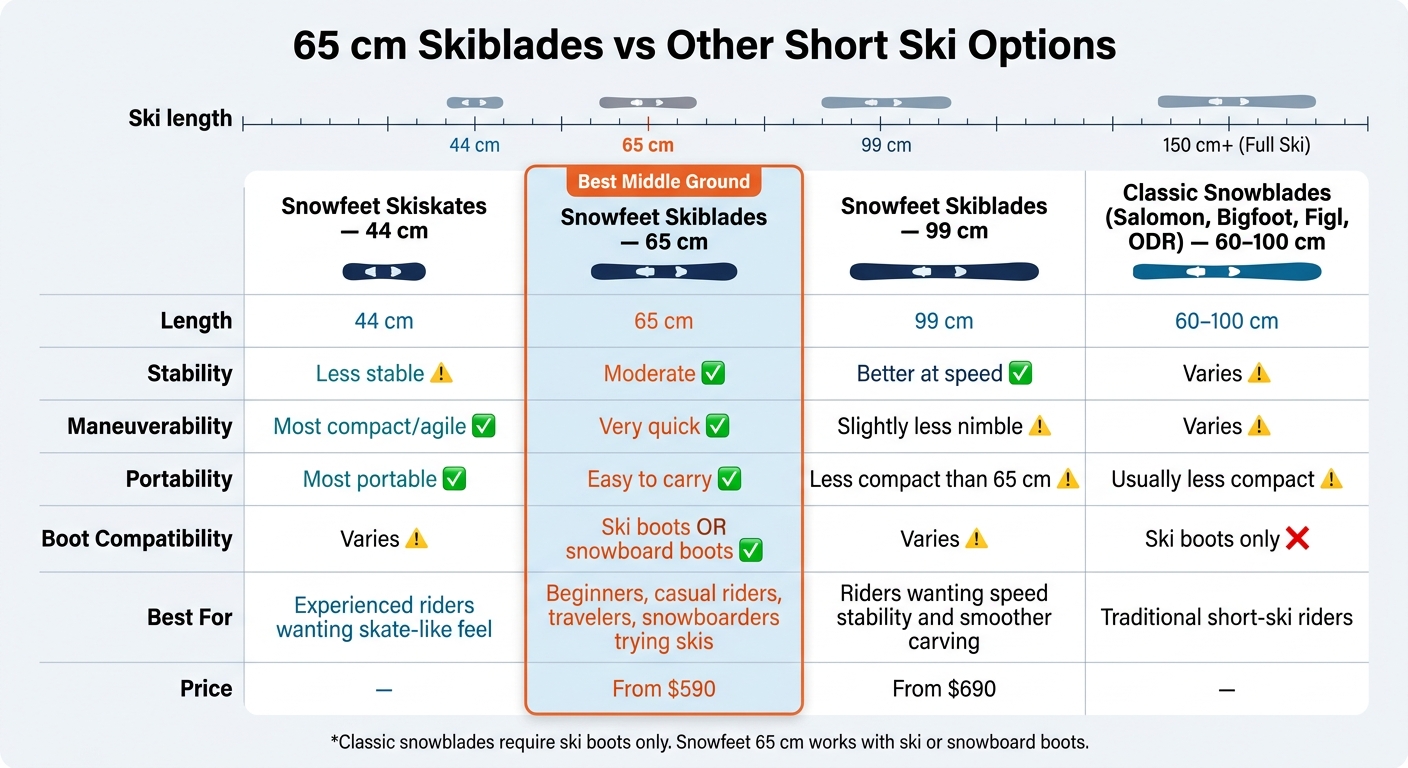
65 cm Skiblades vs Other Short Ski Options: Full Comparison
Once you’ve ruled out full-length skis, the next call is pretty simple: which short-ski length matches how you ride? If short skis already make more sense for you, then you’re down to three main sizes: 65 cm, 99 cm, or 44 cm.
Snowfeet* 65 cm vs Snowfeet* 99 cm
Snowfeet* 99 cm feels closer to a normal ski. It stays steadier at speed, handles longer turns with less fuss, and feels calmer when the snow gets chopped up.
The 65 cm model goes the other way. It’s lighter, quicker, and easier to haul around at about 3.8 lb per pair with ski bindings. It works well on tight, busy runs and for relaxed resort laps. If top-end speed matters most, go with 99 cm. If you want something easy, nimble, and low-hassle, 65 cm makes more sense.
So, 65 cm sits right in the middle. It gives you more stability than 44 cm, without feeling as locked-in as 99 cm.
Snowfeet* 65 cm vs 44 cm Skiskates and Classic Snowblades
The Snowfeet* Skiskates at 44 cm are the smallest option in the lineup. They feel almost like skates on snow. That makes them a blast, and they’re easy to pack, too. But there’s a catch: they ask more from you in balance and precision. For most casual riders, and especially for people new to short skis, they’re tougher to get used to than 65 cm.
Here’s the side-by-side view:
| Option | Length | Stability | Maneuverability | Portability | Best For | Boot Compatibility |
|---|---|---|---|---|---|---|
| Snowfeet* 65 cm Skiblades | 65 cm / 26 in | Moderate | Very quick | Easy to carry | Casual resort riders, beginners, travelers, snowboarders trying skis | Ski boots or snowboard boots |
| Snowfeet* 99 cm Skiblades | 99 cm | Better at speed | Slightly less nimble | Less compact than 65 cm | Riders who want more speed stability and smoother carving | Varies by model |
| Snowfeet* 44 cm Skiskates | 44 cm | Less stable | Most compact | Most portable | Experienced riders who want a skate-like feel; steeper than 65 cm | Varies by model |
| Classic snowblades (Salomon, Bigfoot, Figl, ODR) | 60–100 cm / 24–39 in | Varies | Varies | Usually less compact | Traditional short-ski riders | Ski boots only |
Classic snowblades from brands like Salomon, Bigfoot, Figl, and ODR often lock you into ski boots only. Snowfeet* 65 cm gives you more freedom there, since it also works with snowboard boots.
That’s the trade-off the verdict section needs to sort out.
Verdict: Are 65 cm Skiblades Worth It?
After you stack up control, speed, and portability, the answer is pretty plain: yes. 65 cm skiblades are worth it for casual riders who want the easiest Snowfeet* setup.
The Best Reasons to Buy 65 cm Skiblades
The 65 cm size fits best for beginners, casual resort riders, snowboarders who want to try skis, and families. Customer reviews keep pointing to the same things: fun, easy handling, and snowboard-boot compatibility. That combo makes a lot of sense. You get something that feels less intimidating and more playful, which is half the battle when you're starting out or just want a laid-back day on the mountain.
Their small size is also a big win for travel and storage. They’re easy to pack, easy to carry, and way less of a pain to stash at home. At $590, they’re not cheap. But you’re paying for control, portability, and ease of use.
When to Choose Something Longer Instead
If you ski hard and like more speed, the trade-off changes. Skip the 65 cm model if your top goals are speed, powder, or steep technical terrain. That’s where a longer option makes more sense.
If you want to stay in the short-ski category, the Snowfeet* 99 cm model (from $690) is the better pick. For most casual riders, though, Snowfeet* 65 cm is the better buy.
FAQs
Are 65 cm skiblades hard to learn on?
No. Compared with regular skis, 65 cm skiblades usually have a short learning curve.
Most riders feel at ease after a few runs. Some click with them in as little as five minutes, especially if they’ve done skating or inline skating before. Their short, nimble shape also makes turns and stops feel easier.
Can I use 65 cm skiblades with snowboard boots?
Yes - 65 cm Snowfeet Skiblades* can be used with snowboard boots.
A lot of riders like them more than ski boots because snowboard boots tend to feel more comfortable. They also give good side-to-side support and solid control, which can feel great in terrain parks or on tight lines.
The nice part? Snowfeet bindings are made to work with snowboard boots*, so you can use the boots you already have. No need to buy a separate set of ski boots or other extra gear.
Should I get 65 cm or 99 cm skiblades?
It comes down to what you want most on the mountain.
65 cm skiblades are the go-to pick if you want top-end agility. They’re great for quick turns, freestyle tricks, tight tree runs, and tossing in a bag for easy travel. Short, snappy, and a bit wild - in a fun way :)
If you want more balance between agility and stability, go with 99 cm skiblades. They make more sense for mixed resort terrain, relaxed cruising, and light powder, where a little extra length helps the ride feel smoother.











Laat een reactie achter
Deze site wordt beschermd door hCaptcha en het privacybeleid en de servicevoorwaarden van hCaptcha zijn van toepassing.