



















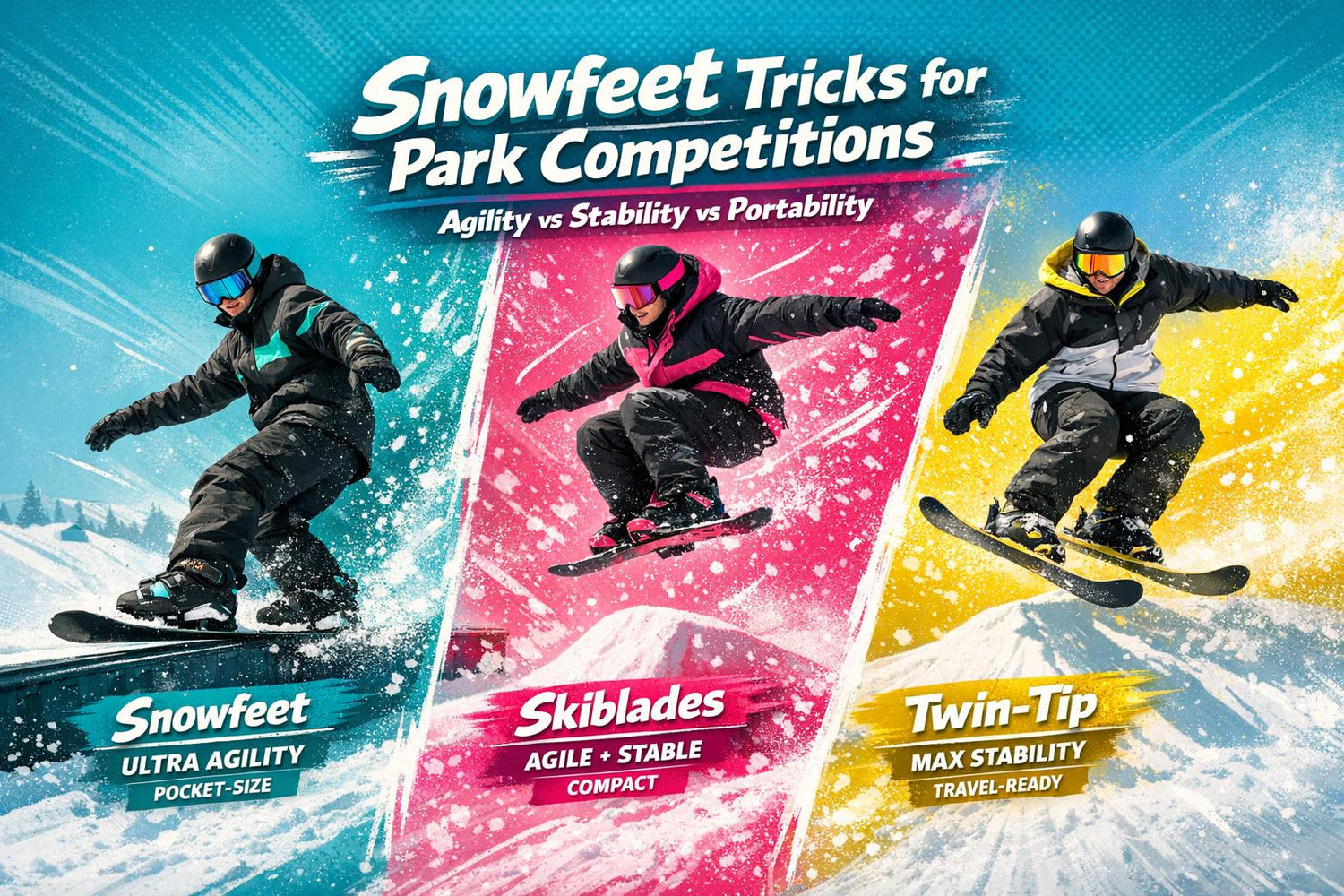
Looking to shake things up in the park? Snowfeet gear offers a fresh way to tackle rails, jumps, and boxes. With compact designs ranging from 17 to 47 inches, these mini skis and skiblades are all about control, agility, and fun. Here's the breakdown:
- Snowfeet Mini Ski Skates (44–50 cm): Great for spins and skating-style tricks. Lightweight and portable, but less stable on bigger jumps.
- Snowfeet Skiblades (65–99 cm): A balance of control and playfulness. Perfect for medium jumps and rails, but not as steady at high speeds.
- Twin-Tip Skis: The classic choice for big air and high-speed features. Stable but heavier and less nimble.
Quick Comparison
| Gear | Best For | Stability | Portability | Price Range |
|---|---|---|---|---|
| Mini Ski Skates | Spins, small features | Moderate | Ultra portable | $275–$575 |
| Skiblades | Medium jumps, mixed park events | Medium to high | Highly portable | $635–$675 |
| Twin-Tip Skis | Big air, advanced tricks | High | Bulky | Varies |
Want to stand out in competitions? Snowfeet gear opens up new trick possibilities, but for larger, high-speed courses, twin-tip skis still hold their ground. Let’s dive into the details.
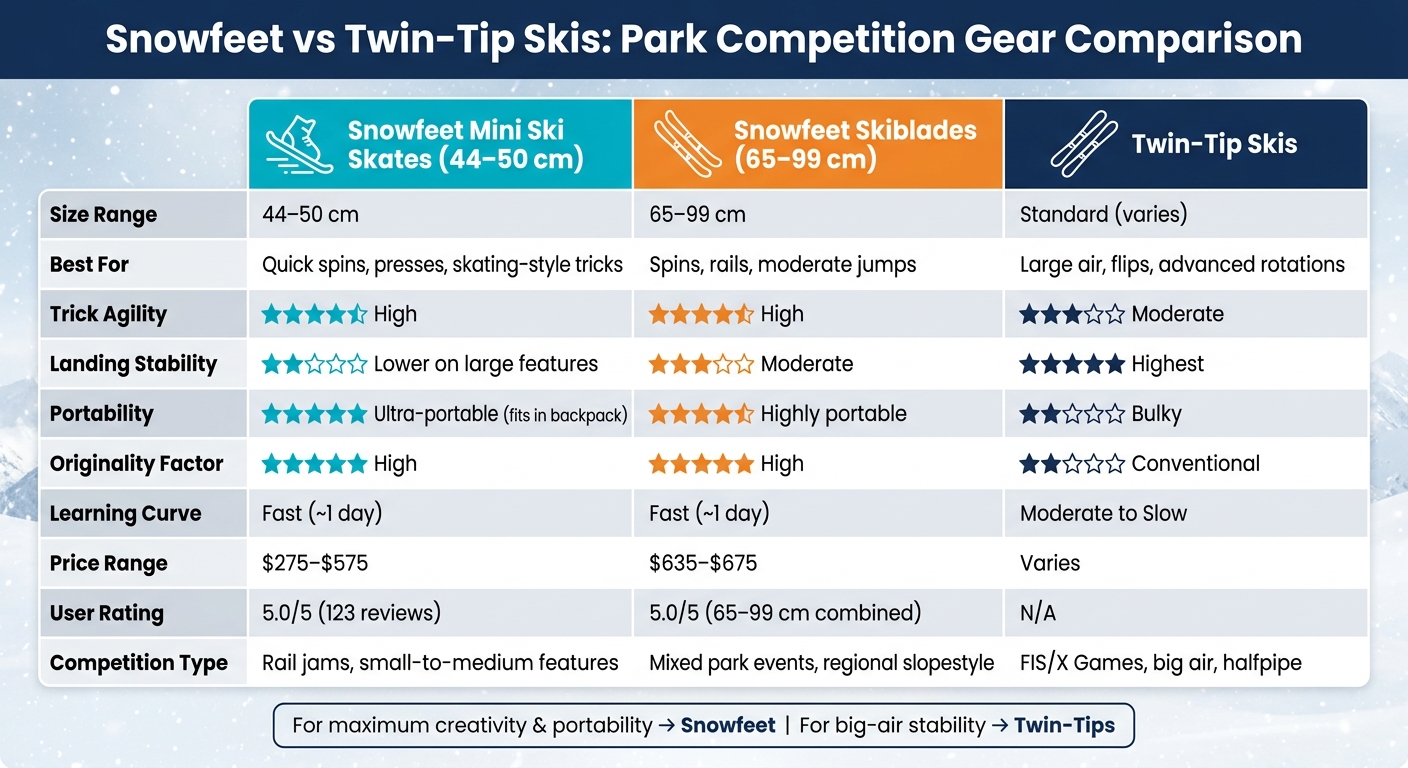
Snowfeet vs Twin-Tip Skis: Park Competition Gear Comparison
Snowfeet* Skiskates TUTORIAL - Skiskating Technique & Tricks
1. Snowfeet* Mini Ski Skates
Snowfeet* Mini Ski Skates come in two sizes: 44 cm (Skiskates) and 50 cm (Pro). Unlike traditional skis, they act more like snow skates, allowing each foot to move independently. This makes them stand out in areas like trick agility, landing stability, and overall versatility.
Trick Agility
These skates offer a level of control that’s ideal for pulling off creative tricks in the park. The independent movement of each leg gives you a skating-like feel, making spins and riding switch feel natural. As Zbyněk, the founder, puts it:
"I love how easy they are to ski and skate and how many different kinds of tricks I can perform effortlessly and almost no restrictions."
If agility is your priority, the 44 cm Skiskates are the way to go.
Landing Stability
Don’t let their small size fool you. The 50 cm Pro model is built with added length and curved tips and tails that provide excellent stability for landing jumps. Using a staggered stance can further improve balance, especially on bigger drops.
Feature Versatility
Thanks to their skating-inspired design, these skates let you adjust your stance quickly on rails, boxes, and other park features - something traditional ski bindings just can’t do. They’re also compatible with common winter shoes and boots, and their lightweight build helps prevent leg fatigue during long sessions.
Scoring Potential
In park competitions, judges love originality, and Mini Ski Skates open the door to tricks you just can’t pull off with regular twin-tips. The 44 cm model has earned a perfect 5.0/5 rating from 123 verified reviews.
| 44 cm Skiskates | 50 cm Pro | |
|---|---|---|
| Best For | Pro tricks & skating | Versatility & balance |
| Stability | Moderate | Enhanced |
| Boot Compatibility | Ski or snowboard boots | Winter shoes or snowboard boots |
| Starting Price | $575 | $275 |
2. Snowfeet* Skiblades
Snowfeet* Skiblades take the agility of their Mini Ski Skates and add a layer of ski-like precision, making them a standout for park enthusiasts. While the Mini Ski Skates are all about skating-style freedom, Skiblades focus on blending that nimbleness with better control. Available in two lengths - 65 cm and 99 cm - each model offers unique advantages, especially when it comes to landing stability on jumps.
Trick Agility
The 65 cm Skiblades are all about quick, sharp moves. With a super-tight 4-meter turning radius and a lightweight build (just 3.79 lbs per pair, including ski bindings), they make spins and rotations feel effortless. The asymmetrical 5 cm twin tips make riding switch feel smooth, which is a game-changer for clean landings. As one user, Brad Tolin, shared:
"These ski blades are a blast to use. Super easy to control, quick to turn, and way more forgiving than traditional skis."
This level of control and maneuverability makes them a top choice for pulling off tricks with confidence.
Landing Stability
When it comes to tackling bigger jumps, the 99 cm wood core model is the go-to option. Dubbed the "Ultimate Short Ski" by Snowfeet*, its stiffer wood core delivers better impact control compared to the 100 cm fiberglass version. With a 5.0/5 rating from 49 verified reviews, users consistently highlight its ability to provide stable, controlled landings.
Feature Versatility
Both models excel across park features like rails, boxes, and jumps. What sets them apart is their binding flexibility - you can choose between ski bindings for precise edge control or snowboard bindings for more freedom during grabs and tweaks. This versatility gives riders the ability to experiment with a broader range of tricks than they could on traditional setups.
Scoring Potential
Judges love originality, and Skiblades bring something fresh to the table. The independent leg movement they allow - something twin-tip skis can't offer - opens up creative recovery moves and unique style variations that stand out in competitions. The 65 cm model, in particular, has earned a 5.0/5 from 77 verified reviews.
| 65 CM Skiblades | 99 CM Skiblades | |
|---|---|---|
| Best For | Spins, switch tricks, agility | Big jumps, carving, stability |
| Core Material | Sustainable wood | Sustainable wood |
| Turning Radius | 4 meters | Deep parabolic |
| Binding Options | Ski or snowboard | Ski or snowboard |
| Starting Price | From $635 | From $675 |
sbb-itb-17ade95
3. Twin-Tip Skis
Twin-tip skis have long been the go-to gear for park riders, especially those tackling large features. However, they don’t quite match the nimbleness of Snowfeet* products.
Trick Agility
Twin-tips shine when it comes to big-feature tricks, but their weight can be a drawback. The longer length means you’ll need extra momentum to pull off spins or quick direction changes.
Landing Stability
One area where twin-tips excel is landing. Their wider platform provides a forgiving surface, especially on big jumps or when riding at higher speeds. As Brad Tolin, a verified Snowfeet* user, put it:
"Only trade-off is at higher speeds, where longer skis still feel more stable - but for overall fun and maneuverability, these are hard to beat."
That added stability can make all the difference when tackling large kickers or other high-impact features.
Feature Versatility
Twin-tip skis offer solid versatility across park features. However, their bulk makes them less portable compared to Snowfeet*, which are compact enough to fit in a backpack.
Scoring Potential
In competitions, twin-tips provide a familiar setup. But their design limits independent leg movement, which can hinder creativity. Snowfeet* products, by contrast, offer a unique edge, allowing riders to stand out with original tricks. This innovation is redefining what’s possible in park competitions.
| Feature | Twin-Tip Skis | Snowfeet* Skiblades (65–99 cm) |
|---|---|---|
| Trick Agility | Moderate (heavier) | High (lightweight with sharp turns) |
| Landing Stability | High | Medium to High |
| Portability | Cumbersome | Easy to carry |
| Originality Factor | Low (conventional) | High (unique style) |
| Learning Curve | Moderate to Slow | Fast (around 1 day) |
This comparison highlights the strengths and trade-offs of each setup, offering insight into why Snowfeet* is shaking up the park scene.
Pros and Cons
Here's a breakdown of the pros and cons for each option, highlighting what makes them stand out and where they might fall short.
Snowfeet* Mini Ski Skates are all about fun and creativity. Their small size (44–50 cm) makes moves like quick spins, surface presses, and skating-style tricks feel effortless. Plus, they’re super portable - just toss them in a backpack - and work with regular winter shoes or snowboard boots. This means you can hit the slopes with minimal prep and start experimenting right away. The downside? Their short length doesn’t offer much stability at higher speeds or on large jumps, making them better suited for small-to-medium features and playful contests rather than big-air competitions.
Snowfeet* Skiblades (65–99 cm) strike a great balance between agility and control. They’re more stable on jumps and provide better edge grip on rails compared to the Mini Ski Skates, but they still maintain a level of maneuverability that traditional skis can’t match. As Zbyněk, Snowfeet*'s founder, explains:
"I love how easy they are to ski and skate and how many different kinds of tricks I can perform without much effort and almost no restrictions."
That said, on icy or high-impact landings, especially at competition speeds, they can feel less secure than full-length skis. Heavier or more aggressive riders might notice this more. Still, their versatility makes them a solid choice for mixed park events.
Twin-tip skis are the go-to for stability and performance on large features. They’re perfect for advanced rotations, big air tricks, and meeting U.S. competition standards. However, their bulk makes them less portable, and their steeper learning curve limits the kind of innovative, skate-inspired maneuvers you can pull off with the other options.
Each of these options brings something unique to the table, showcasing how Snowfeet* is rethinking park competitions with gear that stands apart from the norm.
| Criteria | Snowfeet* Mini Ski Skates | Snowfeet* Skiblades | Twin-Tip Skis |
|---|---|---|---|
| Trick Versatility | Quick spins, presses, skating-style tricks | Spins, rails, moderate jumps | Large air, flips, advanced rotations |
| Landing Stability | Lower on large features | Moderate; balances agility and control | Highest; ideal for big jumps and high speeds |
| Portability | Ultra-portable; fits in a backpack | Highly portable | Bulky; less convenient to transport |
| Competition Readiness | Creative rail jams and small-to-medium features | Mixed park events | Traditional slopestyle and big air contests |
Conclusion
Snowfeet* Mini Ski Skates (44–50 cm) shine when it comes to quick spins, butters, and skating-style tricks on smaller-to-medium features. If you're looking for something more versatile, Snowfeet* Skiblades (65–99 cm) are the go-to choice. They perform well across rails, medium jumps, and mixed park lines, offering a balance of stability and playfulness. For larger, high-speed features, though, twin-tip skis remain the top pick.
Snowfeet* Skiblades stand out for their ability to tackle a variety of terrain. They’re stable enough for medium jumps and longer rails, yet playful enough to keep things fun - perfect for regional slopestyle events or casual park days. If you're after a solid all-purpose option, these are the ones to check out.
That said, traditional twin-tip skis still have the edge for big courses with large kickers, extended rails, or halfpipe walls, like those found in FIS or X Games events. They provide better edge hold and a larger landing platform, which short gear can’t quite replicate. As Brad Tolin, a verified user, puts it:
"Only trade-off is at higher speeds, where longer skis still feel more stable - but for overall fun and maneuverability, these are hard to beat."
FAQs
Which Snowfeet* length is best for my park line?
For hitting the park, the 44 cm and 50 cm Snowfeet* models are top picks. The ultra-short 44 cm Skiskates are perfect for pulling off tricks, spins, and even riding backward with ease. On the other hand, the 50 cm Snowfeet* PRO gives you extra balance and stability while still keeping that skate-like vibe. Both options are way more responsive and playful compared to traditional long skis, which can sometimes feel a bit limiting.
What boots work with Snowfeet* in the terrain park?
Snowfeet* products are a great match for terrain parks, offering plenty of flexibility for tricks. To get the best experience, we suggest using snowboard boots. Why? They’re more flexible and comfortable - perfect for pulling off spins, jumps, and sliding on rails. While some Snowfeet* models work with regular winter shoes, snowboard boots give you the extra stability and snug fit you need for bigger moves. Plus, most Snowfeet* bindings are adjustable and tool-free, accommodating US snowboard boot sizes from 6 to 14.5.
Are Snowfeet* allowed in park competitions?
Yes, Snowfeet are popular in terrain parks for performing tricks, spins, and jumps. Resort policies can differ, but they’re generally allowed in areas where traditional skis are permitted, thanks to their metal edges and practical design. Their small, nimble structure provides excellent control on features like rails and side hits, offering a playful and responsive option compared to larger, heavier skis - perfect for both beginners and seasoned riders.












댓글 남기기
이 사이트는 hCaptcha에 의해 보호되며, hCaptcha의 개인 정보 보호 정책 과 서비스 약관 이 적용됩니다.