



















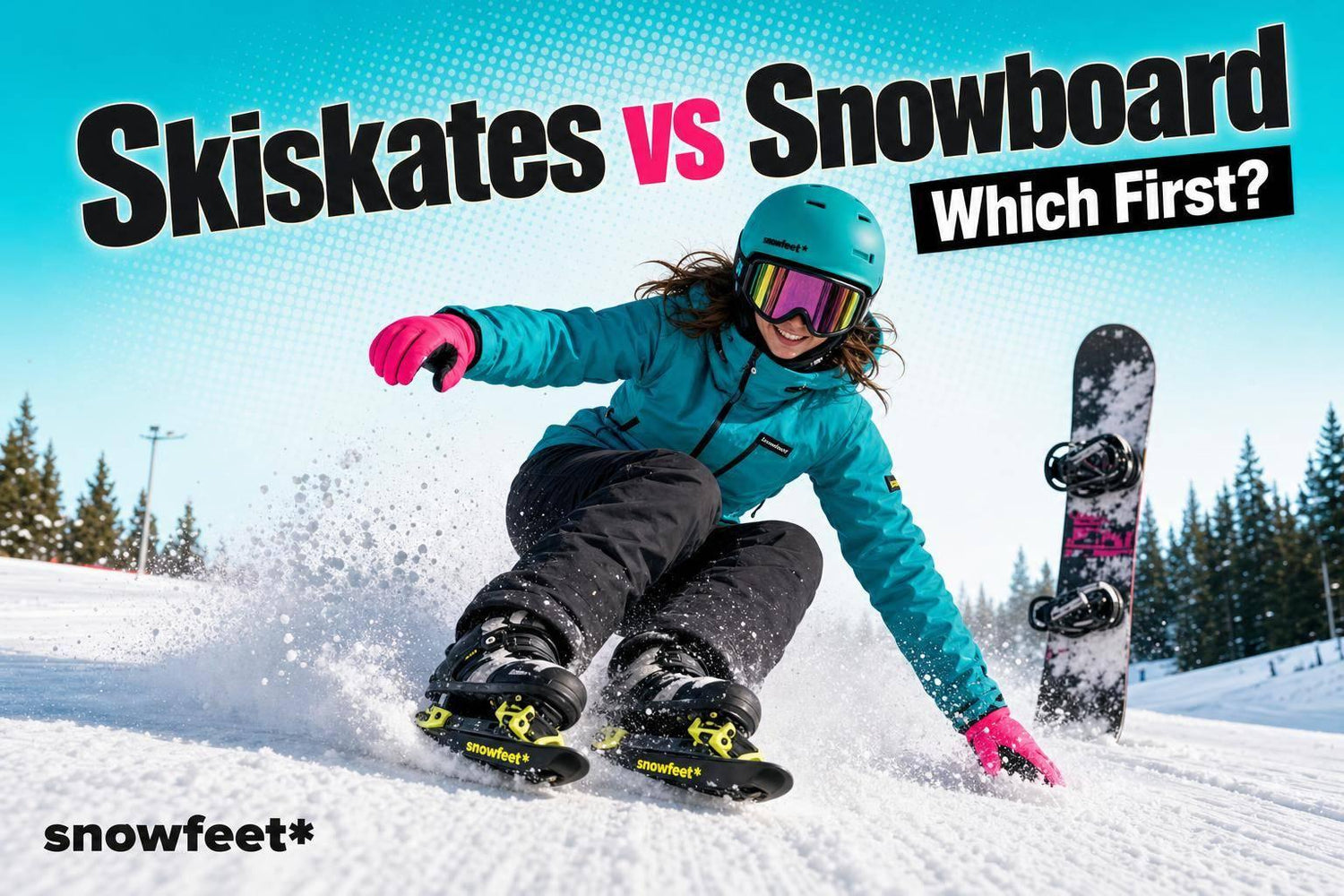
If you want the easier first day, I’d start with skiskates or short skiblades. For most beginners, they’re simpler to balance on, easier to stop, and less tiring than a snowboard. Snowboarding can be a blast, but day one is often rougher, with more falls and more time spent getting back up.
Here’s the short version:
- Best for total beginners: skiskates or short skiblades
- Best for skaters or hockey players: skiskates
- Best for people set on board sports: snowboard
- Best for easy transport: skiskates or mini skis
- Best for park-focused snowboard goals: snowboard
One stat jumps out: many snowboard beginners need 3–4 full days before linked turns feel solid, while basic control on short skis often starts to show on day 1 or 2. And if rentals cost $40–$80 per day at many U.S. resorts, gear choice can hit your wallet fast too.
Skiskates vs Snowboarding: Beginner Comparison Guide
Snowboarder tries Snowfeet* | Which Snowfeet* Short Ski is the Best? | Snowblades 44, 65, 99 Review
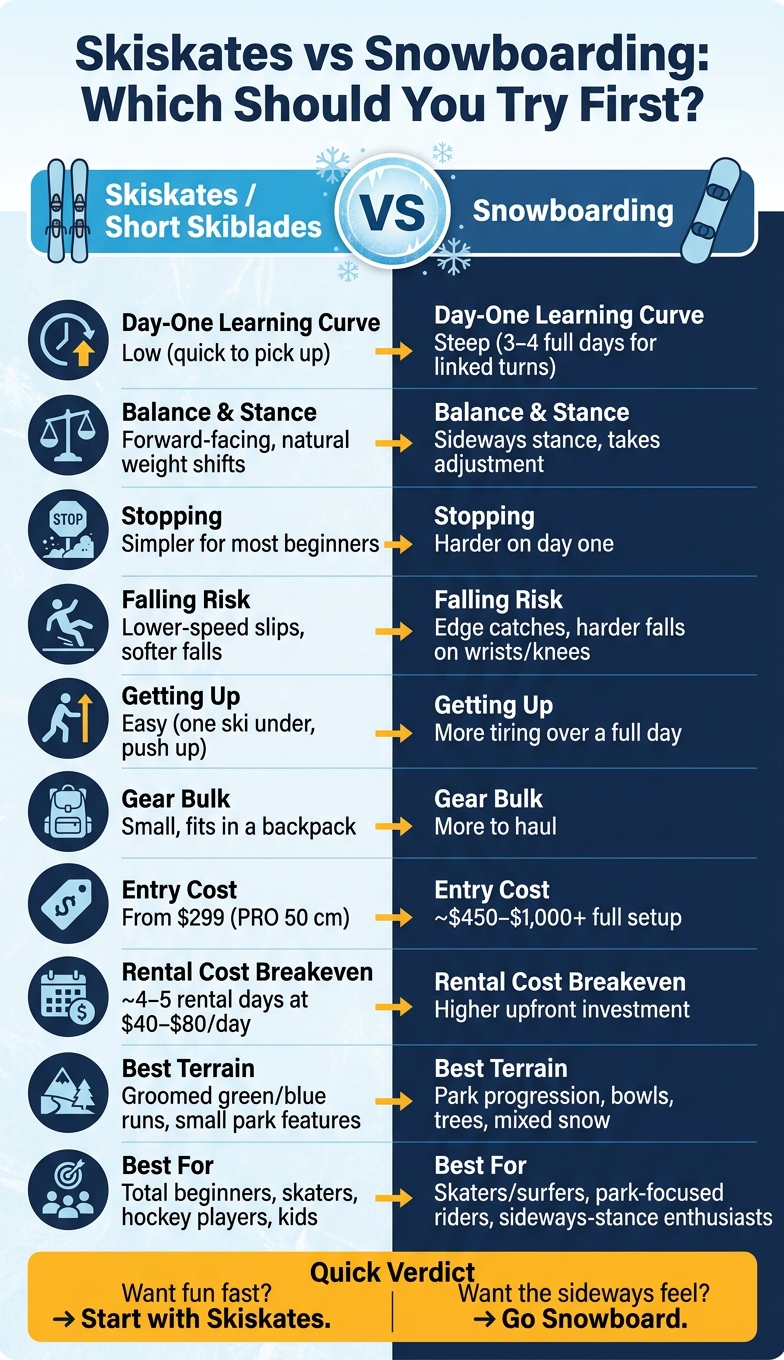
Quick Comparison
| Category | Skiskates / Short Skiblades | Snowboard |
|---|---|---|
| Day-one learning | Easier | Harder |
| Stance | Forward-facing | Sideways |
| Stopping | Simpler for most beginners | Takes more practice |
| Falls | Often lower-speed slips | More hard edge-catch falls |
| Getting up | Easier | More tiring |
| Gear bulk | Small, easy to carry | More to haul |
| Cost to start | From about $299 | About $450–$1,000+ |
| Best terrain fit | Groomed green/blue runs, small park laps | Park path, bowls, trees, mixed snow |
So, my take is simple: pick skiskates first if your goal is to have fun fast. Pick a snowboard first if you already know you want that sideways riding style and don’t mind paying your dues in the snow a bit. Butt-checks included :)
Learning curve: which is easier on day one?
Balance, turning, and stopping: skiskates vs snowboard
On Snowfeet* skiskates or skiblades, you face downhill and move each foot on its own. For most people, that feels more natural right away. Your body already gets the idea of shifting weight from one foot to the other, so balance tends to click faster.
A snowboard is a different beast. Both feet are fixed to one board, and you ride in a sideways stance. That setup takes more getting used to. Edge catches happen a lot, and most beginners need extra time to manage speed and connect turns without feeling like the board has a mind of its own. Instructors often note that smooth, controlled linked turns usually take 3–4 full days for most snowboard beginners, while basic short-ski control often shows up on day one or two. You feel that gap right away when you try to stop, turn, and make it down your first run with some confidence.
Falling, getting up, and first-day fatigue
Short skis often lead to lower-speed slips. Snowboard falls can hit harder, mostly because edge catches can send beginners onto their wrists, knees, or tailbones. That’s one big reason wrist guards are so common for new snowboarders. Snowfeet* short skis, with their lower-speed slips and the fact that each leg can recover on its own, tend to lead to softer falls. If someone feels nervous on day one, that can make a big difference.
Getting back up is easier too. On short skis, you can bring one ski under you and push up, kind of like standing from a kneeling position. On a snowboard, riders often need to move the board so it points downhill, then push up from sitting or kneeling. That gets old fast over a full day at the resort.
Best first choice by experience background
Your sports background can tip the scales a lot. Some people click with one setup almost at once, while the other feels awkward for a bit.
| Background | Better first pick | Why |
|---|---|---|
| No ski or board background | Snowfeet* skiskates or skiblades | Forward-facing stance rewards natural weight shifts from the start |
| Inline skating or hockey | Snowfeet* skiskates or skiblades | Weight shifts, edges, and stride rhythm translate directly |
| Skateboarding or surfing | Snowboard | Sideways stance and board feel match existing muscle memory |
| Kids and family riders | Snowfeet* skiskates or skiblades | Lighter, gentler falls, easier to manage in short sessions |
That easier first day also changes the rest of the trip a bit. Less struggle with balance and getting up can mean less gear stress, less effort, and a smoother resort day overall.
sbb-itb-17ade95
Gear, convenience, and cost on a typical U.S. resort day
What gear you need for each option
Snowboarding asks for more gear before you even touch the snow. A beginner setup usually includes a board, bindings, snowboard boots, and basic protective gear. A full first-time kit can easily hit $1,000. For a first day, fewer pieces usually means less hassle.
Snowfeet keeps that list much shorter. The Skiskates 44 cm and Skiblades 65 cm use adjustable bindings and work with ski or snowboard boots. The PRO 50 cm also works with regular winter boots, so a lot of casual riders can use boots they already own. That’s a nice little win. The adjustable bindings also fit a wide range of foot sizes, which makes sharing a lot easier.
Transport, storage, and getting around the mountain
A snowboard can feel like a lot to drag from the parking lot to the base area. Snowfeet gear in the 44–65 cm range is much easier to deal with. You can carry it in one hand or stash it in a backpack.
The PRO 50 cm fits in a backpack, which makes resort travel simpler. You can walk to the shuttle in your regular boots, then pull the skis out once you get to the snow. At home, they fit in a closet or under a bed. If you're flying, the shorter models will often fit in a checked suitcase.
That kind of convenience also shows up in the cost.
Price and value for casual riders
| Gear | Approx. Price | Boot Requirement |
|---|---|---|
| Snowfeet PRO 50 cm | From $299 | Regular winter boots or snowboard boots |
| Snowfeet Skiskates 44 cm | From $460 | Ski or snowboard boots |
| Snowfeet Skiblades 65 cm | From $590 | Ski or snowboard boots |
| Snowboard setup (board + bindings + boots) | About $450–$1,000+ | Dedicated snowboard boots required |
At U.S. resorts, rentals usually cost about $40–$80 per day. At major Colorado resorts like Beaver Creek, prices start around $68 per day.
For occasional riders, the PRO 50 cm can pay for itself in about 4–5 rental days. The 44 cm and 65 cm take longer to make up the cost. And when you own your gear, you skip rental lines and avoid those beat-up boots that never seem to fit right.
Gear and price matter. But terrain fit is what decides if something feels fun or boxed in. Next, it helps to look at where each option makes sense on the mountain.
Terrain and fun: where each option makes the most sense
Where Snowfeet* skiskates and skiblades work best
Snowfeet gear shines on groomed green and blue runs, plus small park features and small side jumps. If you want easy, playful laps, Skiskates 44 cm and PRO 50 cm are the quickest to turn and the most fun for that loose, casual feel.
If you want a bit more support underfoot, Skiblades 65 cm give you more stability for carving and small jumps. They still feel playful, but with a steadier ride.
That said, keep them on groomers. On flat sections, they tend to lose speed. In rough snow or powder, they can feel less steady. Think of them like a go-kart on smooth pavement - super fun there, not the best tool once the surface gets messy.
Where snowboarding may be the better first pick
Snowboarding makes more sense if your main goal is snowboard-specific progression. If you’re drawn to park progression - learning spins, rail slides, and moving from beginner features to advanced ones - a snowboard fits that path better.
The same goes for riders who picture themselves in tree runs, bowls, or other ungroomed terrain. Once the basics click, a snowboard often feels better in mixed snow, bowls, and tree runs.
There’s also the social side. If your friends ride snowboards, starting on a snowboard may feel like the more natural move. Sometimes that matters more than people admit. Riding with your crew is half the fun :)
For a quick side-by-side view, use the table below.
Comparison table: beginner experience, convenience, and terrain fit
| Category | Snowfeet* Skiskates 44 cm / PRO 50 cm | Snowfeet* Skiblades 65 cm | Snowboarding |
|---|---|---|---|
| First-day learning curve | Low - quick to pick up | Low to moderate | Steep - takes more practice |
| Stability | Moderate | Higher | Low at first, improves with practice |
| Stopping | Easier to learn | Easy, with more support | Harder on day one |
| Turning | Quick, short-radius turns | Responsive, more stable | Takes more practice to link turns |
| Falling risk | Lower | Lower | Higher in the early learning phase |
| Groomed green and blue runs | Excellent | Excellent | Good once you get past day one |
| Small terrain parks | Good for side hits and small features | Better for small jumps and tricks | Best for progression and tricks |
| Deep powder and freeride | Not recommended | Limited | Strong suit |
Final recommendation: which should you try first?
After looking at the learning curve, gear, and terrain, the clearest first pick for most casual riders is Snowfeet*. Put simply: it’s easier to learn, and you can get to the fun part faster.
If you want the easiest and most playful starting point, go with Skiskates 44 cm. Want a bit more stability? Pick PRO 50 cm. If you want the most support in a short format, Skiblades 65 cm make the most sense.
Snowboarding still makes sense first if you want the sideways stance and that snowboard feel, plan to take lessons, and are fine with a steeper learning curve on day one. It’s also the better fit if your main goal is park progression.
Use this quick guide to match your background with the best first choice.
Recommendation by rider profile
| Rider type | Best first pick | Why |
|---|---|---|
| Total beginner | Snowfeet* Skiskates 44 cm or PRO 50 cm | Fastest way to feel comfortable |
| Skater or hockey player | Snowfeet* Skiskates 44 cm or PRO 50 cm | Edge control and lateral balance carry over well |
| Existing skier | Snowfeet* Skiblades 65 cm | More familiar feel on snow |
| Kids and family riders | Snowfeet* Skiskates 44 cm or PRO 50 cm | Lighter, softer falls, and easy to handle |
| Snowboarder wanting a portable second option | Snowfeet* Skiblades 65 cm | Different feel, easier to carry |
| Rider set on snowboarding | Snowboarding | Style preference - go with what you want |
So, the first decision is pretty simple: choose the tool that matches your goal, not the one that just looks harder to outgrow.
FAQs
Do I need lessons to start on skiskates or a snowboard?
Usually, no - Snowfeet* skiskates or skiblades are easy to pick up, and a lot of beginners start feeling good in 15 to 60 minutes.
Why? The movement feels a lot like ice skating or rollerblading. So for many people, they’re simpler to learn on your own than skis or snowboards.
Snowboarding is a different beast. It often takes 4 to 8 hours before most beginners start to feel comfortable. The sideways stance can feel awkward at first, and balance takes more work.
With Snowfeet*, you can often teach yourself by starting with the basics on flat, packed snow:
- Practice your balance
- Work on stopping
- Get used to shifting your weight
That first session tends to feel a lot less intimidating, which is a big win :)
Can I use skiskates on every resort run?
Yes - Snowfeet skiskates work on most resort runs. Most U.S. ski resorts allow them because they have the same key safety features as standard skis, including metal edges and secure bindings.
That means they usually fit right in on groomed trails, in snow parks, and on icy patches too. For day-to-day resort riding, they do the job well without much fuss.
They’re usually the best fit for green and blue runs. Once you get into deeper snow or rougher conditions, longer Snowfeet Skiblades or Short Skis can feel more stable and easier to control.
One smart move before you go: check your resort’s equipment policy first. It takes two minutes and can save you a headache at the lift :)
Which Snowfeet* model is best for my first day?
For your first day, the 65 cm Snowfeet Skiblades* are the best pick. They hit that sweet spot for beginners: more stable than the 44 cm Skiskates, but way easier to control and far less intimidating than long skis.
They’re made to help you learn the basics without fighting your gear. One big plus? They can help you avoid common first-day mistakes, like crossing your tips. And because they work with snowboard boots or winter boots, you can skip stiff ski boots and just focus on having fun out there.











댓글 남기기
이 사이트는 hCaptcha에 의해 보호되며, hCaptcha의 개인 정보 보호 정책 과 서비스 약관 이 적용됩니다.