



















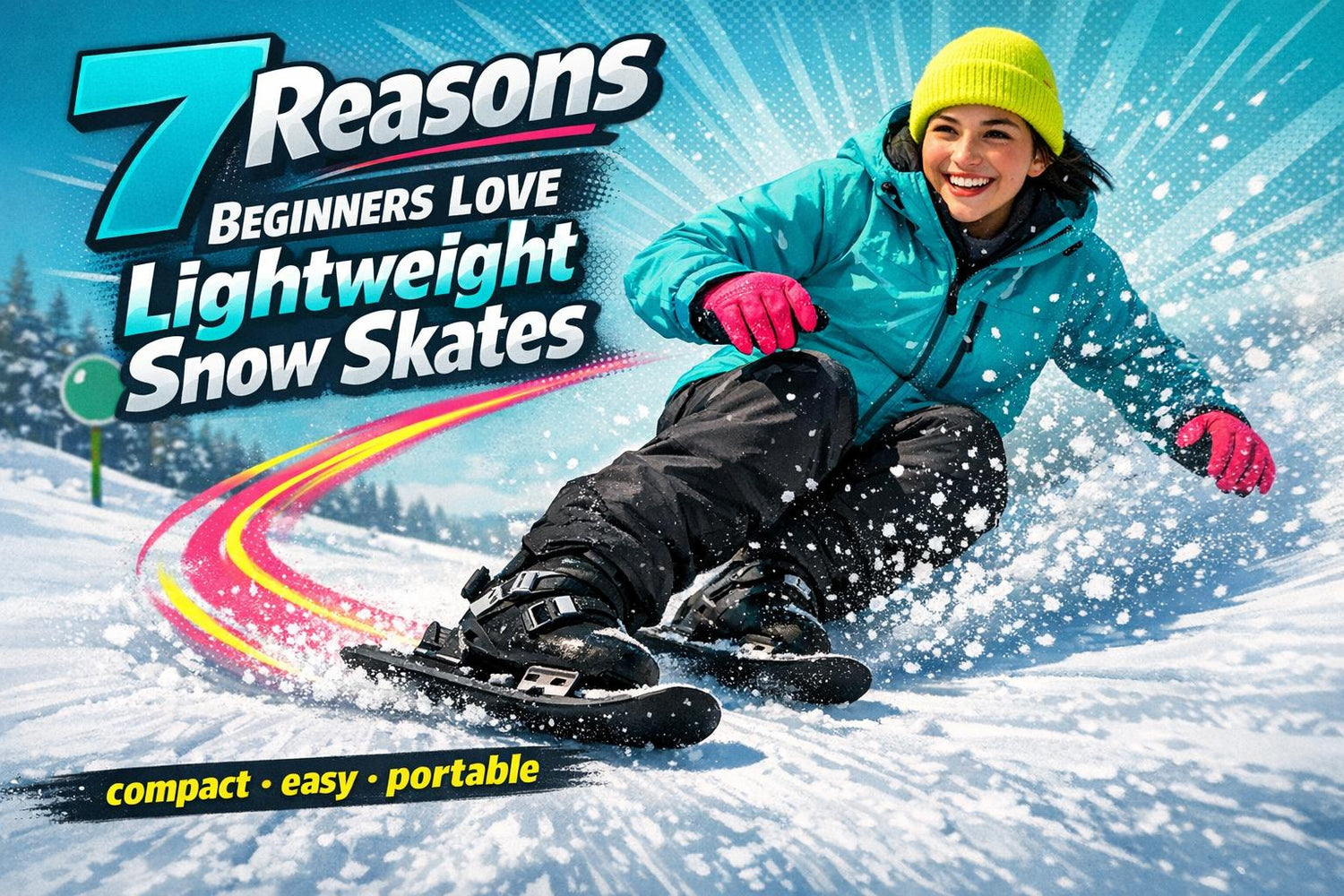
Lightweight snow skates are changing how beginners enjoy winter sports. These compact, easy-to-use skates combine the best of skiing and ice skating without the hassle of bulky gear. They’re small enough to fit in a backpack, work with regular winter boots, and are beginner-friendly - most people can start gliding in just 5 minutes. Here’s why they’re a favorite:
- Quick to Learn: Shorter, lighter design makes stopping and turning intuitive, even for first-timers.
- Easier to Control: Short length allows tighter turns and better balance, reducing falls.
- Less Fatigue: Lightweight design means less strain on your legs, keeping you on the slopes longer.
- Portable: Fits in a backpack - no roof racks or ski bags needed.
- Compatible with Everyday Boots: Works with winter, snowboard, or ski boots, saving you money and hassle.
- Versatile: Perfect for groomed runs, sledding hills, or casual snowy outings.
- Fun and Relaxed: No intimidating gear or steep learning curve - just pure enjoyment.
If you’re looking for a simple, low-commitment way to join your friends on the slopes, lightweight snow skates might be your answer. They’re affordable, easy to carry, and, most importantly, fun to use.
Snowfeet* - Skates For Snow - Mini Skis | Next Big Winter Sport | Official
What Lightweight Snow Skates Are and How They Differ
Lightweight Snow Skates vs Traditional Skis vs Snowboards: A Beginner's Guide
Lightweight snow skates are strap-on devices for winter boots that allow you to glide, carve, and turn on snow. They’re like a mix of ice skates and short skis - compact, nimble, and easy to control. This unique setup is part of what makes them so appealing, especially for beginners.
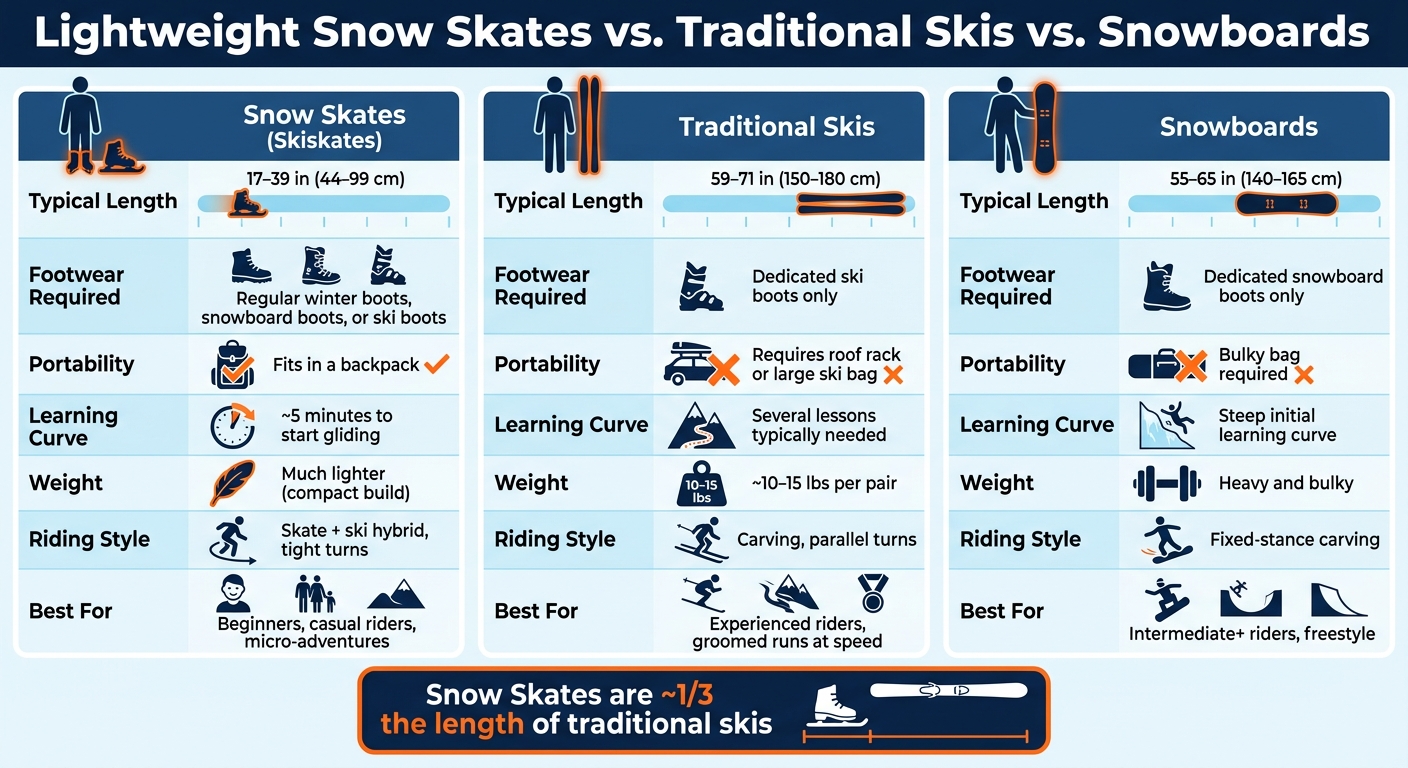
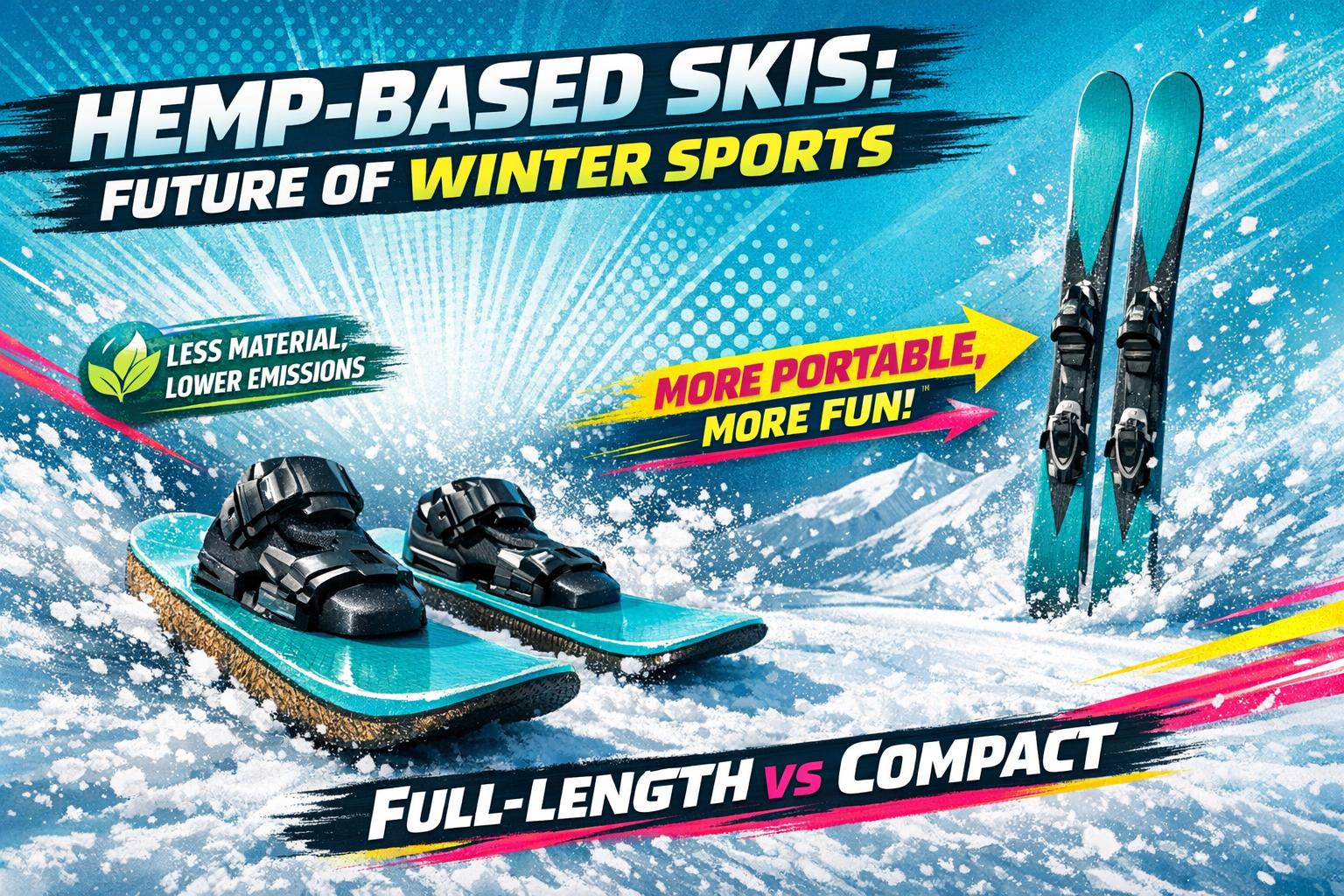
The size difference is striking. Traditional adult skis are typically 59 to 71 inches (150–180 cm) long, and snowboards aren’t much shorter. Snowfeet* Skiskates, however, are just 17 inches (44 cm) long, about one-third the length of regular skis. Their longer Skiblades max out at 39 inches (99 cm), still less than half the length of standard skis. This shorter size means less weight, tighter turns, and a lot less hassle when carrying gear.
| Feature | Snowfeet* Skiskates | Traditional Skis | Snowboards |
|---|---|---|---|
| Typical length | ~17–39 in (44–99 cm) | ~59–71 in (150–180 cm) | ~55–65 in (140–165 cm) |
| Footwear needed | Winter boots, snowboard or ski boots | Dedicated ski boots | Dedicated snowboard boots |
| Portability | Fits in a backpack | Requires roof rack or large ski bag | Bulky bag required |
| Riding style | Skate + ski hybrid | Carving, parallel turns | Fixed-stance carving |
This compact design isn’t just about convenience. It also enables a hybrid movement style that blends the carving capability of skis, the quick edge transitions of skating, and the playful, laid-back vibe of snowboarding. As one customer, Brad Tolin, put it:
"These ski blades are a blast to use. Super easy to control, quick to turn, and way more forgiving than traditional skis."
Snowfeet* has built its reputation around this concept, becoming a leader in short-ski and skiskate innovation. Their products range from the ultra-compact 44 cm Skiskates (starting at $575) to the 99 cm Skiblades (from $675), all designed to work with boots you probably already own.
They also challenge the long-standing belief that longer skis are automatically better. Their take? Shorter skis are easier to handle, less intimidating, and simply more fun for the average rider. For beginners, this shift in perspective is huge. It positions smaller, lighter gear as a smart choice rather than a compromise. This design philosophy is reshaping the way people experience winter sports, making them more approachable and enjoyable for all.
1. Easier to Learn Basic Skills
For most beginners, the toughest part of skiing isn’t tackling the slopes - it’s staying in control during those first few runs. Traditional skis, which are 59 to 71 inches (150–180 cm) long, can feel like trying to steer a couple of oversized planks before you’ve even figured out how to stop. That’s where lightweight snow skates come in, making those early maneuvers much easier.
Thanks to their short and light design, basic movements like gliding, stopping, and turning feel intuitive right away. With less ski underfoot, even a small shift in weight is enough to make quick adjustments. This instant feedback is just what beginners need to gain confidence quickly.
Take Snowfeet* skates, for example. At just 17 inches (44 cm) long, they’re compact enough to make learning feel natural. Instead of struggling to control long, heavy skis, you’ll spend more time actually moving and less time feeling stuck. That shorter length also means the learning curve is way less intimidating.
If you’ve ever rollerbladed or ice skated, you’re already halfway there. The weight-shifting and edge-control techniques you’ve picked up from skating transfer almost seamlessly to snow skates. As Zbyněk, the founder of Snowfeet*, explains:
"I love how easy they are to ski and skate and how many different kinds of tricks I can perform without much effort and almost no restrictions."
Once beginners master the basics - like staying steady, making smooth turns, and managing their speed - they’re ready to dive into more advanced moves. Snow skates make those early steps feel effortless, setting the stage for even more fun as your skills grow. Next, we’ll look at how these skates keep their maneuverability as you improve.
2. More Maneuverable and Forgiving
Once you've got the basics down, lightweight snow skates take the experience to a new level by offering much better control. One big difference beginners notice is the smaller turning radius. With lightweight snow skates, you can pivot with just a shift of your ankles or hips - no need for the full-body effort that longer skis demand. Compare that to traditional alpine skis, which are 59 to 71 inches (150–180 cm) long. Sure, that length is great for speed and stability on groomed runs, but it locks you into wider, sweeping arcs that take more effort to adjust. On easy green runs, the shorter length of snow skates allows for quick, tight turns that naturally control your speed - no need for those big, dramatic moves.
And then there’s the forgiving nature of these shorter skates. On long skis, leaning too far back or twisting awkwardly can quickly throw you off balance, often leading to a fall. But with short skates, the leverage is much less of an issue. A small shift in weight is usually enough to regain control before things go sideways. As Brad Tolin, a Snowfeet* user, explains:
"Super easy to control, quick to turn, and way more forgiving than traditional skis. They're great for carving and navigating crowded slopes without feeling bulky."
This forgiving design is a game-changer in crowded resort conditions. At busy beginner zones in U.S. ski resorts, space can get tight fast. With something like Snowfeet* Skiskates, which are just 17 inches (44 cm) long, you can pivot almost on the spot, step sideways in lift lines, and make full turns in spaces where long skis would be a hassle. This compact design means less gear bumping into others and more focus on learning, making the experience less stressful for beginners.
3. Less Physical Effort and Fatigue
Lightweight snow skates don’t just make turns easier - they help you stay on the slopes longer by cutting down on physical fatigue. Traditional skis, with their bulk and weight, can leave you with burning thighs and a sore back. Every turn demands more from your legs and hips, working your quads, glutes, and calves harder just to stay in control. For many skiers, this muscle fatigue is what ends their day early.
Snow skates, on the other hand, lighten the load. Their compact build means you’re moving less weight with each turn, allowing for smaller, more efficient movements. This keeps your legs fresher and transitions smoother, both on the snow and off it.
And speaking of off the slopes, traditional skis and stiff boots can be exhausting to lug around. Snow skates, with their shorter length and lighter weight, make walking or even just standing around far less tiring. It’s a game-changer for anyone who wants to conserve energy throughout the day.
This is especially helpful for older adults, those returning to the sport, or anyone who isn’t in top physical shape. Sunshine Straiges, a verified Snowfeet* user, summed it up perfectly:
"I had no muscle soreness after using these because I can change my leg position, unlike the snowboard which is set."
That ability to adjust your stance gives your muscles a chance to recover between runs. Less fatigue also means better balance and sharper focus, which can speed up your learning curve and help you avoid unnecessary falls. It’s a win-win for your body and your confidence on the slopes.
4. Easy to Carry and Store
Traditional skis are big, heavy, and, honestly, kind of a pain to deal with. Prepping for a day on the slopes often means wrestling with gear that’s 5–6 feet long and weighs up to 15 pounds per pair. You’ll need roof racks, ski bags, and a decent amount of muscle just to get them from your garage to the mountain.
Snow skates, on the other hand, are a total game-changer. Take Snowfeet* Skiskates as an example - they’re just 44 cm long, which is less than a third of the length of traditional skis. They’re so compact you can toss them into a regular backpack. No bulky ski bags. No roof racks. Just grab them and go. This design makes traveling with them a breeze, which is perfect for anyone who values a hassle-free, fun winter adventure.
-
"A lot easier to haul around the hills & on vacation than traditional skis!" - heyjerz, Verified Snowfeet* Customer
-
"Also a big plus - they're lightweight and much easier to carry around than full-size skis." - Brad Tolin, Verified Snowfeet* Customer
The convenience doesn’t stop when you’re off the slopes. Storing snow skates is just as easy. Forget about needing a garage rack or some dedicated storage space. These fit neatly on a closet shelf, under your bed, or wherever you keep your winter gear. If you live in an apartment or a smaller home, this can make a big difference. And because they’re so easy to grab, those last-minute trips to your local hill feel doable instead of like a logistical headache.
| Feature | Traditional Skis | Snowfeet* Skiskates (44 cm) |
|---|---|---|
| Length | ~150–180 cm (5–6 ft) | 44 cm (17 in) |
| Weight | ~10–15 lbs per pair | Much lighter |
| Storage | Garage racks, long bags | Closet shelf, under a bed |
| Travel | Roof rack or large bags | Fits in a backpack |
| Transport | Heavy and bulky | Light and compact |
sbb-itb-17ade95
5. Works with Everyday Footwear and Multiple Boot Types
Snowfeet* Skiskates stand out not just for their lightweight and compact design but also for their incredible compatibility with various boot types. This flexibility makes them an ideal choice for beginners and seasoned riders alike. Unlike traditional skis that demand stiff, specialized boots, Snowfeet* Skiskates let you use boots you already own, making the experience more accessible and convenient.
The Snowfeet* Skiskates work with a range of footwear, including regular winter boots, snowboard boots, and ski boots, depending on the model. Thanks to their tool-free, adjustable bindings, they easily fit US sizes 4.5 to 14.5. This versatility means one pair can be shared among family or friends, adding to their appeal for group adventures or casual outings.
The type of boot you choose can shape your experience:
- Regular winter boots: Perfect for first-timers or casual use, offering comfort and familiarity.
- Snowboard boots: Great for tricks or relaxed riding, with all-day comfort and easy mobility.
- Ski boots: Provide extra precision and control for faster carving and more technical moves.
Zbyněk, the founder of Snowfeet*, highlights the benefit of snowboard boots:
"Snowboard bindings give you more flexibility while performing all kinds of tricks, they're super comfortable and you can walk with them anywhere without a problem, which makes the ski trip much more pleasant experience." - Zbyněk, Founder, Snowfeet*
By using boots you're already comfortable with, you eliminate the hassle of breaking in stiff, unfamiliar footwear. This lets you focus entirely on the snow and mastering your skills, which can make learning a new winter sport much smoother.
| Boot Type | Best For | Key Benefit |
|---|---|---|
| Regular Winter Boots | Casual outings, first-timers | No extra gear needed; maximum comfort |
| Snowboard Boots | Tricks, relaxed riding | Flexible and easy to walk in all day |
| Ski Boots | Faster carving, more control | Maximum stability and precision |
6. Usable on Different Terrains and for Casual Outings
Snowfeet* Skiskates aren't just convenient to carry - they open up snow-filled adventures beyond the usual ski resort setting.
Thanks to their compact size, these skiskates fit easily into a standard backpack. That means you can toss them in your car and head out to any snowy spot without needing a bulky roof rack. This flexibility is one of the reasons beginners are gravitating toward Snowfeet* instead of traditional skis or snowboards.
Whether it's a neighborhood hill, a snow-dusted park, or the slope behind your cabin, these skiskates let you practice almost anywhere. Unlike full-sized skis, you don’t need a chairlift or a resort to get some quality riding time.
At ski resorts, Snowfeet* Skiskates are perfect for groomed green and easy blue runs, terrain parks, and the gentle slopes near the base area - places where beginners usually spend their time. Their small size also makes them less likely to snag on uneven or tracked-out snow near the edges of runs.
"Although not meant for deep powder, it's wonderful on groomed trails, which I try to use exclusively." - Sunshine Straiges, Snowfeet* Customer
Their sweet spot is packed snow and groomed trails. Icy patches, deep powder, and steep terrain can be trickier because their short length reduces edge contact. But for beginners, this isn’t a drawback - it aligns perfectly with the kind of terrain most newcomers stick to.
7. More Fun and Less Intimidating for New Riders
Lightweight snow skates, like Snowfeet* Skiskates, bring a sense of fun and ease that’s perfect for beginners.
For starters, their playful design instantly makes them feel less daunting. At just 17 inches long, these skates ditch the bulk of traditional ski gear - no long skis, no stiff boots, and no confusing bindings. This compact, approachable look helps new riders feel more at ease before they even hit the slopes.
The movement itself feels natural, too. If you’ve ever tried ice skating or inline skating, you already have the balance and coordination needed. This familiarity shortens the learning curve, making it less about mastering something entirely new and more about building on skills you already have. Beginners often find themselves linking turns and stops quickly, boosting their confidence right away. That “I can do this” moment happens fast.
"In my opinion, Skiskates is the best product for slopes we developed so far. I love how easy they are to ski and skate and how many different kinds of tricks I can perform without much effort and almost no restrictions." - Zbyněk, Founder, Snowfeet*
Traditional skis can feel overwhelming with their size, stiff boots, and the hustle of crowded lift lines. Snowfeet* flips the script, proving that you don’t need long skis for stability or safety. Instead, skiskating offers a relaxed, welcoming vibe that’s perfect for new riders.
Whether you’re gliding down a resort’s beginner slope or playing on a snowy hill in your neighborhood, Snowfeet* Skiskates turn the experience into pure fun. Quick turns, small jumps, and smooth weaving make every run feel like an adventure. It’s a low-pressure way to enjoy winter sports - and that’s what keeps people coming back.
How Lightweight Snow Skates Fit Into the Future of Winter Sports
Winter sports participation in the U.S. has hit a bit of a standstill, with around 10–12 million skiers and snowboarders hitting the slopes before the pandemic. To breathe new life into the industry and attract fresh faces, innovative ideas are essential - and lightweight snow skates are quickly proving to be a standout solution. Among the companies leading this charge is Snowfeet*, with their Skiskates redefining what winter fun can look like.
Snowfeet* is carving out a new niche with skiskating, aiming to establish it as its own winter sport, complete with standardized events and a dedicated community. They even have their sights set on Olympic recognition. This fresh approach aligns with a growing desire for winter sports that are more approachable and, well, just plain fun.
One of skiskating’s biggest appeals is how perfectly it fits into the concept of micro-adventures. Think about it: a quick session on a local hill after work, a spur-of-the-moment stop during a road trip, or a short, playful run before lunch at the resort. Snowfeet* Skiskates are small, portable, and work seamlessly with snowboard and ski boots, removing the logistical headaches that often discourage casual riders. This simplicity doesn’t just appeal to individuals - it opens up exciting opportunities for resorts and rental shops too.
For resorts and rental providers, skiskating could be a game-changer. Imagine “try skiskating” zones, short introductory lessons, or adding skiskates to rental inventories. Even smaller, regional hills could create a buzz with beginner-friendly circuits and skiskating events, attracting visitors who might otherwise feel intimidated by traditional skiing or snowboarding.
Snowfeet* is also challenging the old-school belief that longer skis equal better performance. Their shorter, more agile gear proves that smaller can mean more freedom and fun, especially for recreational riders. As the winter sports industry searches for ways to keep first-timers coming back, lighter and more playful equipment isn’t just a cool option - it’s a smart way to make the slopes more inviting for everyone.
Conclusion
Kickstart your winter sports journey without the hassle of lugging around heavy skis or managing a bulky snowboard. Lightweight snow skates are simpler to pick up, easier on your legs, and forgiving when you slip up - making them perfect for beginners who want to enjoy the slopes without the stress.
With options like Snowfeet* Skiskates and mini ski skates starting at around $250, you can jump into the action with just minutes of practice.
"Super easy to control, quick to turn, and way more forgiving than traditional skis." - Brad Tolin, Verified User
This fresh take on winter sports blends ease and performance seamlessly. Not sure if they’re for you? Try before you buy - find a demo day, check out a rental shop, or borrow a pair from a friend. A quick afternoon on the snow might just convince you that lightweight snow skates beat traditional gear.
Smaller gear means more freedom. For anyone looking to have fun, build confidence, and stay comfy on the slopes, lightweight snow skates are the way to go.
FAQs
Do I need lift tickets to use snow skates?
Whether you need a lift ticket or not depends on where you're planning to use your Snowfeet gear. At most commercial ski resorts, you'll typically need a lift ticket. But here's the cool part about Snowfeet: they're lightweight and super versatile. You can take them to sledding hills, hiking trails, snow parks, or even just mess around in your backyard - no lift ticket required for any of those spots!
Are snow skates safe for total beginners?
Snow skates are a great option for beginners looking for a safe and approachable way to hit the slopes. Thanks to their lightweight and shorter design, they’re easier to control and provide a lower center of gravity compared to traditional skis. This makes it simpler to balance and recover if things get a little shaky. Plus, falls tend to be gentler, which helps reduce the chances of knee or ankle injuries. Many first-timers find the skating-like motion comes naturally, often feeling confident gliding around within just a few minutes.
What terrain should beginners avoid on snow skates?
Beginners should steer clear of deep powder, icy patches, and steep black diamond runs. These types of terrain demand more grip and stability than shorter snow skates, like Snowfeet*, are designed to handle. To keep things safe and fun, stick to gentle, packed, or groomed slopes with an incline of less than 10 degrees. Snowfeet* really shine on these kinds of slopes, giving you the agility and ease you need to build confidence and control.











댓글 남기기
이 사이트는 hCaptcha에 의해 보호되며, hCaptcha의 개인 정보 보호 정책 과 서비스 약관 이 적용됩니다.