



















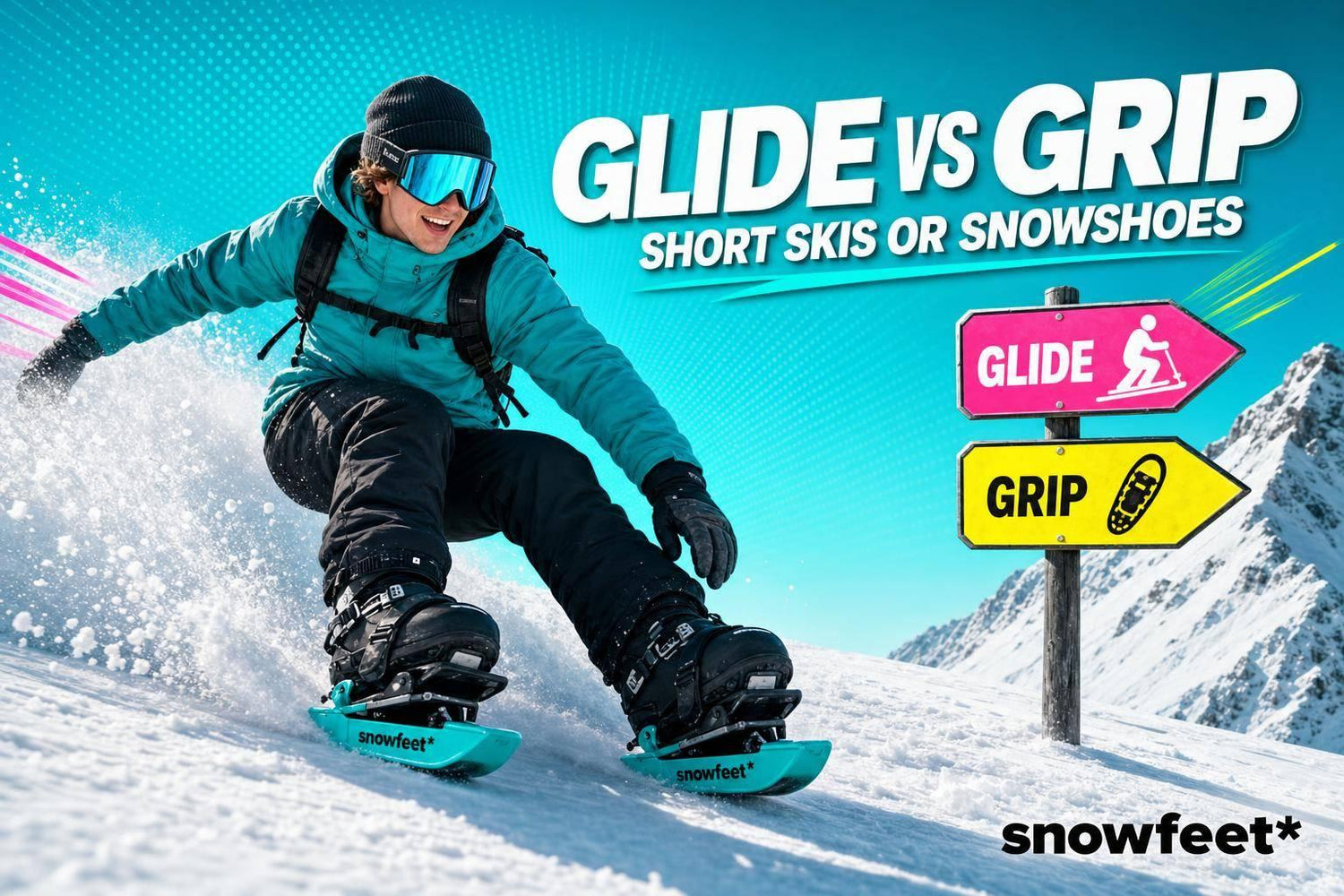
If your route is flat, rolling, or packed, I’d lean short skis. If it’s steep, tight, or brushy, I’d grab snowshoes. That’s the short answer.
Here’s the simple breakdown:
- Short skis are built for glide, longer approaches, and controlled downhill travel
- Snowshoes are built for grip, slow climbing, and tricky terrain
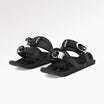
- The Snowfeet* WALKSKI sits in the middle: 100 cm long, 6.9 lb per pair, and starts at $595
- It fits US boot sizes 6–14.5 and works with regular winter boots, snowboard boots, or ski boots
- Compared with a ski touring setup around $2,200, it asks for less gear and less setup
If I wanted one clean rule, it’d be this: pick glide for open terrain, pick grip for steep terrain. That one choice shapes your speed, effort, and how much fun you’ll have when it’s time to head back down :)
Quick Comparison
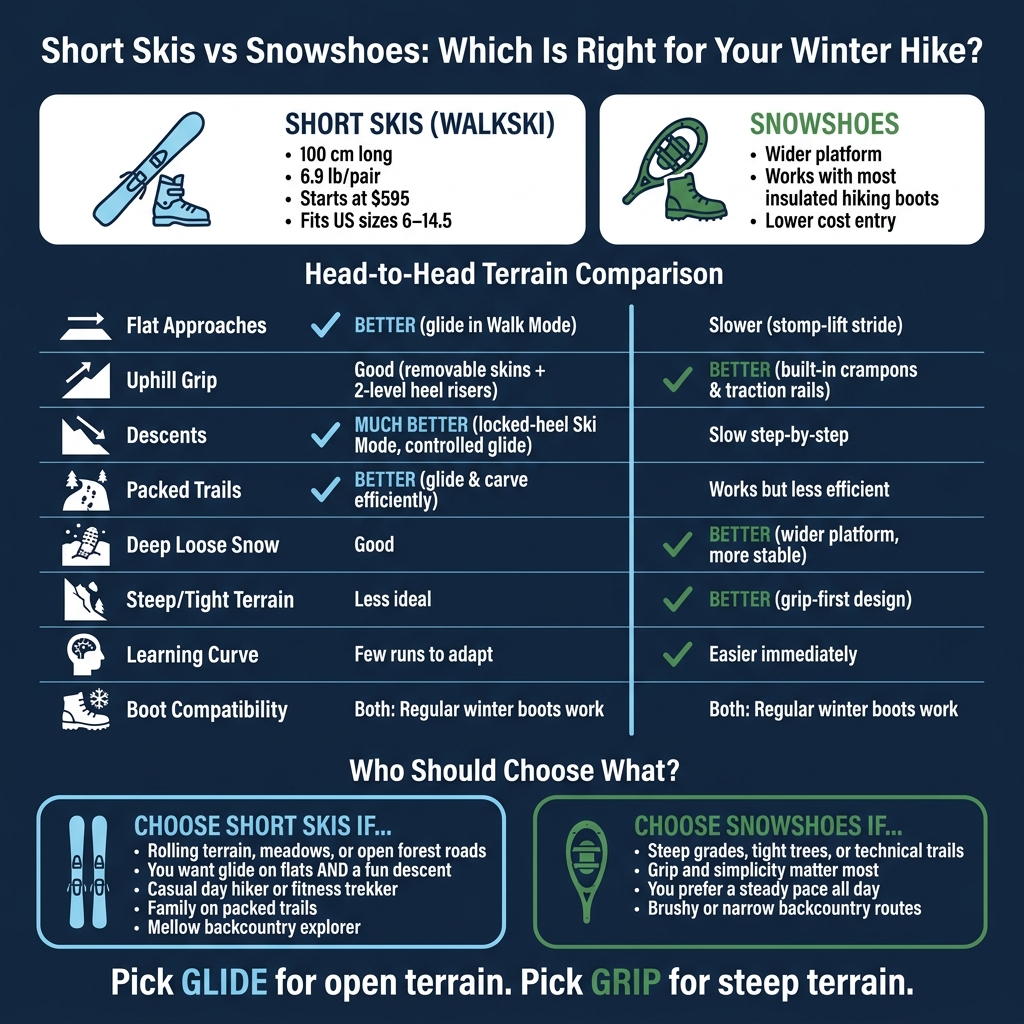
Short Skis vs Snowshoes: Which Is Right for Your Winter Hike?
| What matters most | Short skis | Snowshoes |
|---|---|---|
| Flat approaches | Better | Slower |
| Uphill grip | Good with skins | Better |
| Descents | Much better | Slow walk-down |
| Packed trails | Better | Fine, but more work |
| Deep loose snow | Good | Better |
| Learning curve | Takes a few runs | Easier at first |
| Boot setup | Regular winter boots can work | Regular winter boots work |
| Steep, tight terrain | Less ideal | Better |
So, if you’re a casual winter hiker who wants more glide without a full ski kit, short skis make a lot of sense. If you care most about steady footing on steep trails, snowshoes still do that job best.
Short Skis vs Snowshoes: Performance on Real Winter Terrain
Here’s the terrain-by-terrain comparison. The big gaps come down to traction, glide, and how much work your legs need to do.
| Condition | Snowfeet* WALKSKI (100 cm) | Snowshoes |
|---|---|---|
| Uphill traction | Removable skins + 2-level heel risers | Built-in crampons and traction rails |
| Flat approaches | Free-heel Walk Mode with smooth glide | Slow, lifting stride - no glide |
| Descents | Locked-heel Ski Mode for controlled gliding | Slower step-by-step travel |
| Deep powder (off-trail) | Better maneuverability in softer snow | More predictable in very deep, unconsolidated snow |
| Packed trails | Excellent - glide and carve efficiently | Works, but less efficiently |
| Portability | 100 cm; straps to a backpack | Backpack-compatible but often wider and bulkier |
| Boot compatibility | Winter boots, snowboard boots, or ski boots | Most insulated hiking boots |
Uphill Travel, Flat Approaches, and Overall Speed
Snowshoes climb with solid built-in traction. WALKSKI comes at uphill travel a bit differently, with removable skins and two heel risers for steeper climbs.
Where WALKSKI starts to separate itself is on flat and rolling terrain. The free-heel Walk Mode lets you stride and glide in a more natural way, instead of doing that stomp-lift-stomp routine snowshoes force on you. Over a few miles, that can save a lot of energy. And yeah, your hips and calves will probably thank you :)
Descents, Deep Snow, and Packed Trails
Switch the WALKSKI to Ski Mode - heel locked, risers stowed - and downhill travel changes a lot. Instead of picking your way down step by step, you get controlled gliding. On packed winter trails and groomed slopes, they also glide and carve well.
Snowshoes still hold the edge in very deep, unconsolidated powder off-trail. Their wider platform makes them feel more steady there. But on most packed or groomed routes, WALKSKI handles descents in a way snowshoes just don’t.
Portability, Weight, and Boot Compatibility
The WALKSKI is 100 cm long, so it’s easy to strap to a backpack. Its universal binding fits sole lengths from 9.5" to 15" (24–38 cm), which covers standard winter hiking boots, snowboard boots, and ski boots - no specialized footwear required.
That matters for casual winter hikers. Less setup. Less gear drama. More time moving.
These differences start to matter more as the route gets longer, steeper, or more technical.
Learning Curve, Effort, and Safety
Which One Is Easier to Learn
Performance is only half the call. The learning curve matters too. So does how tired you’ll feel after a long day.
Snowshoes feel natural right away. You step in and start walking. That’s the appeal.
Short skis take a few runs to get used to, but WALKSKI’s 100 cm length and locked-heel Ski Mode help keep things under control. It’s not as big a leap as many people think. A lot of first-timers say they feel fine after a few runs.
Verified buyer Lynn from Jacksonville said it best:
"I took these out on my first time downhill skiing and took a lesson - I found these so easy to turn and control."
Fitness Demands and Fatigue Over a Full Day
Snowshoeing is simple, but each step is still just a step. There’s no glide to help you along.
Over a full day, WALKSKI can cut down effort on flats and descents. Snowshoes make more sense when you want slow, steady movement and don’t mind the steady march. Kind of like hiking in boots versus rolling along on a bike path. Both work. One asks more from your legs.
The trade-off is pretty clear:
- Short skis ask more from your balance and control on the way down
- Snowshoes stay simple if you want the same steady pace all day
That’s where the choice gets practical. What kind of route are you taking, and how do you like to move?
Safety, Terrain Choice, and When Simpler Is Better
Use snowshoes on steep or tight routes. Use short skis on open, lower-angle terrain. And if you’re heading into backcountry terrain, carry avalanche gear.
Brad Tolin summed up the trade-off in a way that feels honest:
"Only trade-off is at faster descents, where longer skis still feel more stable - but for overall fun and maneuverability, these are hard to beat."
Open, lower-angle terrain leans toward short skis. Steep, narrow, or technical terrain leans toward snowshoes. That route difference often decides it.
sbb-itb-17ade95
Who Should Choose Short Skis and Who Should Choose Snowshoes
After looking at the terrain, the next step is pretty simple: which one fits the way you hike?
Choose Snowfeet* Short Skis for Winter Hikes with Lots of Glide
The Snowfeet* WALKSKI 100 cm makes more sense when your route has rolling terrain, open forest roads, meadows, or a backcountry cabin approach where glide can save time and energy. Its compact 100 cm frame and universal binding help keep things simple on moderate winter terrain.
Choose Snowshoes for Steep, Slow, and Traction-First Routes
Snowshoes are the better call on steep grades, tight trees, or any technical winter trail where grip and simplicity matter most. If secure footing matters more than speed, this is the grip-first option.
The Core Trade-Off: Glide vs Traction, Fun vs Simplicity
So, who should choose what?
This quick breakdown turns the terrain comparison into a clear buyer's guide.
| User Profile | Better Choice | Why |
|---|---|---|
| Casual day hiker | Snowfeet* WALKSKI | Adds glide on flats |
| Family on packed trails | Snowfeet* WALKSKI | Easy with regular winter boots |
| Fitness-focused trekker | Snowfeet* WALKSKI | Light, efficient over distance |
| Mellow backcountry explorer | Snowfeet* WALKSKI | Compact for narrow trails |
| Steep or technical route hiker | Snowshoes | Best traction on steep terrain |
That trade-off leads straight into the conclusion: match the tool to your route, snow, and pace.
Conclusion: Match the Tool to Your Route, Snow, and Style
After looking at the terrain side by side, the choice comes down to one thing: glide or grip.
For rolling terrain and packed trails, Snowfeet* WALKSKI 100 cm is the better pick. It weighs just 6.9 lb per pair, so you can clip it to your pack without a hassle, and it works with regular winter boots. The price helps too. Starting at $595, it costs a lot less than a typical $2,200 ski-touring setup.
Snowshoes, on the other hand, still earn their spot on steep, technical, or brushy climbs where traction matters more than speed.
For most casual winter hikers, WALKSKI brings something snowshoes simply don’t: a controlled descent after the climb.
FAQs
Are short skis harder to learn than snowshoes?
Usually, yes. Snowshoes are the most beginner-friendly option because they feel a lot like normal walking.
That said, Snowfeet short skis are much easier to learn than long, standard skis. They’re light, small, and easy to control, so most beginners can get the hang of the basics fast - often in just five minutes - without the tougher learning curve that comes with regular ski gear.
Can I use short skis with regular winter boots?
Yes. Snowfeet* short skis and touring options like the WALKSKI 100 cm use universal bindings that fit boots you may already have.
That can include regular winter boots, snowboard boots, or even hiking shoes. So you get the comfort of familiar footwear without having to buy stiff ski boots.
Which is better for deep powder?
Traditional snowshoes have been a go-to pick for deep powder for a long time. Their wide frames help you stay on top of the snow, which is great for flotation. The trade-off? They can feel slow and take more effort, especially on longer outings.
If you want a more modern option, Snowfeet* POWDER skiblades (99 cm) and 120 cm Short Skis are built to give you the flotation and stability you need in deep snow. But they do it with a feel that's more agile, easier to carry, and less tiring to use.











Hagyj egy hozzászólást
Ezt a webhelyet a hCaptcha rendszer védi, és a hCaptcha adatvédelmi szabályzata, valamint szolgáltatási feltételei vonatkoznak rá.