



















If you snowboard and want ski turns that feel less awkward, short skis are often the easiest jump. In this comparison, I’d boil it down like this: 44 cm and 65 cm short skis turn the fastest, 99 cm gives more calm underfoot, a snowboard still wins for surfy flow, and full-length 160–180+ cm skis win once speed, chop, or powder show up.
Here’s the simple version:
- Short skis (38–99 cm) feel easier to pivot than standard skis
- Snowboarders usually adjust fast because they already know edge pressure, rotation, and centered balance
- 44 cm is the most snappy
- 65 cm is the easiest crossover for most riders
- 99 cm gives more edge hold and a calmer ride
- Snowboards still feel best for smooth carving
- Standard skis still do best at higher speed and in deeper snow
A few numbers tell the story fast:
- Standard adult skis: 160–180+ cm
- Short skis in this article: 38 cm, 44 cm, 65 cm, and 99 cm
- Claimed adjustment time for some riders on Skiskates: about 5 minutes
- Light powder range for 99 cm short skis: up to about 4 in / 10 cm
- Starting prices mentioned: $460, $590, and $690
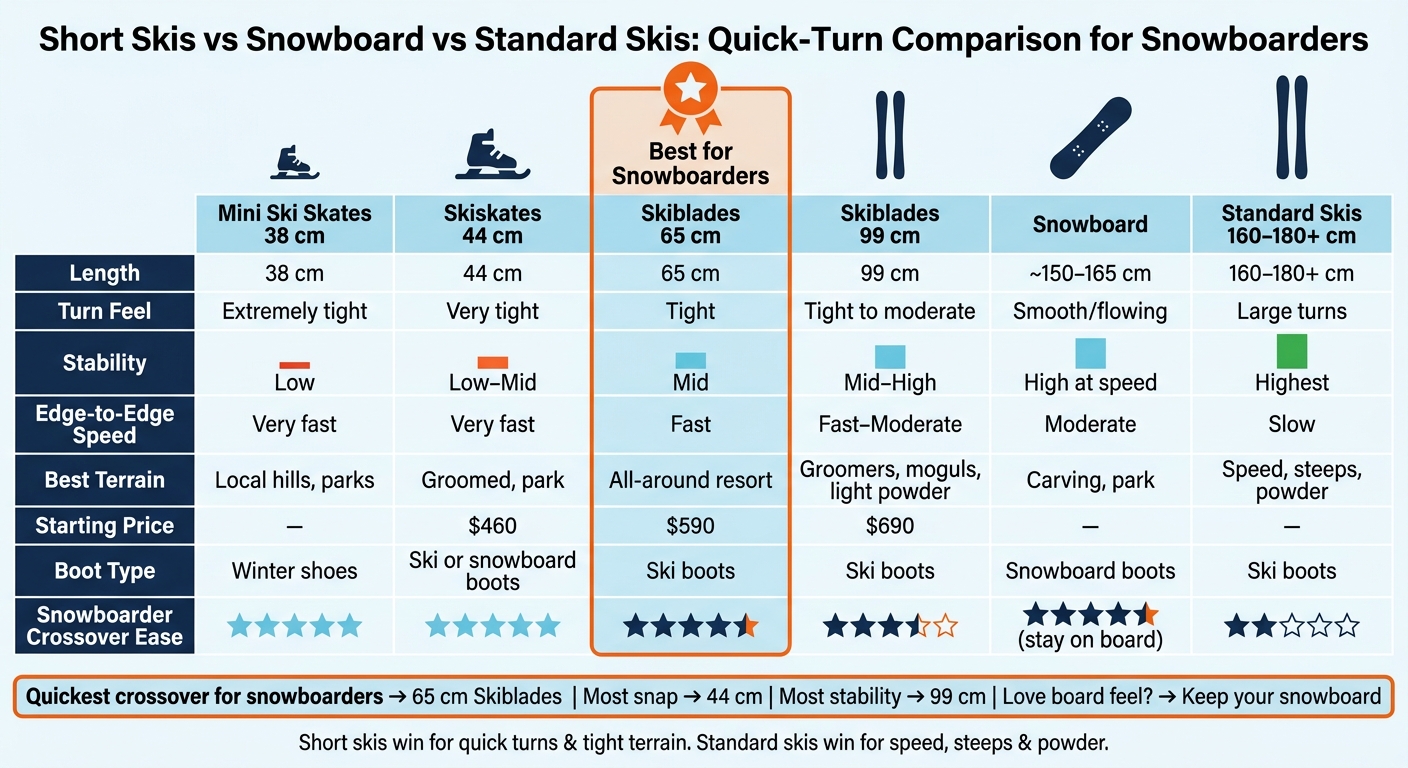
Short Skis vs Snowboard vs Standard Skis: Quick-Turn Comparison for Snowboarders
Snowboarder tries Snowfeet* | Which Snowfeet* Short Ski is the Best? | Snowblades 44, 65, 99 Review
Quick Comparison
| Gear | Turn feel | Stability | Best use |
|---|---|---|---|
| Snowfeet* Mini Ski Skates 38 cm | Tightest turns | Low | Short runs, beginner areas, park laps |
| Snowfeet* Skiskates 44 cm | Very tight, skate-like | Low to mid | Fast direction changes, playful groomers, park |
| Snowfeet* Skiblades 65 cm | Tight and easy | Mid | Best all-around pick for snowboarders |
| Snowfeet* Skiblades 99 cm | Tight to mid | Mid to high | Groomers, moguls, small hills, light powder |
| Snowboard | Smooth, flowing | High at speed | Carving, park, riders who want board feel |
| Standard skis 160–180+ cm | Large turns | Highest | Speed, steeps, mixed snow, powder |
My short take? If you want the cleanest move from snowboard to skis, I’d point you to 65 cm first. If you want the most snap, go 44 cm. If you want more calm and edge grip, go 99 cm. And if you still love that sideways stance, uh, keep your snowboard :)
That’s the whole article in plain English. The rest just explains where each option fits best.
1. Snowfeet* Skiskates 44 cm
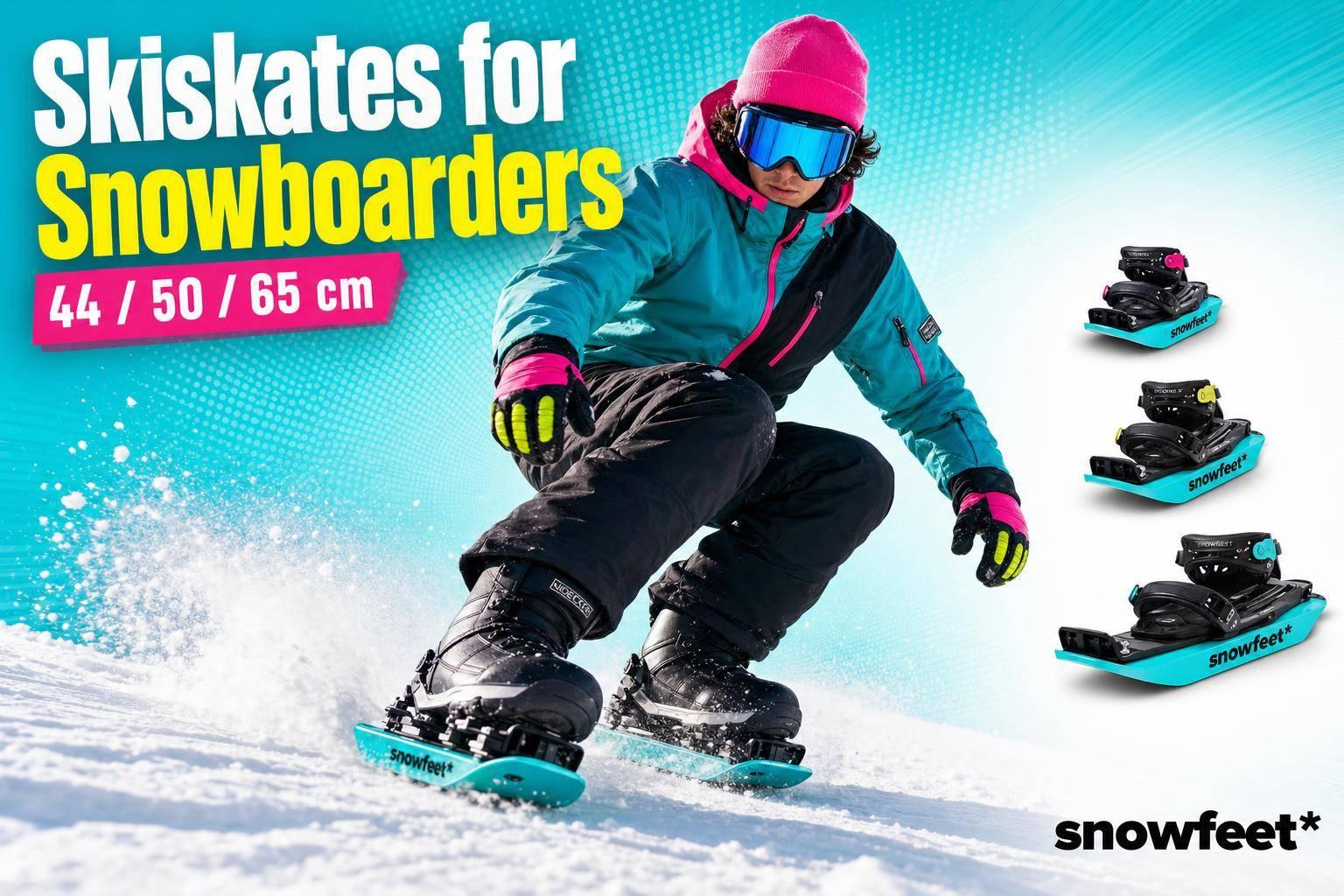
At just 44 cm (about 17 inches), Snowfeet* Skiskates are the shortest, most skate-like pick in the lineup. That short length makes them the fastest to pivot. If you come from snowboarding, that quick, snappy feel will make a lot of sense right away.
The main shift for snowboarders is simple: you face forward instead of sideways. Your feet move on their own, so it helps to keep them hip-width apart and your knees loose. Riders who use a duck stance often get the hang of it the fastest. Snowfeet* says most people adjust in about 5 minutes. That’s a big reason the boot setup matters just as much as the length.
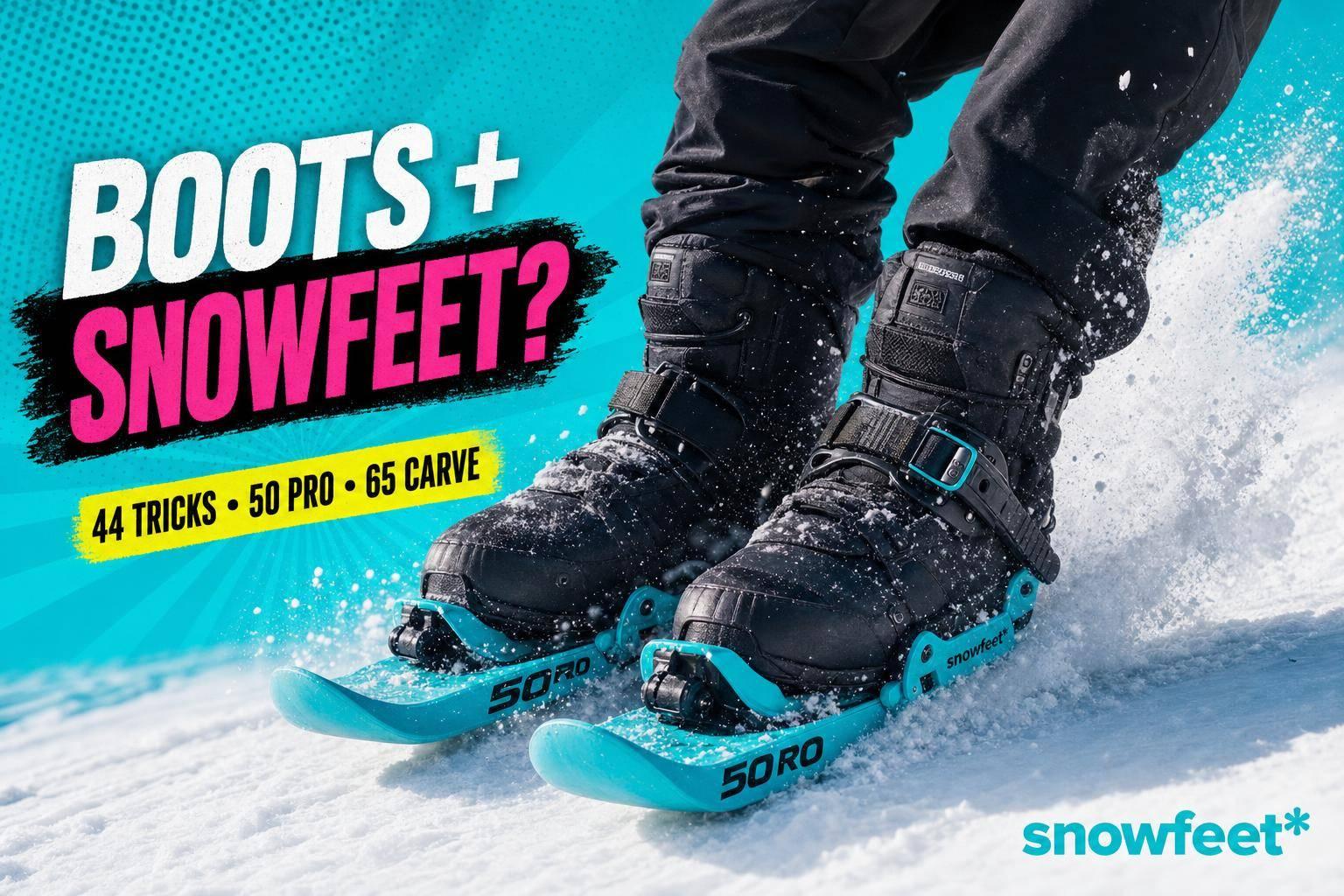
And here’s a nice bonus: Skiskates work with your current snowboard boots thanks to tool-free adjustable bindings. So you don’t need stiff ski boots. That keeps the ride feeling much closer to what snowboarders already know.
"If you play hockey, ice skate, or rollerblade, this will feel completely natural. For beginners, the short length makes learning to turn and stop significantly easier than long skis." - Snowfeet*
These are built more for fun than for charging hard. They shine on groomed runs, in terrain parks, and on short resort laps where quick turns and a skate-like ride are the whole point. On steep, icy groomers at speed or in deep powder, though, the short edge has less grip and less float. The wood-core model starts at $690.
Next up, the 65 cm Skiblades add a bit more stability without giving up that quick-turn feel.
2. Snowfeet* Skiblades 65 cm
At 65 cm (about 25.6 inches), these Skiblades sit in a sweet middle spot. They feel more stable than the 44 cm Skiskates, but they’re still short enough to stay quick and easy underfoot. The twin-tip shape and centered bindings help you pivot fast and link sharp turns on groomed runs. For snowboarders, that means ski-style control without giving up that loose, surfy vibe.
The big shift is your stance. Both feet point downhill instead of sideways on one board. That sounds odd at first, but most riders get the hang of it fast. Once it clicks, short turns start to feel natural. You get faster edge-to-edge moves, less of that “whoa, this is a lot of ski” feeling, and easier balance than on full-length skis. That’s a big reason these work so well on runs where quick, repeatable turns are the whole game.
They do best on groomed runs and in terrain parks. The short length makes tight S-turns feel easier, and the twin-tip shape gives you more freedom on park features. On hardpack, they hold well at moderate speeds. On soft groomers or slush, they stay playful instead of feeling clunky.
Compared with the 44 cm Skiskates, these bring more stability on steeper slopes or firmer snow, while still feeling way more nimble than long skis. If you want quick turns but don’t want the shortest model to feel too twitchy, this is a solid pick. Pricing starts at $590. Next up: the 99 cm Skiblades, which give up a bit of quickness for more stability.
3. Snowfeet* Skiblades 99 cm
At 99 cm (about 39 inches), these Skiblades are the most stable short-ski pick in the Snowfeet* lineup. They give you more edge hold than the 65 cm model and more stability than the 44 cm Skiskates. That mix of control and agility is a big reason snowboarders tend to like them. It also helps explain why some riders still stick with a snowboard: the feel gets close in some ways, but not all the way there.
The centered bindings and short length make edge-to-edge moves feel familiar for snowboarders. And the strong sidecut helps the skis carve without as much work. The shorter platform also makes front-to-back balance mistakes easier to save. On 170+ cm skis, that same slip can turn into a yard sale fast.
These work best on moguls, small resort hills, and light powder up to about 4 inches (10 cm), where quick, short turns matter most. Deep powder and very high speeds are still the zones where longer skis win out.
On the stability-to-playfulness scale, the 99 cm Skiblades lean more toward the stable side of the short-ski family. Even so, they still feel loose and fun next to full-length skis. Pricing starts at $690.
4. Snowboard
A snowboard turns when you tip the board onto its edge and rotate your body into the turn. The result is a smooth, flowing carve that feels natural on groomers and in the park.
That smooth feel comes with a tradeoff. When you need fast, repeated direction changes, a snowboard asks for more commitment.
Both feet are fixed to one board, so you can’t pivot each leg on its own. That makes quick switches less instant than they feel on short skis.
The sideways stance gives you strong edge control at speed. But it’s less nimble in tight trees, crowded traverses, and short moguls. Short skis point downhill, so they’re easier to steer around obstacles. You notice that gap even more when you compare a snowboard with standard all-mountain skis.
So, the feel is pretty simple:
- Snowboard: rhythm, flow, and smooth carving
- Short skis: instant pivoting and faster edge-to-edge moves
Next, standard all-mountain skis show how much extra length slows quick turns.
sbb-itb-17ade95
5. Standard All-Mountain Skis (160–180+ cm)
You feel the gap most with full-length skis. Here, both the ski length and the stance make fast pivots harder. Standard all-mountain skis are built for do-it-all resort riding. Most adult models sit in the 160 to 180+ cm range, with wider waists and moderate sidecuts.
For snowboarders, this is where things can feel a bit awkward at first. You have to switch to a forward stance, control each leg on its own, and manage more balance from tip to tail. That takes time. It can also slow your confidence with quick turns early on. On a snowboard, your body stays sideways and both feet move as one. On skis, it’s a whole different dance.
Where full-length skis shine is on groomed blue and black runs. They give you strong edge hold, a calm feel, and steady speed once you get moving. They also track well through chopped-up or mixed snow, and the extra length helps on steeper pitches when momentum starts to build. For snowboarders, though, it often takes more work to make the same quick turn that feels more natural on Snowfeet* gear.
The weak spot shows up in tight or slow terrain. Think narrow tree runs, crowded beginner areas, or small terrain parks. In those spots, the extra length is harder to pivot and tougher to swing around fast. If you want turns that feel even snappier than what 160–180+ cm skis can give, the 38 cm Mini Ski Skates take things one big step shorter.
6. Snowfeet* Mini Ski Skates 38 cm
At 38 cm (15 inches), Snowfeet* Mini Ski Skates are the shortest, most playful pick in the lineup. For snowboarders who want the fastest turns possible, these are about as close as skis get to a board-like feel. If the 44 cm Skiskates feel quick, the 38 cm minis take that snappy turn feel even further.
For most snowboarders, the stance change feels more natural than you'd expect. You already know balance, edge pressure, and rotation. The big shift is simple: you're facing forward on two separate platforms instead of one board. That sounds odd at first, but most riders get used to it fast. One intermediate snowboarder said the freer leg movement felt natural and less tiring than snowboarding.
That’s a big part of the appeal. These mini ski skates work well for snowboarders who want fast, easy turns without a lot of effort on short runs. They shine on:
- Local hills
- Beginner areas
- Terrain parks
Their small size makes tight spaces easy to handle, which is half the fun. They can get through light powder, but once the snow gets deeper, things go downhill fast - and not in a fun way. Steep, icy runs also aren’t their thing. With less edge on the snow, carving at higher speeds can feel shaky and hard to trust.
So the trade-off is pretty clear: top agility at low to medium speeds, but less control when the snow gets steep, rough, or fast. Next up, it helps to look at how these 38 cm skates compare in feel, control, and terrain use.
Quick-Turn Comparison: Feel, Control, and Terrain
For snowboarders, quick turns boil down to two things: how fast the gear pivots and how much edge you need to handle. Shorter skis make both easier.
Here’s a side-by-side look at the stuff that matters most when you want fast, tight turns:
| Equipment | How tight it turns | How fast it rolls from one edge to the other | Boot Compatibility |
|---|---|---|---|
| Snowfeet* Mini Ski Skates 38 cm | Extremely tight | Very fast | Winter shoes |
| Snowfeet* Skiskates 44 cm | Very tight | Very fast | Ski or snowboard boots, depending on version |
| Snowfeet* Skiblades 65 cm | Tight | Fast | Ski boots |
| Snowfeet* Skiblades 99 cm | Tight to moderate | Fast to moderate | Ski boots |
| Snowboard | Moderate | Smooth flow, moderate pivot speed | Snowboard boots |
| Standard All-Mountain Skis 160–180+ cm | Large | Best for speed and stability, not quick pivots | Ski boots |
If you ride a snowboard, Snowfeet* gear can feel like a nice middle ground between a board and full-length skis. It’s short enough to turn fast, but not so twitchy that it feels wild. The 65 cm Skiblades are the easiest next step. The 99 cm version gives you more stability while keeping most of that quick-turn feel.
For most snowboarders, the main adjustment isn’t balance. It’s stance.
And that fast-turn edge shows up most when the trail gets tight, crowded, or just plain short. Terrain makes a big difference here. Short Snowfeet* gear shines in low-speed, tighter spots. Longer skis still do better when you want speed or more float.
| Terrain | Best Options | Notes |
|---|---|---|
| Local hills | Snowfeet* Skiskates 38–44 cm, Skiblades 65 cm | Short runs, low speeds |
| Crowded slopes | Snowfeet* Skiblades 65–99 cm | Quick pivots for traffic |
| Terrain parks | Snowfeet* Skiblades 65–99 cm | Spins, jumps, switch riding |
| Open groomers | Standard skis, snowboard | Smooth carve, more stability at speed |
| Powder / ungroomed | Standard all-mountain skis | More float and control |
So the split is pretty simple: Snowfeet* works best for quick turns and easy control, while long skis still own speed and powder. The next section breaks that down by rider type.
Pros and Cons by Rider Type
After looking at turn feel, control, and terrain, this is the fast way to line up each option with the kind of rider who’ll enjoy it most. At this point, the turn-speed gap is pretty clear. What matters now is which setup feels right for how you like to ride.
| Option | Best Fit Summary | Main Pros | Main Cons | Rider Profile |
|---|---|---|---|---|
| Snowfeet* Mini Ski Skates 38 cm | Most portable, most agile | Fits in a backpack, maximum maneuverability | Less stable at speed, best on short runs | Riders who want pure short-run fun and portability |
| Snowfeet* Skiskates 44 cm | Fastest, snappiest turn feel | Works with ski or snowboard boots, highly responsive | Less stable at higher speeds | Snowboarders who want the most agile ski-like experience |
| Snowfeet* Skiblades 65 cm | Best balance of easy turning and control | Quick edge-to-edge response, easier to learn than full skis | Less float in soft snow | Riders who want a gentle, fun move into skiing |
| Snowfeet* Skiblades 99 cm | Most stable short-ski option | Versatile on varied groomed terrain, still easy to turn | Slightly less playful than 65 cm | Snowboarders moving toward a conventional ski setup |
| Snowboard | Best for riders who want to keep board feel | Best for riders who prefer the board feel they already know | No independent-foot turning, less efficient for very tight pivots | Riders who want to stay with what they already love |
| Standard All-Mountain Skis (160–180+ cm) | Best for riders who want conventional ski performance | Best stability and speed on steep or variable terrain | Best for riders who want traditional ski behavior, not quick pivots | Riders who want full ski performance above all else |
The big split comes down to feel. A snowboard keeps both feet locked into one platform, so the ride feels smooth and surfy. Short skis are a different beast. They pivot faster, react faster, and give each foot more freedom.
So, if you love that connected board feel, a snowboard still makes a lot of sense. If you want tighter turns and a more nimble setup, short skis start to look pretty tempting :)
Next up is the clean final matchup: which setup gives snowboarders the best blend of quick turns and confidence on snow.
Conclusion: Which Option Works Best for a Snowboarder?
Short skis make sense for snowboarders for one simple reason: they keep some of that playful board feel, but they’re easier to pivot and less intimidating than 160–180+ cm skis.
After looking at turn feel, control, and terrain, it comes down to a pretty simple tradeoff: Do you want more stability, or do you want the fastest, snappiest turns?
- Snowfeet* Skiskates 44 cm - best for terrain park riders who want the most agile, skate-like feel. This is the most maneuverable pick, starting at $460.
- Snowfeet* Skiblades 65 cm - the sweet spot for most snowboarders. They turn fast, feel easy to control on normal resort runs, and make a solid first step away from a board. Starting at $590.
- Snowfeet* Skiblades 99 cm - a better fit if you want to carve harder, hold an edge longer, and get more stability than the 65 cm. Starting at $690.
For most snowboarders, 65 cm is the easiest crossover. If you want more stability under you, 99 cm is the better next move.
You’ll notice that tradeoff even more when you stack short skis against full-length resort skis. Standard all-mountain skis still win when speed picks up, terrain gets steep, or snow turns mixed and messy. More length gives you more stability and more float. Pretty simple.
And if you still love the sideways stance and that surfy snowboard flow? Stay on your board. Short skis don’t replace a snowboard. They just give you another fun option for days when tight, quick turns are the whole game. :)
FAQs
Are short skis easier to learn than regular skis?
Yes. Short skis are usually much easier to learn than regular skis.
With long skis, many beginners need days or even weeks of lessons before things start to click. Snowfeet short skis are different. They use a more natural, skating-like movement, so a lot of first-timers can get the hang of them in as little as five minutes to a few hours.
That short length also helps in a big way. It cuts down on crossed tips, which is one of those classic beginner problems that can make skiing feel awkward fast. And since they work with comfortable, flexible snowboard boots, they tend to feel less scary and more forgiving for new riders.
Put simply: they’re easier to control, less intimidating, and a lot friendlier when you’re just starting out.
Which short ski length feels best for snowboarders?
It depends on your goal.
For the easiest transition, 65 cm Skiblades are the best pick. They’re compact, feel less intimidating than full-length skis, and they’re harder to cross while you’re learning. That makes the first few runs feel a lot less awkward.
If you want more agility and a bit more stability, go with 99 cm Skiblades. They give you a touch more platform underfoot without feeling bulky.
If you want an ultra-nimble, skate-like feel for short runs or park laps, 44 cm Skiskates are the way to go. Think quick, playful, and super easy to toss around.
Can I use my snowboard boots with short skis?
Yes - Snowfeet short skis are made to work with snowboard boots.
They use a special non-release binding with:
- a baseplate
- a highback
- a two-strap system
That setup holds your boots in place while keeping the comfort, flex, and quick response that snowboarders tend to like.
They fit most snowboard boot styles, including soft, stiff, and Step-On boots, in U.S. sizes 6–14.5.











Hagyj egy hozzászólást
Ezt a webhelyet a hCaptcha rendszer védi, és a hCaptcha adatvédelmi szabályzata, valamint szolgáltatási feltételei vonatkoznak rá.