



















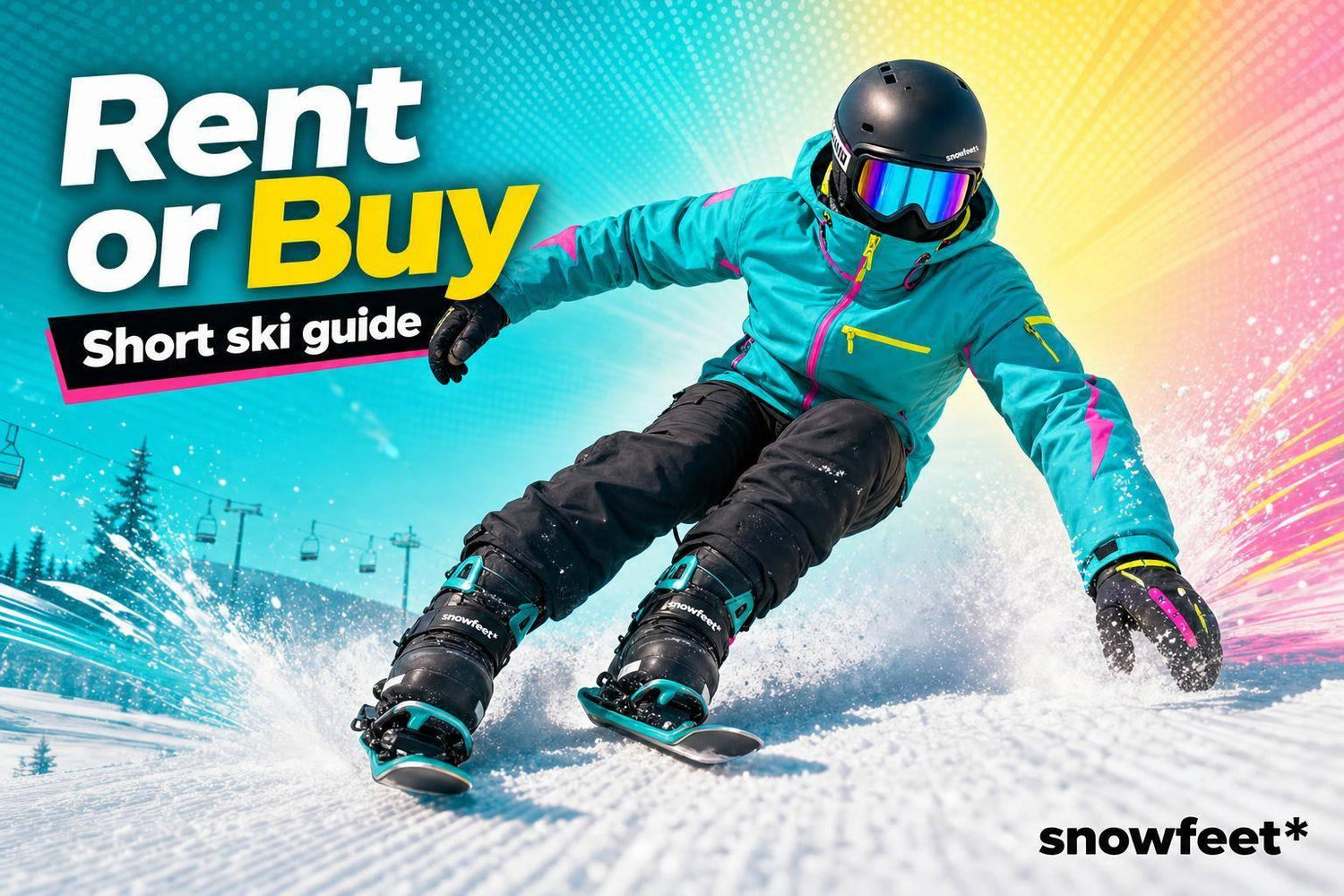
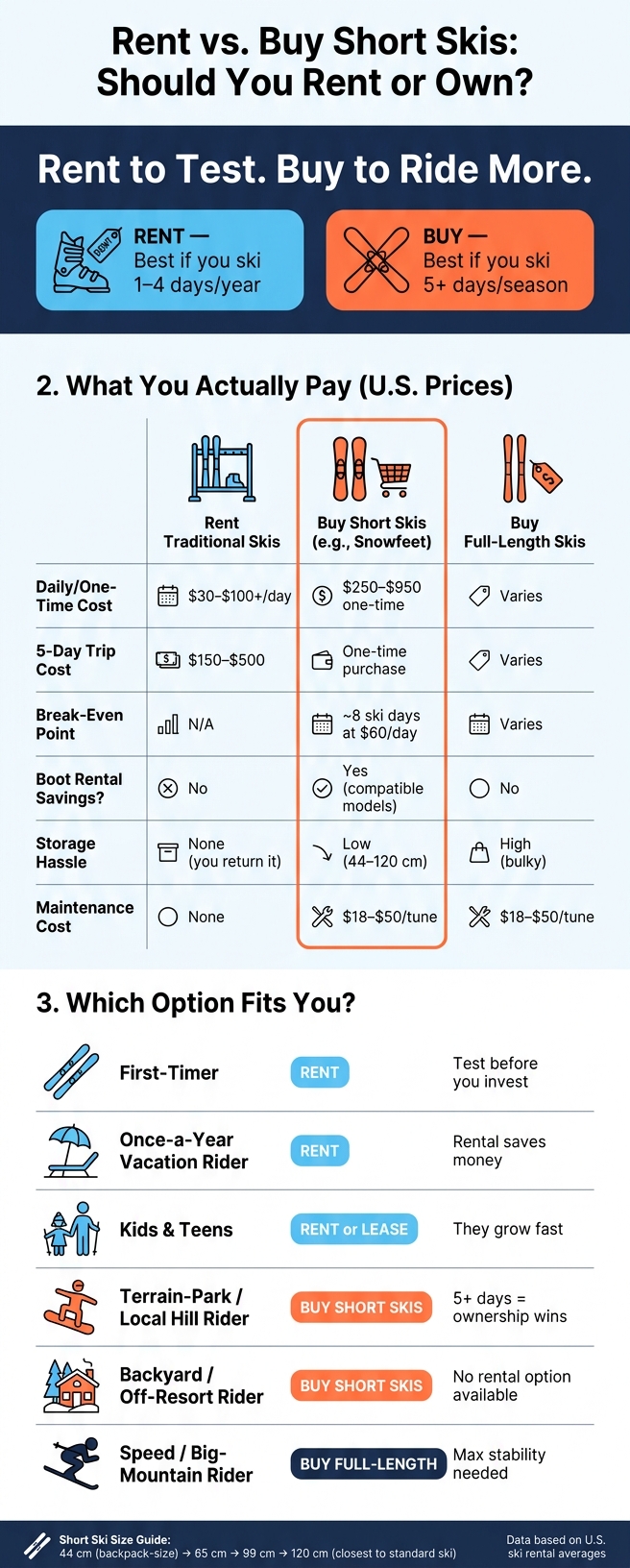
If you ski once or twice a year, rent. If you ride about 5+ days a season, buying often starts to make more sense. That’s the short answer.
I’d look at five things first:
- How often you ride
- Your skill level
- Your budget
- Where you ride
- What boots you already own
Here’s the key math: ski rentals in the U.S. often cost $30 to $70 per day, and premium setups can hit $100+ per day. So after a handful of days, rental costs can stack up fast. Short skis also take up less space, are easier to carry, and some models work with winter boots or snowboard boots, which can cut boot-rental costs too.
If I had to boil the whole thing down, it would look like this:
- Rent if you’re a first-timer, a once-a-year vacation rider, or shopping for fast-growing kids
- Buy short skis if you ride local hills, parks, backyard spots, or go several times each winter
- Buy full-length skis if your focus is higher speeds, steep runs, or big-mountain days
Rent vs. Buy Short Skis: Cost & Fit by Rider Type
All you need to know - Snowfeet* | Skiskates | Skiboards | Snowblades | Skiblades FAQ
Quick Comparison
| Option | Best for | Main cost | Main tradeoff |
|---|---|---|---|
| Rent short skis | Testing the sport, rare trips | $30–$100+ / day | Rental lines, changing gear each trip |
| Buy short skis | Frequent riders, park laps, local hills, backyard use | About $250–$950 once | You handle waxing and storage |
| Buy full-length skis | Faster carving, steeper terrain, all-mountain focus | Varies | More gear, more bulk |
So, if you want the plain-English version: rent to test, buy if you’ll use them enough to beat the daily rental bill. Pretty simple, and your wallet will usually tell you when it’s time. :)
Cost and Convenience: What You Actually Pay in the U.S.
Rental Costs vs. Ownership Costs Over a Season
In the U.S., ski rentals add up fast. Standard resort packages usually cost about $30–$70 per day for skis, boots, and poles. If you want demo or premium gear, that number can climb to about $100/day. So yeah, a five-day trip can burn through a few hundred bucks before you even touch lift tickets.
That’s where buying starts to make sense, especially if you ride more than a handful of days each season.
Snowfeet* products are a one-time buy instead of a daily rental charge. Prices start at $250 and go up to $950, based on the model. For people who ride often, that math gets pretty simple. At $60/day, the Skiskates 44 cm cover their cost in about 8 ski days.
Cost is one part of the story. The other part is whether owning gear is a pain or not.
Storage, Travel, and Maintenance: Why Short Skis Are Easier to Own
This is where short skis feel like a breath of fresh air. Snowfeet* gear ranges from 44 cm to 120 cm (17 to 47 in.), so it fits in a car trunk or a closet without turning your home into a gear cave. That alone fixes one of the biggest reasons people avoid buying ski gear in the first place.
There is some upkeep, but it’s pretty light. A wax-only service at a U.S. shop usually costs about $18–$30, and a basic edge-and-wax tune is often around $45–$50. For most riders, occasional waxing and edge care are enough.
Some Snowfeet* models also help you skip boot-rental fees. Boot-only rentals usually run $15–$25/day. If your model works with regular winter boots or snowboard boots, that’s one more cost you can dodge.
So, owning this kind of gear is a lot less annoying than people think. No giant skis. No awkward storage battle. No rental counter shuffle.
Cost and Logistics Comparison Table
Here's the side-by-side view.
| Factor | Rent Traditional Skis | Own Snowfeet* Short Skis | Own Other Short Skis |
|---|---|---|---|
| 5-day cost | About $150–$350, with premium gear closer to $500 | $250–$950 one-time purchase | Varies |
| Travel hassle | High - bulky and harder to carry | Low - easy to carry and store | Low to moderate |
| Storage space needed | Large | Small - closet or shelf | Small |
| Maintenance | None | Low - wax and edge checks | Low |
| Boot-rental savings possible? | No | Yes, on compatible models | Varies |
| Best for | One-off or rare trips | Frequent riders and local use | Frequent riders |
sbb-itb-17ade95
Performance and Learning Curve: How Renting and Owning Affect the Ride
Once price and convenience are sorted out, ride feel becomes the tiebreaker.
Rental skis are made to work for lots of people and take a beating day after day. They’re not built around your stance, your habits, or how you like to turn. That’s where owning short skis often pulls ahead.
When you ride the same short skis every time, you build muscle memory and edge control faster. You’re not adjusting to a different setup on each trip. You get the same feel, the same feedback, and a more predictable ride run after run. If the price gap is small, that steady feel on snow often makes the choice pretty simple.
Where Short Skis Beat Standard Rentals for Casual Riders
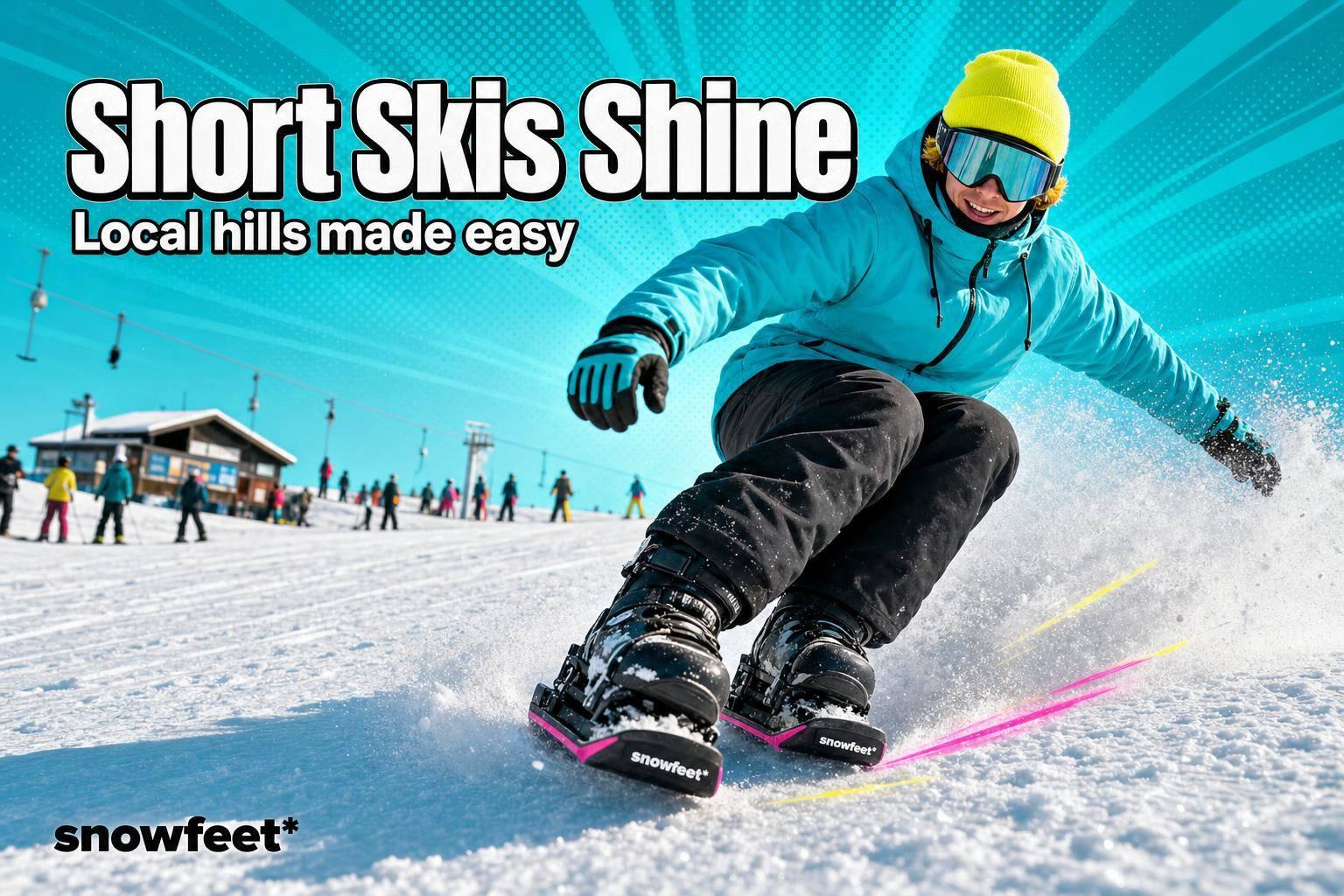
For casual riders on groomers, local hills, and small park features, short skis often have a clear edge over standard rentals. Turn initiation feels easier because there’s less ski underfoot. That can make the whole day feel less awkward and a lot more fun.
Short skis also work well in tight or crowded spots, like:
- narrow beginner runs
- small terrain park features
- local hills with limited vertical
You need less room to turn, and direction changes come fast. Some Snowfeet* models also skip ski boots, which can make those first few runs feel a lot less like wrestling gear in a parking lot.
Long skis still come out on top at high speed, on steep terrain, and in icy or off-piste conditions. Short skis are built for fun and agility, not max speed.
Which Snowfeet* Model Fits Which Riding Style
If you decide to buy, the next step is picking the length that matches how you ride.
- Skiskates 44 cm: quick spins and short-radius turns on local hills and backyard setups. They’re small enough to fit in a backpack, which is pretty wild.
- Skiblades 65 cm: playful on groomers and in the park, with more edge grip than the 44 cm.
- 99 cm: more stability for mixed terrain and moderate off-piste.
- 120 cm: the closest thing to a standard ski in the Snowfeet* lineup. Best for carving on groomers with more stability than the shorter models, while still feeling nimble.
Performance Comparison Table
| Factor | Rent Standard Skis | Rent Short Skis | Own Snowfeet* 44 cm | Own Snowfeet* 65 cm | Own Snowfeet* 99/120 cm |
|---|---|---|---|---|---|
| Beginner-friendliness | Moderate | High | High | High | Moderate–High |
| Stability at speed | High | Moderate | Low | Moderate | Moderate–High |
| Park suitability | Low | Moderate | High | High | Moderate |
| Terrain range | Wide | Moderate | Narrow–Moderate | Moderate | Moderate–Wide |
| Boot compatibility | Ski boots only | Varies | Winter / snowboard / ski boots | Winter / snowboard / ski boots | Winter / snowboard / ski boots |
| Consistency session to session | Low | Low | High | High | High |
Best Choice by Rider Type: Rent or Buy?
Use the rider type below to match the cost, convenience, and fit factors already covered.
First-Timers, Vacation Riders, and Kids
Here’s the simple version: if you ski once a year, or you’re trying short skis for the first time, rent. It keeps the cost down and lets you test things without locking yourself in. Buy Snowfeet* only when you expect to spend several days on snow each season.
For kids, rentals or season leases usually make more sense. They grow fast, and gear that fits this winter can feel tiny by next season. Buy short skis only if they ride a lot at a local hill or use them in the backyard on a regular basis.
For families who go to a local hill often, compact Snowfeet* kids' models can pay for themselves pretty fast. And since they’re small and easy to share, they can pass between siblings without much fuss.
Terrain-Park Riders, Local-Hill Users, and Backyard Riders
Once you start riding more often, owning gear starts to win on more than convenience.
Frequent riders usually save money by buying instead of renting.
There’s also the feel factor. When you own one setup, each session starts where the last one ended. That kind of consistency helps people progress faster. Snowfeet* 99 cm or 120 cm gives local-hill riders a setup they can step into and ride right away, without the usual rental-shop shuffle.
For terrain-park riders who care about tricks and short-radius moves, the Skiskates 44 cm or Skiblades 65 cm give a steady, playful feel that rental gear just can’t match session after session. Their compact size and regular-boot compatibility also make life easier. Show up, click in, ride. Nice and simple.
Backyard and off-resort riders usually don’t even have a practical rental option. In that case, compact Snowfeet* models are the most practical pick.
Scenario Decision Table
Use the table below as the final filter.
| Rider Type | Best to Rent | Best to Buy Snowfeet* | Best to Buy Full-Length Skis |
|---|---|---|---|
| First-timer | Try the sport first. | Multiple local-hill or backyard sessions planned. | Not recommended until committed. |
| Occasional vacation rider | Skiing once a year, no local hill. | 2–3+ trips per year or local hill access. | High-speed groomer or big-mountain focus. |
| Kids and teens | Once-a-year resort trips. | Frequent use only. | Teens in race or all-mountain programs. |
| Terrain-park rider | Occasional park use only. | Best for frequent sessions. | Larger park features or all-mountain use. |
| Local-hill pass holder | Very few days per season. | Consistent setup, long-term savings. | Advanced carving or racing. |
| Backyard / off-resort user | Rare trial days only. | Most practical choice. | Only if also skiing resorts regularly. |
Conclusion: The Simple Rule for Choosing Rent vs. Buy
If you ski once a year, or you’re still figuring out whether short skis are your thing, rent. It’s the easy move. No big commitment, no gear taking up space in the garage.
Once you start riding more often, buying usually makes more sense. It’s cleaner, simpler, and, honestly, less of a hassle over time.
Buy if you ride five or more days a season, especially at a local hill or right in the backyard. That’s where Snowfeet* shines most.
The big win with ownership is portability. Short Snowfeet* models are easy to carry, easy to store, and easy to toss in the car. And when gear is that simple to grab, you’ll use it more. That’s just how it goes.
Price matters, sure. But ride feel matters too. Full-length skis still win for high-speed, aggressive all-mountain skiing. If that’s your lane, go with standard gear. But for most casual U.S. riders, Snowfeet* is the better buy: compact, low-maintenance, and easy to use anytime.
Simple rule: rent to test, buy Snowfeet* to ride more.
FAQs
How many ski days make buying worth it?
With full-length ski gear, buying often makes more sense after two or three seasons of steady use. If you ski five or more days per season, you're usually a good fit for owning your setup.
With Snowfeet, that break-even point comes sooner. The upfront cost is lower, and you don’t need special ski boots. That makes owning a pair a lot easier for casual riders who want to get on snow without spending a small fortune.
Can I use my own winter or snowboard boots?
Yes - one of the best things about Snowfeet products is that you can use your own boots. That means no need to rent or buy those big, clunky ski boots.
Most models work with regular waterproof winter boots that have firm ankle support. If you want more stability, or you plan to ride in the terrain park, snowboard boots are a good fit too. And if you're looking at the longer Snowfeet models, many of them also work with standard ski boots.
Which short ski length is best for me?
The right length comes down to three things: your skill level, your weight, and how you like to ride.
If you're an absolute beginner and weigh under 150 lbs, go with Snowfeet 65 cm Skiblades. They’re a great match when you’re just starting out. If you want something even more playful and forgiving, 15-inch (38 cm) or 17-inch (44 cm) Skiskates can be a fun pick for learning and freestyle sessions.
If you weigh over 150 lbs and you’re starting to progress, 120 cm Short Skis give you the best mix of control and stability. For intermediate and advanced riders, the sweet spot is usually 99 cm to 120 cm if you want more performance, speed, and all-around use.











Hagyj egy hozzászólást
Ezt a webhelyet a hCaptcha rendszer védi, és a hCaptcha adatvédelmi szabályzata, valamint szolgáltatási feltételei vonatkoznak rá.