



















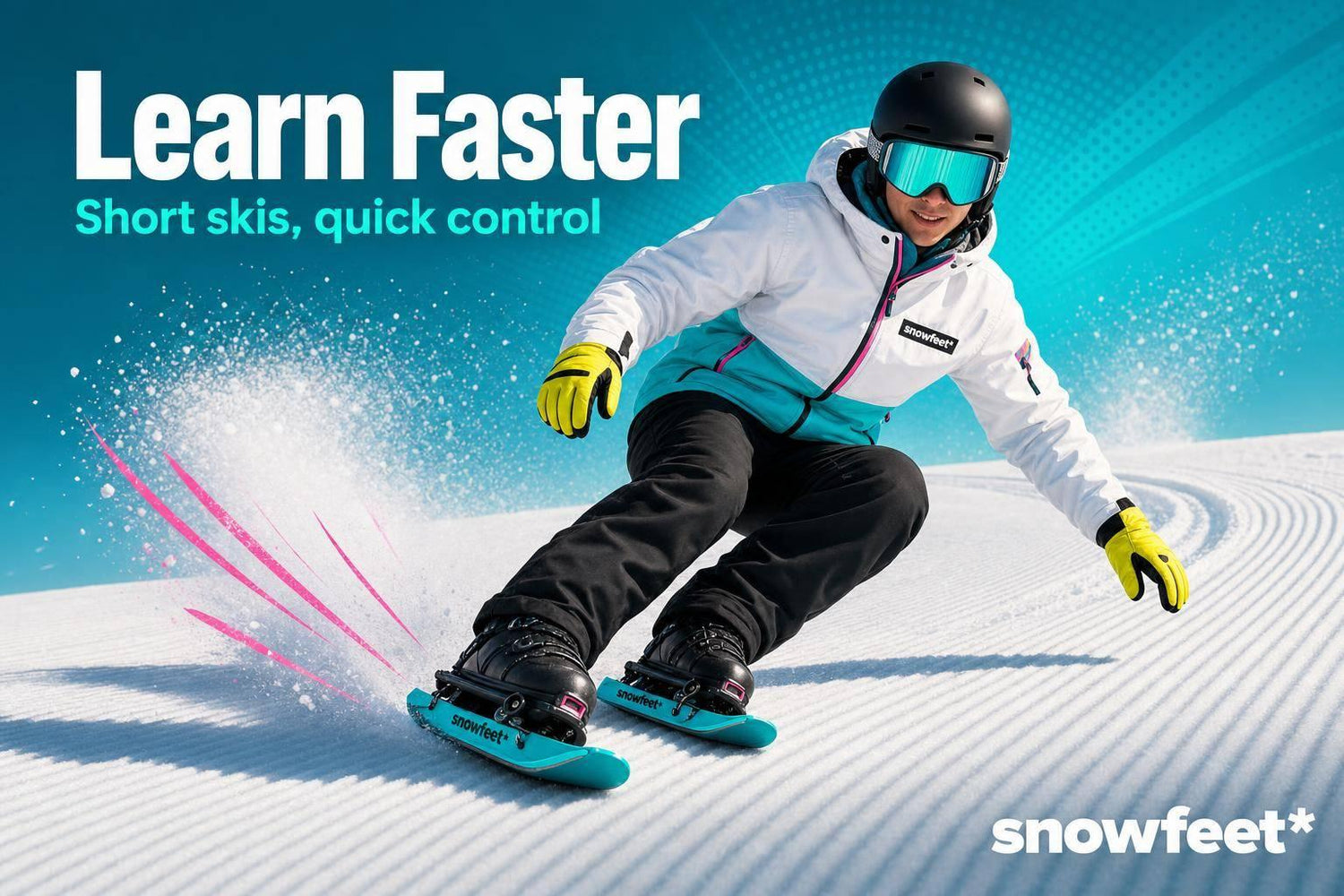
Yes - most beginners get basic control sooner on short skis. On groomed green runs and small U.S. hills, shorter skis are easier to turn, easier to stop, and less intimidating than full-length skis.
Here’s the plain-English version:
- Short skis help you learn control first
- Long skis still win for speed, powder, and steep terrain
- 44–50 cm models feel best for skaters and playful learners
- 65 cm is a strong pick for first-time resort skiers
- 99 cm gives more stability without the full-length ski feel
When I look at beginner progress, I care about 3 things:
- Linking turns
- Stopping on command
- Skiing at a calm, moderate pace
If that’s your goal, short skis usually get you there with less hassle. That doesn’t mean you’ll ski faster downhill. It means you’ll feel in control sooner. And for day one, that’s the whole game :)
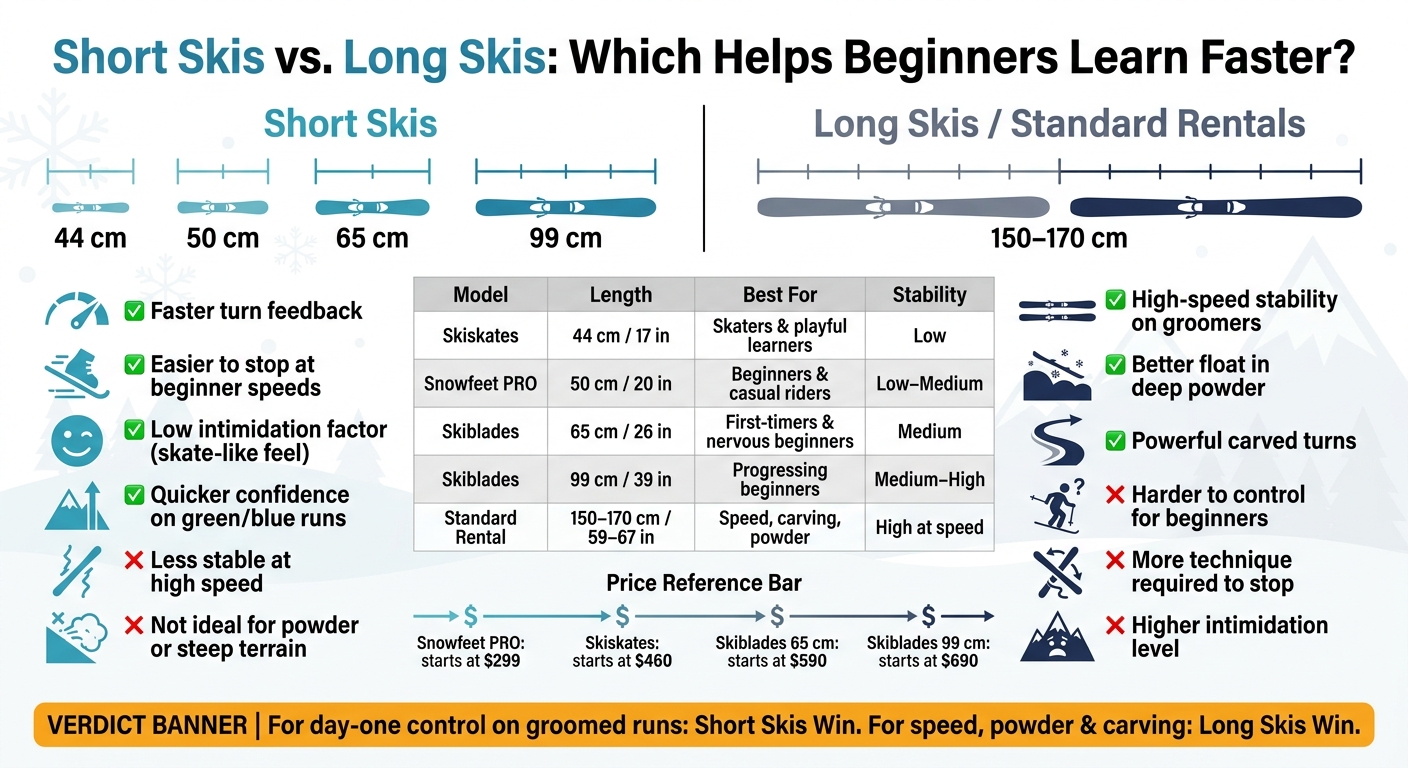
A few numbers help show the gap:
- Standard adult rental skis often land around 59 to 67 in (150 to 170 cm)
- Snowfeet short-ski options here range from 17 in to 39 in (44 to 99 cm)
- The Snowfeet PRO starts at $299
- Skiskates start at $460
- Skiblades 65 cm start at $590
- Skiblades 99 cm start at $690
Short Skis vs Long Skis: Which Is Best for Beginners?
Are Short Skis Better for Beginners?
Quick Comparison
| Model | Length | Best For | Terrain | Stability |
|---|---|---|---|---|
| Skiskates | 44 cm / 17 in | Skaters, hockey players, playful learners | Small hills, groomed beginner slopes | Low |
| Snowfeet PRO | 50 cm / 20 in | Beginners, casual riders | Green/blue runs, local hills | Low–Medium |
| Skiblades | 65 cm / 26 in | First-timers, nervous beginners | Green runs, easy resort terrain | Medium |
| Skiblades | 99 cm / 39 in | Progressing beginners, occasional resort visitors | Groomed greens and blues | Medium–High |
| Standard rental skis | 150–170 cm / 59–67 in | Skiers focused on speed, carving, powder later on | Full resort, steeper terrain | High at speed |
My take: if you want the shortest path to turning and stopping with confidence, short skis make a lot of sense. If you want top-end stability, powder float, and long carved turns, longer skis still have the edge.
If you want a quick visual before you buy or rent, these videos can help:
So, if you’re new, nervous, or just don’t want to wrestle giant rental planks on day one, short skis are often the easier way in.
Why Long Skis Often Slow Down Beginners
Beginners usually feel this right away.
Long skis feel bigger, faster, and harder to control
Standard adult rental skis are often sized around chin height. For most adults, that lands somewhere around 59 to 67 in (150 to 170 cm), based on weight and ability.
That sounds normal on paper. On snow, though, a longer ski can feel like a lot of board to deal with.
There’s more ski to move. More ski stays in contact with the snow. So for a beginner, steering, pivoting, and those little balance fixes can feel slow and awkward. Even on a mellow green run, long skis can feel faster and less easy to handle. If someone is nervous, it can feel like the skis are pulling them downhill.
And then the classic beginner move shows up: a stiff stance, hips behind the boots, weight on the heels. Totally human. Also not helpful. That position makes the skis even harder to steer and harder to stop. So instead of learning the basics, a lot of beginners spend their energy just trying not to get bossed around by their gear.
Turning and stopping require more precise technique
Long skis are less forgiving when the basics get sloppy.
If a beginner twists the upper body first or lets the ski tips drift too close together, mistakes show up fast. Catching an edge often starts when the upper body moves before the skis do. And in a wedge stance, the tips can cross with even a small inward knee movement. That’s one of those “well, that got weird fast” moments.
Finishing a turn cleanly can also be tougher. The skier has to move weight onto the outside ski and engage the edge in a smooth way across a bigger contact area. If a beginner stays flat on both skis or keeps weight to the inside of the turn, the longer ski tends to resist. The result is usually skidded turns and weak speed control.
Short skis are easier to control and turn.
This hits casual skiers the most. These are the folks who ski a few weekends each season, then come back months later and feel like they’re starting from scratch again. Rental sizing charts don’t always match that kind of skier. They often assume more days on snow than these guests actually get.
Long skis can make a lot of sense later. On day one, they usually ask too much.
Where long skis still have the edge
Long skis still do well in a few places. At higher speeds on groomed runs, in powder, and in big carved turns, they still win for speed, powder, and aggressive carving.
| Situation | Long Skis | Short Skis |
|---|---|---|
| High-speed stability on groomers | ✅ Better tracking and grip | ❌ Less stable at speed |
| Deep powder and off-piste | ✅ Better float, less tip dive | ❌ Not ideal |
| Big carved turns | ✅ More powerful edge engagement | ❌ Limited radius |
| Low-speed control for beginners | ❌ Harder to manage | ✅ More forgiving |
| Casual resort learning | ❌ Often too demanding | ✅ Faster confidence |
Long skis ask for more precision, so beginners tend to learn control at a slower pace. That’s why shorter skis often give new skiers faster feedback and quicker control.
sbb-itb-17ade95
How Short Skis Make Learning Easier
Shorter length means quicker turns and faster feedback
For beginners, learning tends to click faster when the skis turn sooner, stop sooner, and don’t feel like they’re arguing with every move. That’s where short skis help. They react fast to small foot and ankle movements, so you get turn feedback almost right away. Shift your weight or roll your ankles, and the ski responds. A longer ski needs more effort and more room to do that same job.
That fast response makes a big difference early on. You can fit more turns into each run, which means more reps in less time. And when something goes off - maybe you lean too far back or twist your upper body - the ski lets you know fast. So you can fix it on the very next turn instead of waiting through a long, slow recovery.
Better control at moderate speed builds confidence
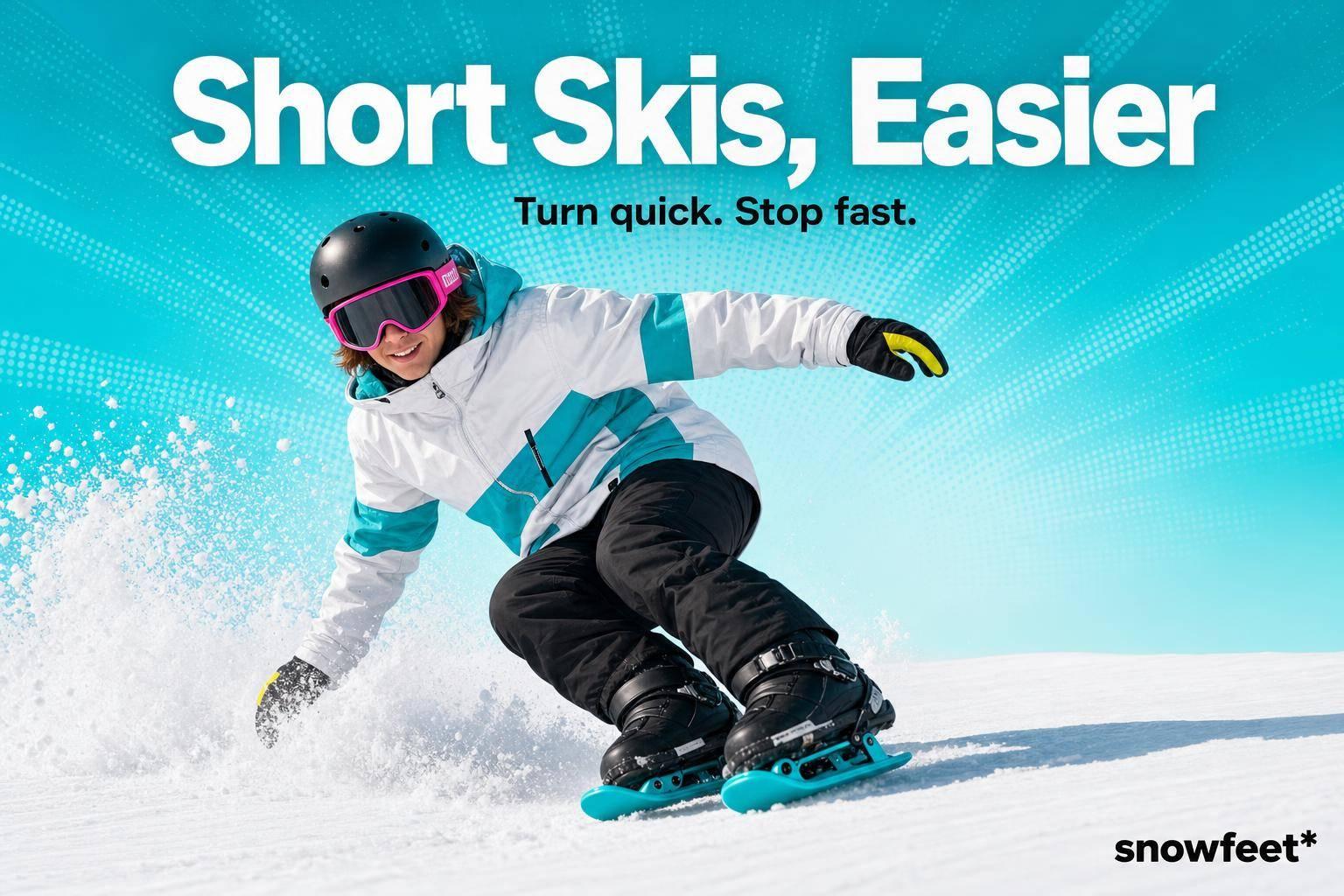
Short skis are made for easy control at lower speeds. That lines up well with bunny slopes, green runs, easy blues, and local hills. That’s where short skis stand out.
At normal beginner speeds, it’s simple to pivot a short ski across the fall line and scrub speed. You don’t need polished technique or powerful legs to slow down or stop. For nervous beginners, that matters a lot. They spend less time trying to recover and more time practicing turns. And that sense of control - knowing you can stop when you want - helps people relax. Once you relax, you usually ski better. Funny how that works :)
Short skis also feel less intimidating. Visually, they look closer to skates than long skis, which can make the whole setup feel less scary for adults new to snow sports. A calmer skier tends to stand in a more natural way, pay more attention to balance, and try things without freezing up. That usually leads to faster progress.
That quick, low-speed control is one reason compact Snowfeet* models often feel easier for first-time skiers than long, standard skis.
Short skis vs. long skis: side-by-side comparison
For most casual U.S. resort skiers learning on groomed greens, easy blues, and local hills, the main differences look like this:
| Category | Short Skis | Long Skis |
|---|---|---|
| Learning speed | Fast; quick turn feedback | Slower; demands more technique |
| Maneuverability | Very high; easy to pivot | Moderate; needs more space and effort |
| Stopping ease | Easier at beginner speeds | Requires more precise technique |
| Intimidation level | Low; feels skate-like | Higher for new adult skiers |
On the terrain where most beginners start, short skis come out ahead in the areas that matter most. The trade-offs - speed stability and powder float - don’t matter much until you’re skiing faster or heading into tougher conditions.
Best Snowfeet* Models for a Fast Learning Curve
Once you get why short skis help beginners, the next step is simple: which Snowfeet* model fits the way you learn?
Snowfeet* Skiskates 44 cm and Snowfeet PRO 50 cm for quick control
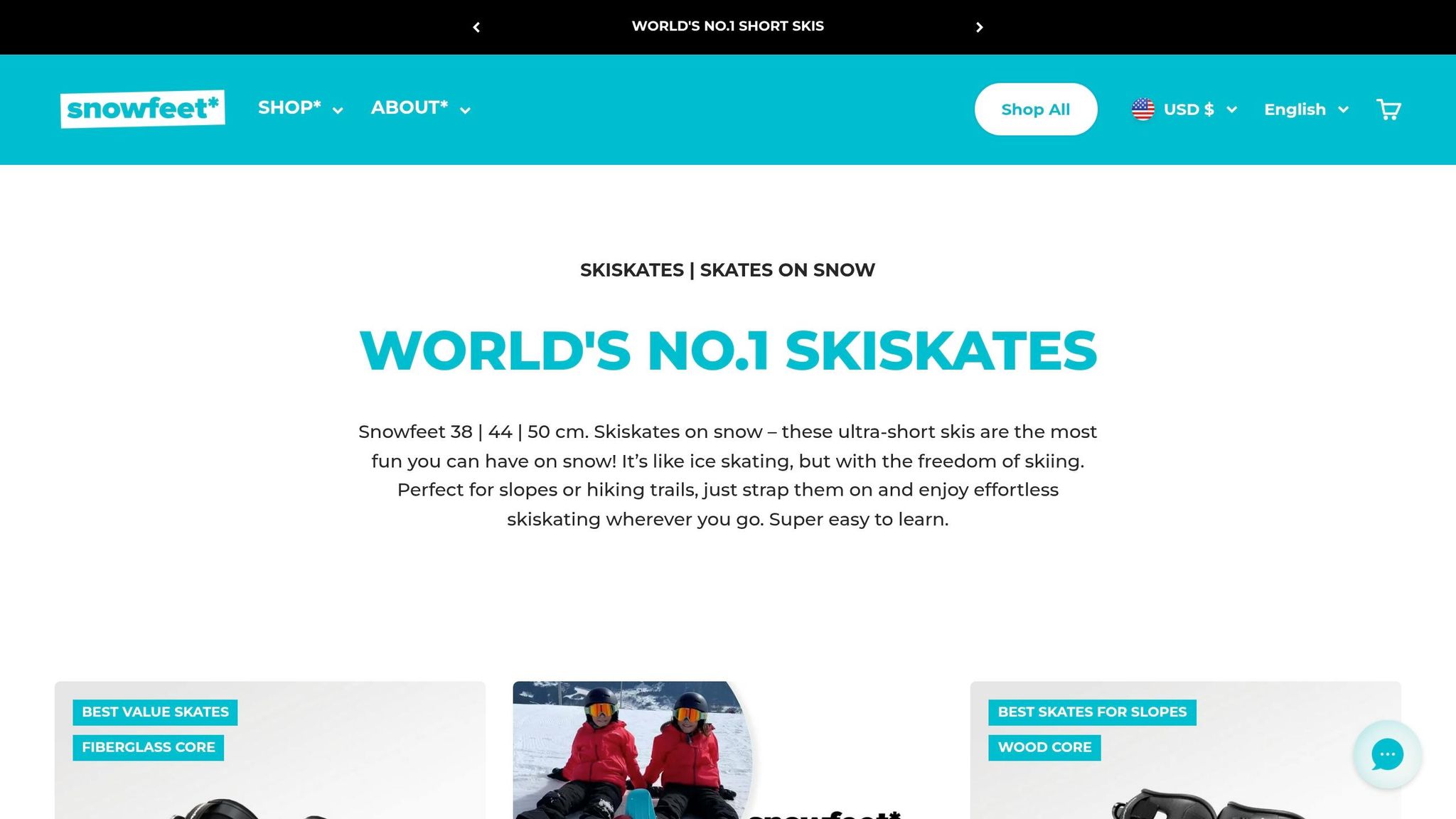
Pick the 44 cm or 50 cm model if you want the fastest path from “I’m new at this” to “okay, I can do this.”
At 44 cm, Skiskates are the smallest Snowfeet* option. That short length makes them quick to turn and easy to react with. If you skate or play hockey, this model often feels like the most natural move onto snow. It’s the easiest Snowfeet* choice for people who want that fast skater-to-snow switch.
The Snowfeet PRO 50 cm adds 6 cm of length, which gives you more edge grip and better balance when you’re going straight, but it still keeps that light, nimble feel. The PRO starts at $299. Skiskates start at $460.
There is a catch, of course. Once speed picks up, both models feel less planted than longer skis. They work best on groomed green runs, easy blue runs, and smaller local hills.
If you want a bit more calm under your feet for resort laps, step up to the longer Skiblades.
Snowfeet* Skiblades 65 cm and 99 cm for resort learning
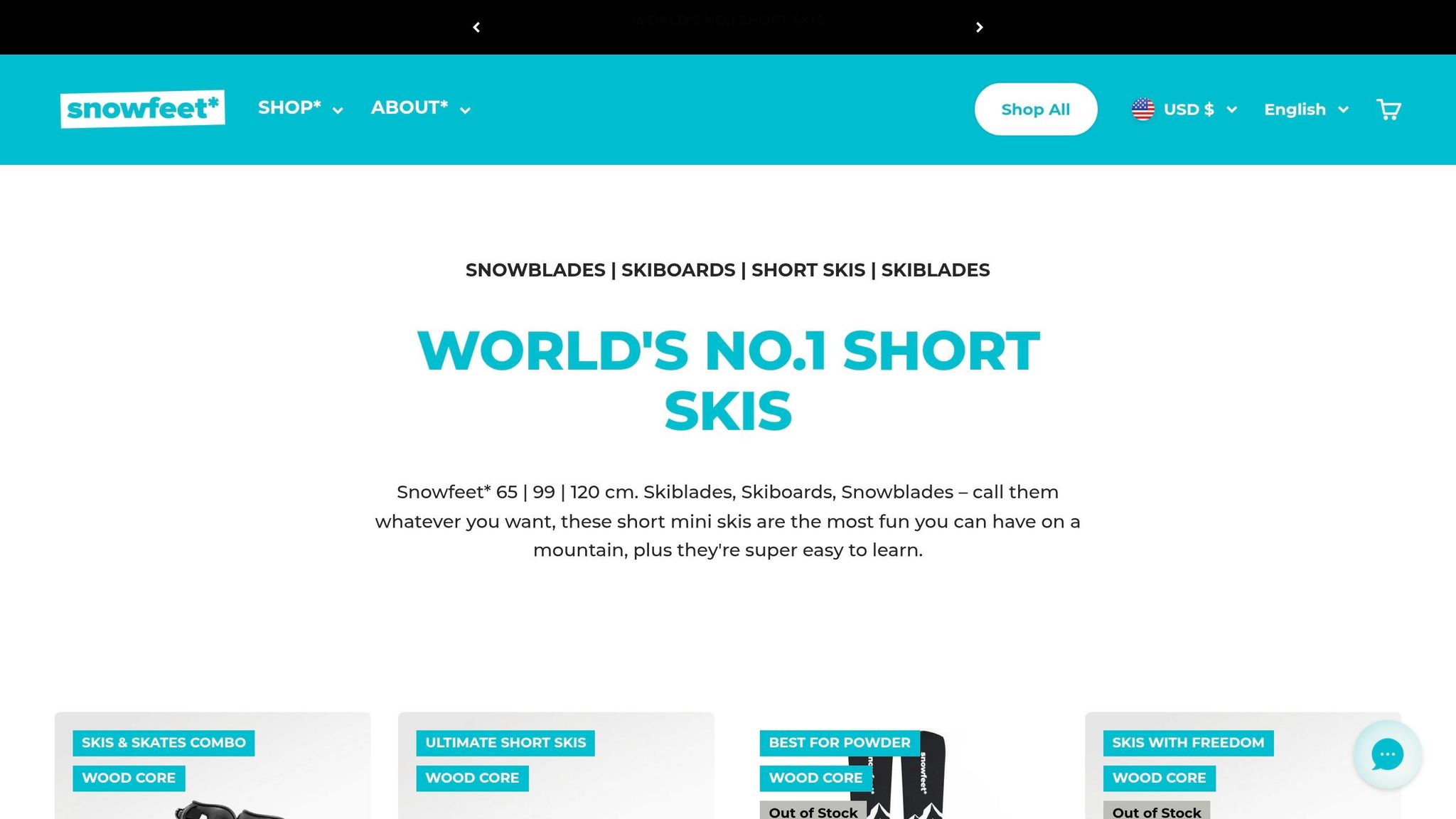
The 65 cm and 99 cm Skiblades still feel beginner-friendly, but they add more stability for resort terrain. You lose a little snap in the turns, and in return you get a steadier ride on groomed runs.
The Skiblades 65 cm start at $590. They fit green runs and easy blues where easy turning matters more than speed. For someone who has never skied before and feels a little freaked out by long skis, this is often the easiest way in.
The Skiblades 99 cm start at $690 and give you another step up in stability. Brad Tolin put it like this:
"Super easy to control, quick to turn, and way more forgiving than traditional skis. I felt comfortable on them within just a few runs."
- Brad Tolin, User
At about 39 inches, the 99 cm model is still much shorter than a standard adult ski. So you still get easier turns and less of that “these things are huge” feeling, while gaining more confidence at moderate resort speeds.
Both Skiblade models come with a wood core, metal edges, and a graphite base. Snowfeet* bindings can also be set up for ski boots or snowboard boots, which gives you more room to work with on gear day.
Which Snowfeet* model helps you learn fastest?
The best pick comes down to three things: your background, your goal, and where you plan to ride.
| Model | Best Terrain | Best For | Stability |
|---|---|---|---|
| Skiskates 44 cm | Local hills, groomed beginner slopes | Skaters, hockey players, playful riders | Low |
| Snowfeet PRO 50 cm | Green/blue runs, local hills | Beginners, skaters, casual resort skiers | Low–Medium |
| Skiblades 65 cm | Green runs, easy resort terrain | First-timers, nervous beginners | Medium |
| Skiblades 99 cm | Full resort, groomed greens and blues | Occasional visitors, progressing beginners | Medium–High |
If you want the fastest skating-to-snow switch, go with the 44 cm Skiskates or 50 cm PRO. If you want the easiest all-around beginner choice for resort skiing, the 65 cm Skiblades are a smart bet. If you want more stability without jumping to full-length skis, the 99 cm Skiblades are the most forgiving short-ski option.
So, yeah, the choice is pretty simple: pick the shortest model that still fits your terrain and your comfort level.
How to Pick the Right Setup and Final Verdict
Match your choice to terrain, experience, and goals
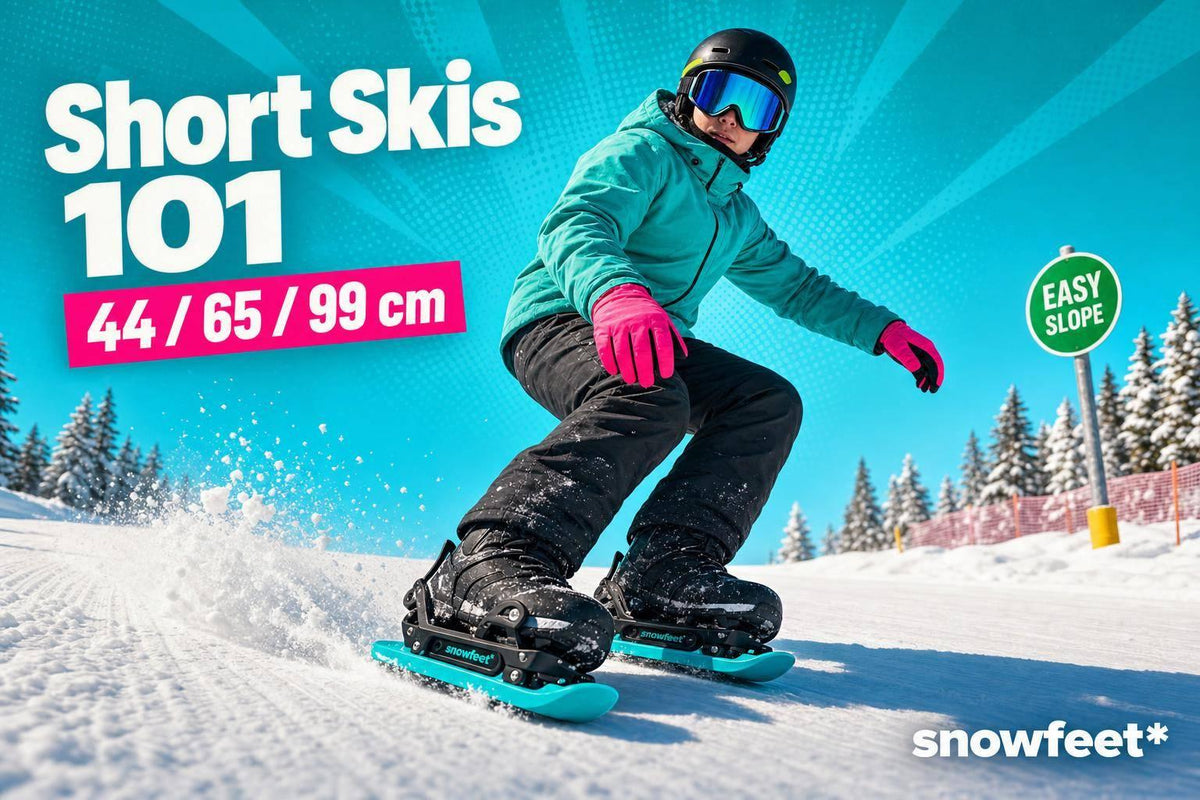
Pick the shortest option that fits where you plan to ride. If you want playful, low-commitment practice, go with 44–50 cm. For first resort laps, 65 cm is a solid pick. If you want the most stable short-ski option, choose 99 cm.
Long skis still come out on top for speed, powder, and hard carving. That part doesn’t change.
Before you lock in your setup, make sure the gear matches the terrain. Also check the local rules. It’s a small step, but it can save you a big headache later.
Safety, resort rules, and realistic expectations
After you choose your setup, check resort rules before your first run. Some resorts limit short-ski-style gear, so a fast website check or phone call can save trouble when you get there. Wear a certified ski helmet and start on easy terrain. Nice and mellow wins the day :)
One point is worth saying again: faster learning means faster control, not faster downhill speed.
Conclusion: Are short skis the fastest way to learn?
With the right setup and a few basic precautions, the answer is pretty simple. Yes. For most beginners, short skis help build control faster than long skis.
Snowfeet* stands out for casual riders because it mixes easy turn initiation with a gentler learning curve.
FAQs
Are short skis harder to balance on?
No. For beginners, short skis are usually easier to balance on, not harder.
Snowfeet* feel lighter and move faster from edge to edge. They also react more quickly to small body movements. That makes it easier to recover from a wobble or a caught edge.
Long skis are a different story. They often need steadier forward pressure, more strength, and more exact control.
Can I use short skis all day at a resort?
Yes - short skis like Snowfeet gear can work well for all-day resort use.
They’re light, easy to handle, and usually take less effort to turn and stop. That means your legs may feel less tired than they would on long skis, which is a nice little win by mid-afternoon :)
They also make a lot of sense on:
- Groomed runs
- Crowded slopes
- Mixed conditions
Long skis still tend to do better in deep powder or when you’re skiing fast on wide, open terrain.
Do I need ski boots for Snowfeet* products?
Usually, no. Most Snowfeet* models - including Mini Ski Skates, Skiskates, and the 50 cm PRO - work with regular waterproof winter shoes or snowboard boots. That’s a big plus compared with standard skis, which usually lock you into ski boots.
For longer models like the 65 cm and 99 cm Skiblades, you’ve got more choice. You can use ski boots, snowboard boots, or sturdy winter boots, so you can go with what feels best on your feet.











Hagyj egy hozzászólást
Ezt a webhelyet a hCaptcha rendszer védi, és a hCaptcha adatvédelmi szabályzata, valamint szolgáltatási feltételei vonatkoznak rá.