



















If full-size skis feel like a pain to haul, short snow gear is the easy fix. Standard skis often run 59–71 in. (150–180 cm), while the gear here ranges from 15–47 in. (38–120 cm), which means it can fit in a trunk, checked bag, or even a backpack.
Here’s the short version:
- Mini ski skates (38–50 cm) are best if you want the smallest setup and use winter boots
- Skiskates (44 cm) work well for skaters, snowboarders, and park laps
- Skiblades (65–99 cm) give you a more ski-like ride without the bulk
- Short skis (120 cm) feel closest to normal skis and suit longer resort days
- WALKSKI (100 cm) is more for walking, mellow gliding, and mixed snow use
- Assled is the pick for simple sledding, not skiing
The main trade-off is simple: the shorter the gear, the easier it is to pack, but the less stable it feels at speed. So if you stick to green and blue runs, small hills, family trips, and short sessions, compact gear makes a lot of sense. If you want steep lines, deep powder, and fast carving all day, full-size skis still win. No shock there :)
Snowboarder tries Snowfeet* | Which Snowfeet* Short Ski is the Best? | Snowblades 44, 65, 99 Review
Quick Comparison
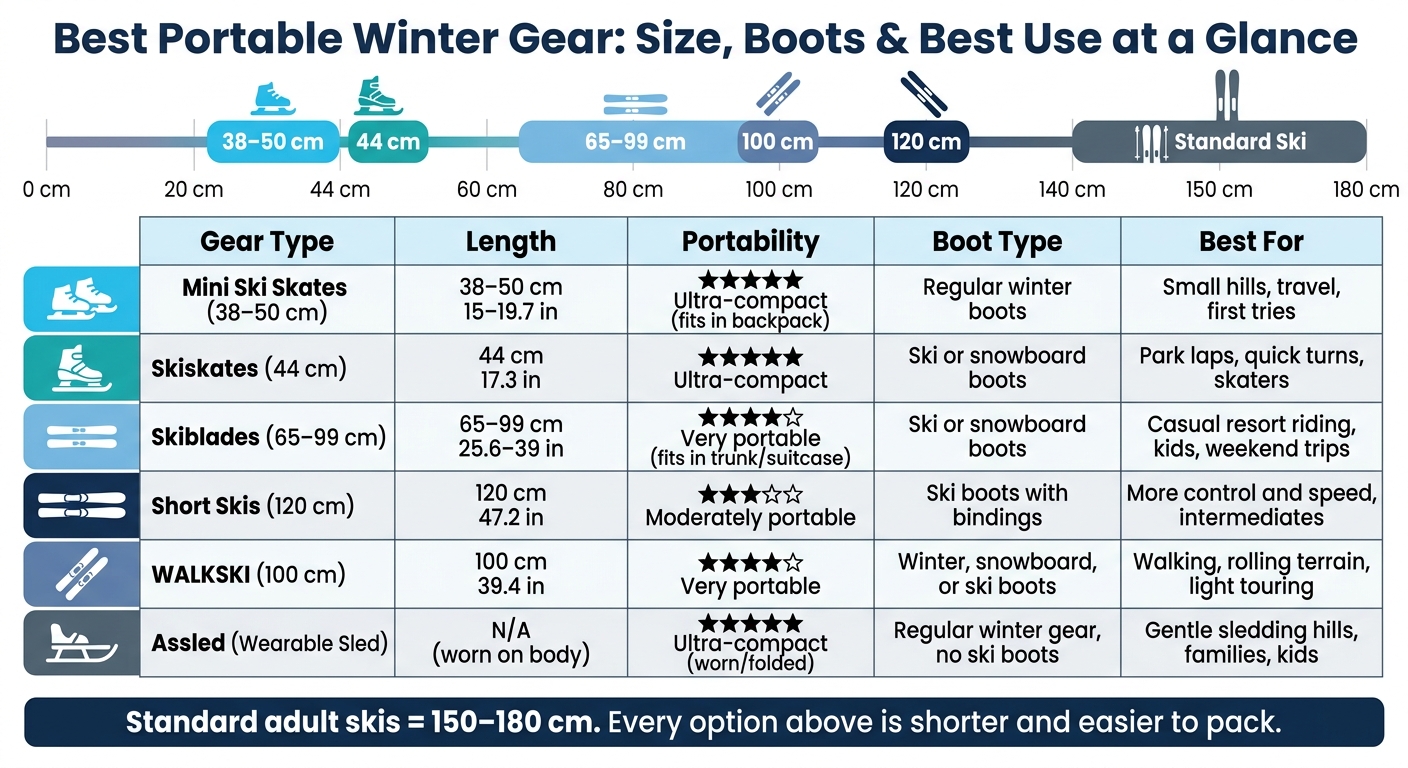
Best Portable Winter Gear: Size, Boots & Best Use at a Glance
| Gear | Size | Boots | Best For |
|---|---|---|---|
| Snowfeet* Mini Ski Skates | 15–19.7 in. (38–50 cm) | Winter boots | Small hills, travel, first tries |
| Snowfeet* Skiskates | 17.3 in. (44 cm) | Ski or snowboard boots | Park laps, quick turns, skaters |
| Snowfeet* Skiblades | 25.6–39 in. (65–99 cm) | Ski or snowboard boots | Casual resort riding, kids, weekend trips |
| Snowfeet* Short Skis | 47.2 in. (120 cm) | Ski boots | More control and more speed |
| WALKSKI | 39.4 in. (100 cm) | Winter, snowboard, or ski boots | Walking, rolling terrain, light touring |
| Assled | Wearable | Regular winter gear | Gentle sledding hills |
My take: if you want the best mix of pack size and downhill feel, I’d look first at 65 cm or 99 cm skiblades. If you want the smallest thing possible, go with 38 cm or 50 cm mini ski skates. And if you just want to slide with the kids and not deal with ski boots at all, Assled keeps it dead simple.
That’s the whole idea of this guide: pick the setup you’ll bring most often, not the one that looks coolest in the garage.
Quick Comparison: The Most Portable Winter Gear at a Glance
Standard adult alpine skis run 150–180 cm (59–71 in), so every option here is shorter and much easier to pack. That’s the big win.
Here’s the side-by-side snapshot:
| Product | Length | Portability | Boot Compatibility | Learning Curve | Best Use Case |
|---|---|---|---|---|---|
| Snowfeet* Mini Ski Skates 38 cm | 38 cm / 15.0 in | Ultra-compact | Regular winter boots | Very beginner-friendly | Backyard hills, travel days, quick laps |
| Snowfeet* Mini Ski Skates 50 cm | 50 cm / 19.7 in | Ultra-compact | Regular winter boots | Very beginner-friendly | Same use, with a bit more stability |
| Snowfeet* Skiskates 44 cm | 44 cm / 17.3 in | Ultra-compact | Ski or snowboard boots | Easy for skaters; moderate for total beginners | Short resort runs and terrain park play |
| Snowfeet* Skiblades 65 cm | 65 cm / 25.6 in | Very portable | Ski or snowboard boots | Easy if you already ski or snowboard | Green and blue resort runs for casual riders and kids |
| Snowfeet* Skiblades 99 cm | 99 cm / 39.0 in | Very portable | Ski or snowboard boots | Moderate; picks up fast with some ski experience | All-day resort use and car-based weekend trips |
| Snowfeet* Short Skis 120 cm | 120 cm / 47.2 in | Moderately portable | Ski boots with bindings | Moderate; more like traditional skis | Travel-ready option for intermediates who want stability at speed |
| WALKSKI 100 cm | 100 cm / 39.4 in | Very portable | Ski boots or sturdy winter boots | Moderate; designed for walking and mellow gliding | Snowy walking, mellow touring, and casual fitness on snow |
| Assled Wearable Sled | N/A (worn) | Ultra-compact | No ski boots needed; worn over regular winter clothing and boots | Almost no learning required | Family sledding days and spontaneous sliding on gentle hills |
The table makes the main trade-off pretty clear: smaller gear is easier to pack, while longer compact skis give you more stability.
Snowfeet* covers the biggest range here, from backpack-size 38 cm skates to 120 cm short skis. WALKSKI leans more toward mellow snow walking and light touring. Assled sits in its own lane. It’s for sledding, not skiing.
Next, we’ll look at the features that make compact winter gear simple to carry, pack, and bring on the road.
What Makes Winter Gear Easy to Carry and Pack
Four things decide whether winter gear is easy to bring along: pack size, boot needs, how it handles on short local hills, and what you lose compared to full-size gear.
Pack size is the first thing most people notice. And for good reason. Small gear is just easier to live with. It fits in a trunk, suitcase, or backpack without turning your whole trip into a packing puzzle.
Snowfeet* mini ski skates are 15–20 inches (38–50 cm) long, so they can fit inside a duffel bag or a large backpack. Even the longer Snowfeet* Skiblades, at 39 inches (99 cm), can fit across a back seat or into a compact trunk. That makes a big difference on road trips, airport runs, and carpool days.
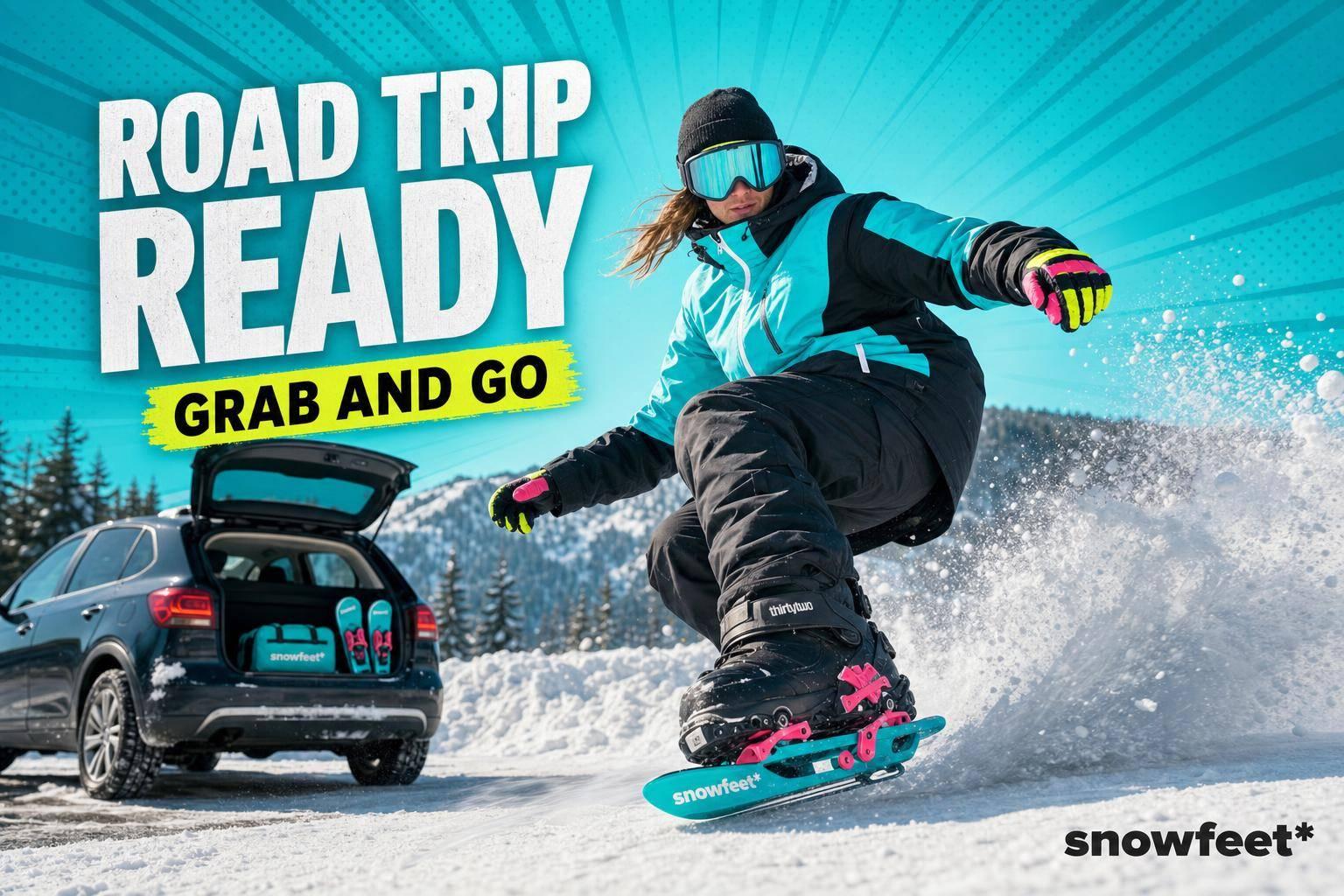
Here’s what that looks like when you use it for real.
Boot fit is the next big piece, and a lot of people don’t think about it until they’re standing in a freezing parking lot. Alpine ski boots are heavy, bulky, and kind of a pain to carry. Gear that works with normal insulated winter boots - like the Snowfeet* 38 cm and 50 cm mini ski skates - keeps things simple. You wear one pair of boots from the car to the hill and back. No boot bag. No parking-lot shuffle. No extra boot cost.
Of course, there’s a catch. Regular winter boots don’t give you the same edge control and power as stiff ski boots. So this setup works best for casual riding, not hard carving.
Short gear also matches the kind of terrain most casual riders use. Think about it: if you’re hiking up a golf-course hill with your kids, doing laps at a small community ski area, or stopping at a roadside slope on a road trip, you don’t need gear made for long black-diamond runs.
Compact skis and skates are built for:
- Low-to-moderate speeds
- Quick turns
- Repeated short laps
That’s pretty much the sweet spot for these places. They’re also light enough to carry in one hand on the walk back up, which is a huge plus when there’s no chairlift. Your arms will thank you :)
The trade-offs are real, but they’re easy to understand. Full-length skis and snowboards are better for high-speed stability, firm edge hold on steep ice, and staying on top of deep powder. Compact gear gives up some of that. In return, you get more agility and a lot less hassle.
So, if you want top speed on steep groomers all day, full-length skis are the better pick. If you want short, fun sessions on easy-to-reach terrain without dragging around a ski bag, compact gear makes more sense.
That trade-off is what separates the options below. With that in mind, the next sections match each model to the rider and terrain it fits best.
1. Snowfeet* Mini Ski Skates 38 cm
Price: From $190
At 15 inches (38 cm), these are the most packable skis in the lineup. They’re small enough to toss into a backpack, duffel, carry-on, or your car trunk. That’s a big deal if you want gear that travels easy and doesn’t take over your whole trip.
Another plus: they work with regular winter boots or sturdy hiking boots. So if you’re new to this, you can skip the whole ski-boot drama. No stiff plastic moon boots. No extra hassle. Just clip in and go :)
The 38 cm model makes the most sense for quick laps on small hills and beginner runs. It does best on:
- groomed beginner slopes
- small hills
- snow parks
Because they’re so short, they make spins, pivots, backward riding, and quick turns feel much easier. That’s part of the fun. They feel playful, almost like the snow version of skates.
The downside is pretty clear: you get less stability at higher speeds than you would with longer skis. If you already skate or rollerblade, you’ll likely get the hang of them fast. If you’re a total beginner, start on gentle slopes and give yourself a little room to learn.
If you want a bit more balance but still want something easy to pack, the 50 cm model is the next step up.
2. Snowfeet* Mini Ski Skates 50 cm
Price: From $299
If the 38 cm version feels a bit too twitchy, the 50 cm model smooths things out without giving up that toss-it-in-a-bag size. At 50 cm (about 19.7 inches), it’s a clear jump from the 38 cm version, but it still fits in a carry-on, duffel, or trunk. Nice and simple. You can grab them and walk from the car to the hill without feeling like you’re hauling a full ski setup.
Like the 38 cm model, these work with regular winter boots, though snowboard boots give you better control. That extra length gives you a bit more edge contact and more fore-aft stability, so the ride feels steadier underfoot. It’s not night and day, but you’ll notice it. Built around a fiberglass-reinforced core, they still feel lively and responsive. So you get that ski-skate feel: more planted, but still playful.
These work best on groomed beginner runs, small resort slopes, and casual weekend laps. They shine on green and easy blue runs, mostly on firm snow at moderate speed.
So, if you want ultra-portable gear but don’t want the ride to feel too nervous, the 50 cm model is the best next step.
3. Snowfeet* Skiskates 44 cm
Price: From $460
At 44 cm (about 17.3 inches), these are still easy to toss in a backpack, but they feel more planted than the 38 cm and 50 cm mini ski skates. They land right in that sweet spot between the super-short mini ski skates and the steadier 65 cm Skiblades.
You can pick ski-boot or snowboard-boot bindings based on what you already have. Snowboard boots feel more comfortable and make a lot of sense for tricks and mellow laps. Ski boots give you a tighter, more locked-in feel, which helps with edge control.
The 44 cm length leans toward agility, not speed. That means you can pivot fast, spin, and snake through tight spots without much effort. It’s a strong pick for:
- Snow parks
- Groomed beginner runs
- Small local hills
These work best at low to moderate speeds. If you want something that feels a bit more like skiing and gives you more room for error, the 65 cm Skiblades are the next move.
Go with these if you want more control than mini ski skates but still want that backpack-level portability. Skaters, inline skaters, and hockey players often click with them fast. Total beginners can learn on them too, but the 65 cm Skiblades tend to feel more forgiving.
If you want more stability without giving up easy carry, the 65 cm Skiblades are the next step up.
4. Snowfeet* Skiblades 65 cm
Price: From $590
At 65 cm, or about 25.6 inches, these skiblades land right in the middle of the Snowfeet* lineup. They feel more stable and more like skis than the ultra-short mini skates, but they’re still small enough to toss in a car trunk or a large checked suitcase. That makes them a nice fit for day trips, weekend travel, and local hills. In most cases, they’ll still fly as checked baggage, but they’re way easier to pack than full-size skis. This is the first Snowfeet* model that starts to feel close to a real ski while still being easy to carry around.
You can choose between ski boot bindings (EU 36–49 / US 4.5–14.5) and snowboard boot bindings (EU 38–49 / US 6–14.5). So if you already own one type of boot, you can match that setup. Snowboard boots tend to feel more comfortable for laid-back riding, while ski boots give you a more locked-in feel.
Snowfeet* calls this model The Combo, and that name fits. It mixes ski control with skate-like agility. You get a wood core, metal edges, and a sintered base, so the ride feels much closer to a ski than you might expect from something this short. It’s made for groomed slopes, moguls, and snow parks.
Here’s the plain-English trade-off: 65 cm skiblades are easier to turn and easier to carry than full-length skis, but they won’t feel as planted once speeds climb. On steep, fast, or icy terrain, longer skis still do better. But for groomed runs, short local hills, and park laps, this length hits a sweet spot. You get easy handling and decent control without dragging around big gear.
Compared with the 44 cm Skiskates, the 65 cm version gives newer riders a bit more room for error. Total beginners often find it easier than the 44 cm and 50 cm models, which makes it a smart step into the Snowfeet* lineup. If you want more stability for longer resort days, the 99 cm Skiblades are the next move.
sbb-itb-17ade95
5. Snowfeet* Skiblades 99 cm
Price: From $690
If you want more stability but still want gear that’s easy to haul around, the 99 cm model is the next move. At 99 cm, these are the most ski-like skiblades in the lineup, yet they still fit in a car trunk or a checked bag without much fuss.
You can pick ski-boot or snowboard-boot bindings based on how you like to ride. Ski boots give you tighter, more exact control. Snowboard boots feel softer and more relaxed for mellow laps.
Snowfeet* calls this the "Ultimate Short Ski," and that fits. It’s built with a certified sustainable wood core, sintered bases, and metal edges. The sidecut helps it carve with a smooth feel on groomers, moguls, and light powder. For casual and intermediate riders, it lands in a sweet spot between easy carrying and solid downhill performance.
Compared with the shorter models, these feel more planted. The trade-off is pretty simple: next to longer skis, they lose some high-speed stability, but they’re still easier to carry and more forgiving when the trail gets tight and turny. Next up: the 120 cm Short Skis, for riders who want a bit more speed and a more standard ski feel.
6. Snowfeet* Short Skis 120 cm
Price: $950
The Snowfeet* Short Skis 120 cm sit in a sweet spot. They give you the most ski-like ride in the Snowfeet* lineup without going all the way to full-length skis.
At 120 cm, they’re the longest Snowfeet* skis. Even so, they can still fit in many car trunks and shorter ski bags. That makes travel a lot easier than hauling around full-size skis.
The setup is simple and familiar. These skis use standard ski bindings and alpine ski boots, so you don’t need special footwear or some odd add-on gear. Just click in and go. Nice and easy :)
They shine most on:
- Groomed runs
- Blue trails
- Chopped-up afternoon snow
They’re also fun for short repeat laps, playful turns, side hits, and small bumps. That said, they’re not built as a powder-specific tool.
The big selling point here is the balance between stability and agility. Compared with shorter Snowfeet* models, the 120 cm version gives you more stability and better edge hold, but it still stays quick from turn to turn. That’s a pretty nice mix. It helps keep the learning curve low for basic parallel turns and fast direction changes, while still giving intermediate riders a playful, responsive ride.
If you want a setup that feels lighter on foot and less like a standard ski, the next options give up some downhill performance in exchange for easier walking and more casual snow use.
7. Snowfeet* WALKSKI 100 cm
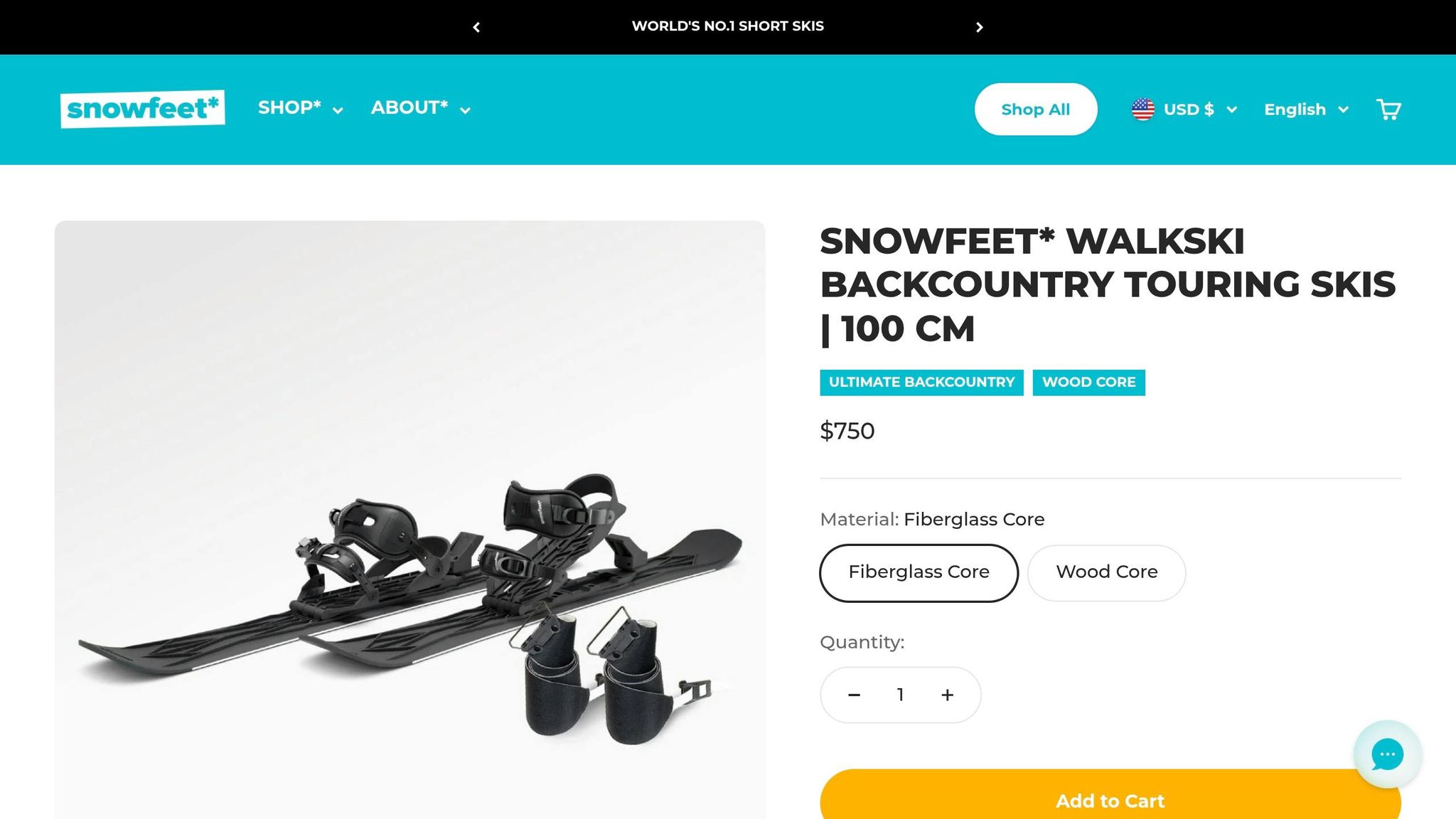
Price: $750
The Snowfeet* WALKSKI 100 cm is a better pick if you want something more friendly for touring than the 120 cm short skis. Instead of focusing on lap after lap downhill, this setup leans toward walkable terrain, backcountry travel, rolling hills, and all-mountain riding. It’s also much easier to pack than full-length skis, which is a big deal if you don’t want to wrestle gear all day. You can fit it in or strap it onto a backpack without much fuss.
Weight stays pretty reasonable too. The wood-core version comes in at 6.9 lb per pair, while the fiberglass version weighs 8.8 lb per pair.
One of the best parts is the universal binding system. It works with:
- Standard winter boots
- Snowboard boots
- Ski boots
That means you can skip dedicated touring boots, which saves money and hassle. Snowboard and winter boots fit US sizes 6–14.5, and ski boots fit US sizes 4.5–14.5. At about $750, it also lands well below the cost of a typical $2,200 ski touring setup.
The bindings switch between Walk, Ski, Climb 1, and Climb 2 modes, and the package includes removable climbing skins. So, you’re not stuck with a one-trick setup.
For travelers and casual riders, this is the most flexible option in the lineup. You can hike in, glide down, and pack out with one setup. Compared with full-length touring skis, the WALKSKI turns faster in tight trees and rolling terrain. Full-length skis still do better at high speed, no surprise there. But the upside here is simple: better portability, easier handling, and a short learning curve. That makes it a smart match for mixed-use snow days, especially if a dedicated sled-style option feels too narrow for how you ride.
8. Assled Wearable Sled
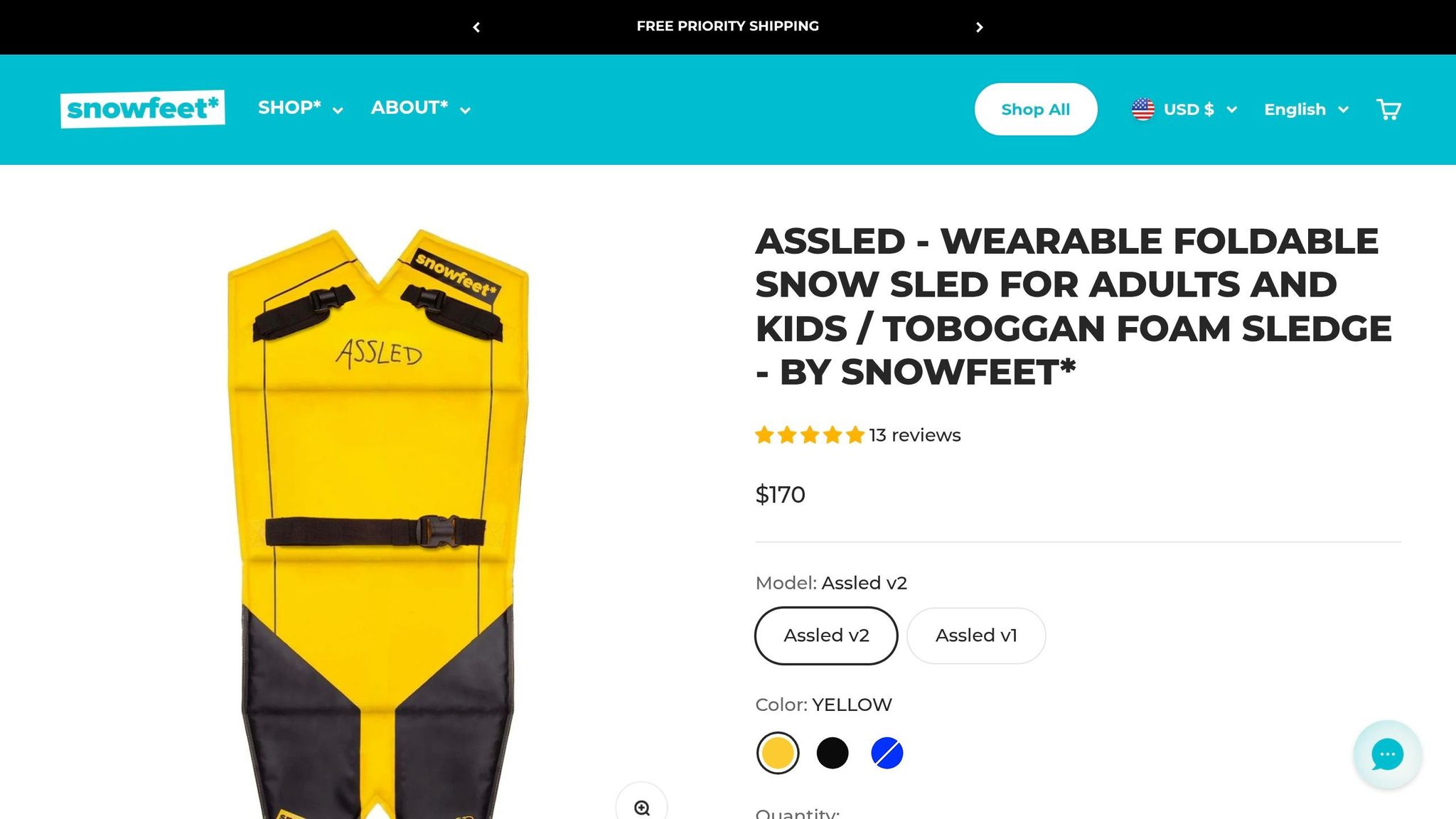
If you want the easiest thing to pack, the Assled is hard to beat. It’s a strap-on sled that fits around your lower body - around your hips and thighs - so you wear it instead of carrying it. And yep, it folds down small enough to fit in a daypack, carry-on, or even a car seat. That makes it the most packable option on this list. But let’s be clear: it’s not a ski substitute.
It works with insulated winter boots, hiking boots, or snowboard boots. The key is simple: you use your heels to brake and steer.
Unlike the Snowfeet options, Assled is made for one thing: sliding downhill. It’s not built to help you learn ski technique. It works best on small to medium packed hills, like neighborhood slopes, resort sledding zones, and mellow terrain near a cabin or parking lot.
Here’s how control works:
- Drag one heel to turn
- Drag both heels to slow down
That setup is easy to learn, and it handles soft turns fine. But there’s a catch. It’s tough to steer around obstacles, so you give up a lot of ski-like control. You get ultra-simple fun, but not much room to grow your skills. Most people get the hang of it in a few runs, and it does not teach ski or snowboard technique.
If your main goal is portability and no-hassle fun, this is a solid pick. Toss it in the trunk and you’re set for quick sledding stops.
For riders choosing between these compact options, the next section breaks down which one fits your style.
How to Pick the Right Option for Your Riding Style
The best pick comes down to how you like to ride. So, start with the rider type that feels closest to you.
Beginners: Snowfeet* Skiskates 44 cm or Snowfeet* Skiblades 65 cm are a good place to start. They’re short and forgiving, which helps a lot when you’re still getting the hang of things. If it’s your very first time on snow, go with Snowfeet* Mini Ski Skates 38 cm or Assled Wearable Sled.
Kids: Snowfeet* Mini Ski Skates 38 cm or Assled Wearable Sled usually make the most sense. Both are light, easy to carry, and simple to use. One quick note: Assled is for simple, seated sliding, not for building ski skills.
Travelers: If you want gear that doesn’t eat up your trunk space, look at Snowfeet* Mini Ski Skates 38 cm, Snowfeet* Mini Ski Skates 50 cm, or Snowfeet* WALKSKI 100 cm. They all fit in a backpack or trunk and work with standard winter boots. That’s a nice setup if you like to pack light :)
Snowboarders: Snowfeet* Skiskates 44 cm or Snowfeet* Skiblades 99 cm tend to feel the most natural. Both favor quick turns and a loose, playful ride. If you like that surfy, less locked-in feel, these are worth a look.
Casual riders: Snowfeet* Skiblades 99 cm, Snowfeet* Short Skis 120 cm, or Snowfeet* WALKSKI 100 cm are solid fits. They give you more of a ski-like feel without being a pain to store.
| Rider Type | Best Pick | Why It Works |
|---|---|---|
| Beginners | Snowfeet* Skiskates 44 cm / Skiblades 65 cm | Short, forgiving |
| First-time riders | Snowfeet* Mini Ski Skates 38 cm / Assled | Minimal learning curve |
| Kids | Snowfeet* Mini Ski Skates 38 cm / Assled | Light, simple |
| Travelers | Snowfeet* Mini Ski Skates 50 cm / WALKSKI 100 cm | Compact, boot-friendly |
| Snowboarders | Snowfeet* Skiskates 44 cm / Skiblades 99 cm | Quick turns, soft-boot options |
| Casual riders | Snowfeet* Skiblades 99 cm / Short Skis 120 cm / WALKSKI 100 cm | Ski-like feel, easy to store |
If you still want more context, compare these options against full-length skis and snowboards next.
Short Gear vs. Full-Length Skis and Snowboards
Before you pick a model, it helps to stack short gear up against full-length skis and snowboards.
Full-length gear still has the upper hand in a few big areas: speed, steep terrain, and deep powder. Against the short Snowfeet* options above, long skis and snowboards do better at high speeds, on hard-charging groomers, and in deep snow. That’s the trade-off.
For casual riders, though, that trade-off often swings the other way. For most people reading this, the main question is simple: how much do you give up to get easier transport? For easy runs and short outings, the answer is: not much.
You’ll notice the difference right away. Full-length skis and snowboards often need a roof rack or ski bag. Short gear like Snowfeet* Skiblades or WALKSKI fits in almost any car trunk. That’s a big deal if you don’t want your garage, car, and weekend plans to revolve around giant gear.
Short gear is also easier to store at home. But let’s be honest - transport and on-hill ease matter more than closet space for most people.
| Category | Short Portable Gear | Full-Length Skis / Snowboards |
|---|---|---|
| Transport | Fits in most trunks; no roof rack needed | Often needs a roof rack or ski bag |
| Learning speed | Usually easier to learn than full-length skis | Higher learning curve; often takes more than one day |
| Short outings | Ideal for 1–2 hour sessions, backyard slopes, and small local hills | Better for full-day resort trips |
| High speed / powder | Less stable at speed and in deep snow | Better for speed, carving, and deep snow |
That’s why compact gear tends to suit casual riders better. Once you know the trade-off, the next step is matching each portable option to how it feels on snow.
What to Expect From Each Type of Portable Gear
Each portable option rides in its own way. That’s the big thing to know up front. Snowfeet covers the whole portable snow-gear range, from mini skates to short skis. The trade-off is pretty simple: the easier the gear is to carry, the less speed and powder performance you’ll get. From there, it’s all about matching the ride feel to your skill level and how you like to move on snow.
Mini ski skates (38 cm and 50 cm) feel loose and skate-like. They’re quick, playful, and best for short, high-energy sessions. They make a lot of sense if you already have decent balance.
Skiskates (44 cm) feel like the most controlled short option. You still get that playful feel, but with better grip on groomed snow and park laps.
Skiblades and short skis are the most forgiving group. The 65 cm length is the most playful, 99 cm gives you more stability, and 120 cm feels closest to a standard ski.
WALKSKI (100 cm) is made for walking and light gliding across mixed terrain. This is not the pick for resort-style carving.
Assled is the simplest option on gentle, open sledding hills. With this one, terrain choice matters more than anything else.
Use the chart below for a quick side-by-side look at feel, stopping control, and where each type works best.
| Gear Type | Best For | Stopping Control | Terrain Range |
|---|---|---|---|
| Mini ski skates (38–50 cm) | Playful short runs, skaters, active adults | Skidding | Mellow slopes, small hills |
| Skiskates (44 cm) | Freestyle riders, snowboarders, skaters | Strong edge grip | Groomed runs, park features |
| Skiblades (65–99 cm) | Beginners, casual riders, travelers | Snowplow and parallel stops | Green and blue runs, light chop |
| Short skis (120 cm) | Intermediate–advanced skiers | Full ski-style stops | Steeper groomers, variable snow |
| WALKSKI (100 cm) | Hikers, snowshoers, and outdoor explorers | Controlled skidding | Trails, rolling terrain, light off-piste |
| Wearable sled (Assled) | Families, kids, non-skiers | Heel drag | Gentle sledding hills only |
Now pick the type that fits how you actually ride, not just what looks fun in a product photo :)
Conclusion
After stacking these options side by side, one thing jumps out: portability only matters if the gear leaves the house. The best carry-anywhere winter setup is the one you’ll pack, bring, and use.
For most casual riders, Snowfeet* mini skis, Skiskates, and Skiblades hit the sweet spot between small size and pure fun. Verified reviews back that up. They’re practical, easy to bring along, and a good fit for casual riders, travelers, and snowboarders.
That said, not every portable option works for every rider. Two more niche picks fit tighter use cases. WALKSKI makes sense for walking and light touring across mixed terrain. Assled is the better pick for mellow hills where a sled does the job.
If you want the simplest way to choose, match your gear to where you ride and how often you’ll carry it. Look at your terrain, your skill level, and how much room you have.
Pick the compact setup you’ll bring most often. Pack small. Ride more.
FAQs
Which Snowfeet* size is best for beginners?
For beginners, the best Snowfeet* picks are the Mini Ski Skates in 38 cm or 50 cm, or the 65 cm Skiblades.
The 38 cm and 50 cm models are a great place to start. Their short length makes them easier to turn and control than standard skis, which takes a lot of the stress out of learning. And, well, they’re easy to toss into a normal backpack too :) Plus, they work with regular winter boots or snowboard boots, so you don’t need a bunch of extra gear.
Can I use Snowfeet* with regular winter boots?
Yes. Snowfeet* comes with adjustable, tool-free bindings that fit most regular winter shoes, hiking boots, and snowboard boots.
For the best ride, go with waterproof boots that have solid ankle support. Snowboard boots are a popular pick because they feel secure and are often more comfortable to walk in than ski boots.
Are short skis stable enough for resort runs?
Yes. Most resorts allow short skis because they use the same metal edges and standard bindings as regular skis.
Shorter options, like 44 cm Skiskates, are all about quick turns, tricks, and smooth groomed runs. They feel playful and nimble.
Longer options, like 99 cm and 120 cm Skiblades, give you more stability and better edge hold. That makes them a better fit for higher speeds, steeper slopes, and mixed resort terrain.
For most riders, the 99 cm model hits the sweet spot. It gives you a fun, agile ride without feeling too twitchy.











Hagyj egy hozzászólást
Ezt a webhelyet a hCaptcha rendszer védi, és a hCaptcha adatvédelmi szabályzata, valamint szolgáltatási feltételei vonatkoznak rá.