



















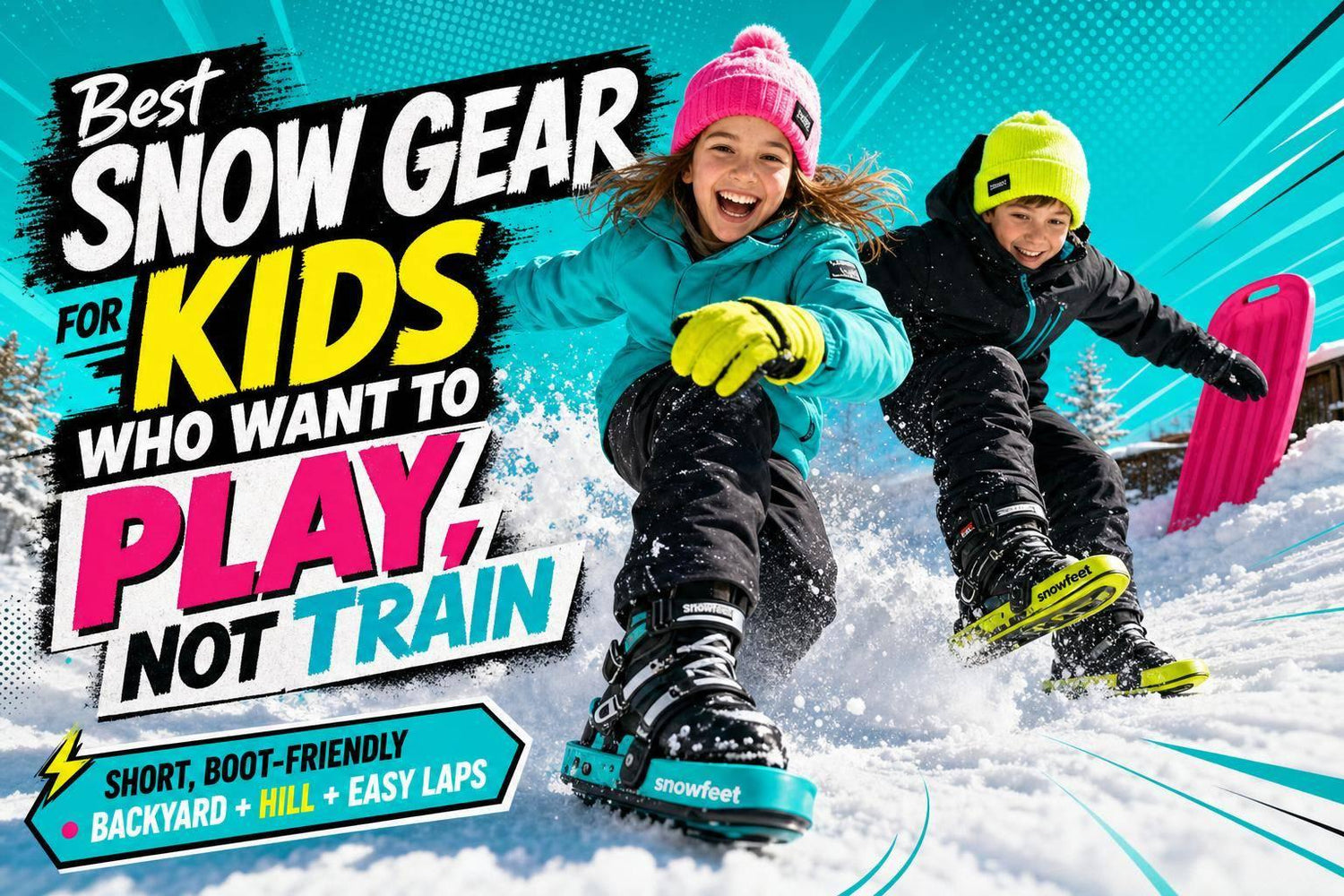
If you want your kid sliding with the least fuss, pick gear that works with regular winter boots and small hills. That means Snowfeet* MINI KIDS and 38 cm Mini Ski Skates are the easiest first picks, while PRO 50 cm and 65 cm Skiblades make more sense for older kids who want more glide.
Here’s the short version:
- Best first pick for ages 5–15: Snowfeet* MINI KIDS - simple, light, and made for gentle slopes
- Best step-up option: 38 cm Mini Ski Skates - still backpack-sized, with a bit more room to stand
- Best for older kids on mellow resort runs: PRO 50 cm
- Best for kids who want more of a ski feel: 65 cm Skiblades
- Best for lesson-based skiing: kids’ skis
- Best for kids set on boarding: youth snowboard
A few numbers stand out:
- $205 for MINI KIDS at the listed sale price
- $250+ for 38 cm Mini Ski Skates
- $275 for PRO 50 cm
- $200–$350 for kids’ ski packages, plus boots
- Most Snowfeet* options are 15–26 inches long, so they’re much easier to carry than skis or a snowboard
My takeaway: if your goal is backyard fun, sledding hills, and short resort laps, go short, light, and boot-friendly. If your kid is in lessons or wants the full ski or snowboard path, the longer gear still has its place.
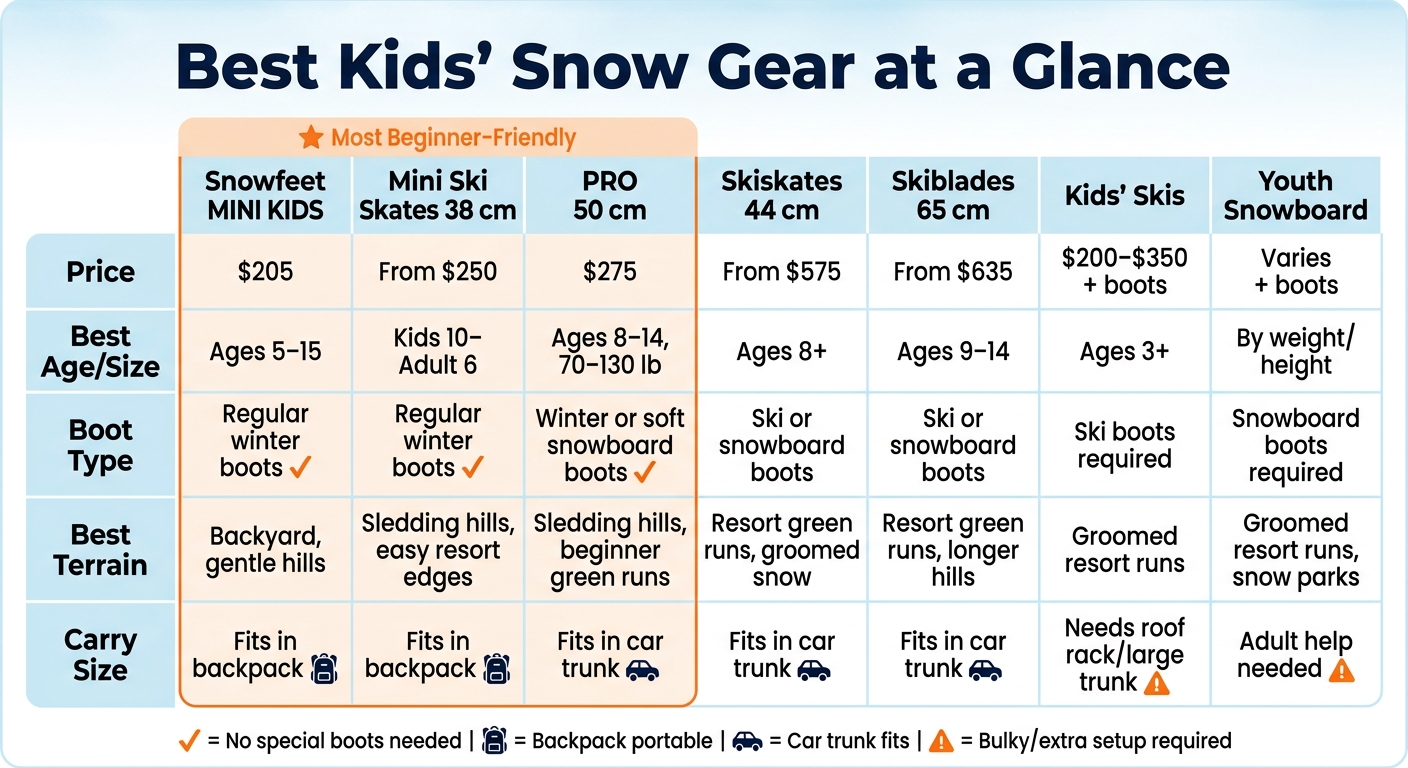
Best Snow Gear for Kids: Side-by-Side Comparison Guide
The ultimate fun skis for kids. 🎿
Quick Comparison
| Gear | Best For | Boots Needed | Where It Works Best | Main Tradeoff |
|---|---|---|---|---|
| Snowfeet* MINI KIDS | Young kids and first-timers | Regular winter boots | Backyard snow, gentle hills | Limited on steeper terrain |
| 38 cm Mini Ski Skates | Kids ready for a small step up | Regular winter boots | Sledding hills, easy snow play | Less steady at higher speed |
| PRO 50 cm | Older kids who want more glide | Winter boots or soft snowboard boots | Mellow hills, green runs | Needs more balance than MINI |
| Skiskates 44 cm | Tweens with skating balance | Ski or snowboard boots | Groomed runs, park laps | Not for brand-new riders |
| Skiblades 65 cm | Older kids wanting a ski-like ride | Ski or snowboard boots | Green runs, longer hills | Heavier than short models |
| Kids' skis | Lesson track | Ski boots | Groomed resort runs | More gear and setup |
| Youth snowboard | Kids set on snowboarding | Snowboard boots | Beginner resort slopes | Hardest to learn at first |
So, if you want less parking-lot chaos and more time on snow, the short Snowfeet* models are the plain answer :)
1. Snowfeet* MINI KIDS
Age and Boot Fit
Snowfeet* MINI KIDS are made for kids ages 5 to 15. The big win here is simple: they strap onto regular winter boots. No ski boots. No long setup. Kids can get on snow and start sliding fast.
The bindings are easy to use, even for small hands. They fit US shoe sizes Kids 10 through Adult 6. So if your kid wants to jump into snow play without hauling around big gear, this is about as easy as it gets.
Play Terrain
MINI KIDS shine on easy, low-stress terrain. Think:
- backyard snow
- neighborhood sledding hills
- low-angle resort areas
The double-blade design helps with balance on hard-packed snow and ice, which makes them handy even when you're not on a groomed ski run.
That said, they’re not built for steep slopes, fast groomers, or terrain parks.
Carry and Storage
These are short and light enough to fit in a standard backpack. That’s a big deal for kids who want to carry their own gear instead of dragging it like a Monday morning chore. It also makes spur-of-the-moment winter trips much easier.
Speed and Control
Metal edges and a heel brake help new riders slow down and stop with less drama. For beginners, that can make the whole thing feel a lot less scary and a lot more fun.
As one parent, Ashley Castle, said after her 10-year-old son tried the Snowfeet* MINI KIDS:
"Within 30 min he was hockey stopping, and going backwards with crossovers... They don't feel like they're going to break and they're easy to put on as well."
Best for kids 5–15 who want easy snow play on gentle terrain without ski boots or bulky gear.
Current price: $205 (regular price $308).
2. Snowfeet* Mini Ski Skates 38 cm
Age and Boot Fit
If MINI KIDS is the easiest way in, the 38 cm Mini Ski Skates are the next move. They give kids a bit more space to stand, glide, and turn without jumping straight to full skis.
The Snowfeet* Mini Ski Skates 38 cm fit US kids' sizes 10 through adult 6 (EU 27–38), and they strap onto regular winter boots. So kids can get on snow fast without ski boots. This size works well for kids who can already balance, glide, and steer with light supervision and want a simple step up from the smallest beginner setup.
Play Terrain
These do best in backyards, on sledding hills, on gentle terrain, and around resort edges. That short length is a big plus in tight spots where full-length kids' skis can feel clunky. They’re not the right pick for deep powder or steep, fast runs.
Carry and Storage
At 38 cm, they fit in a standard backpack. That makes them easy to bring along for quick hill laps, cabin trips, or a last-minute snow day.
Speed and Control
Metal edges and a heel brake help kids slow down and stop with less fuss, while the short length makes turning feel quick and simple.
Best for kids who want an easy, boot-on step up from MINI KIDS, with more room to balance but the same grab-and-go simplicity.
Current price: From $250.
For kids ready for more stability and a slightly longer feel, the 50 cm PRO is the next option.
3. Snowfeet* PRO 50 cm
Age and Boot Fit
If 38 cm starts to feel a bit cramped, PRO 50 cm gives kids more glide without making the jump to full skis.
It’s the next step up from the 38 cm model and works best for ages 8–14 and riders around 70–130 lb. It fits US kids’ size 3 through adult 8 and straps onto insulated winter boots or soft snowboard boots, not stiff ski boots. That’s a big plus for families. Kids can gear up without the whole parking-lot wrestling match. The bindings are simple enough for most kids to handle on their own, so there’s less messing with straps and more time sliding downhill.
Play Terrain
That extra length helps on bigger hills and mellow resort terrain.
It works best on:
- Packed snow
- Backyard hills
- Sledding hills
- Beginner green runs
Deep powder and terrain parks are not a good match here.
Carry and Storage
At 50 cm, it still fits in most trunks or back seats. So, yeah, it’s easy to toss in the car for a spur-of-the-moment hill session or a winter cabin trip.
Kids can carry it from the parking lot to the slope by themselves, which is always nice. And when the day’s done, storage is simple. A closet, mudroom, or corner by the door does the job just fine.
Speed and Control
PRO 50 cm lands right in the middle between mini skates and youth skis.
It’s faster and more stable than the 38 cm model, but still much easier to turn than youth skis. That shorter base makes quick direction changes feel natural, especially at lower speeds on tight sledding hills. Reviewers describe it as easy to control, quick to turn, and more forgiving than old-school skis.
Best for older kids who want more glide and control with less gear.
Current price: $275.
4. Snowfeet* Skiskates 44 cm
Age and Boot Fit
Compared with the 50 cm PRO, the 44 cm Skiskates feel a bit more like small skis and give kids a bit more stability. They’re a good match for older kids and tweens who can already balance, snowplow, and stop on gentle slopes. These are made for ski or snowboard boots, not regular winter boots like the MINI models. A snug fit matters here, and the boot should sit centered.
Play Terrain
The 44 cm Skiskates work best on groomed resort runs, snow parks, and packed snow. They’re still made for fun, playful riding, not formal ski training. Their short length and metal edges help them turn fast and steer with less effort.
They’re not the right tool for steep, icy, or rough terrain. And in deep powder, the short platform won’t give much float. Think of them like a quick little sports car: fun on smooth ground, less happy when the road gets messy.
Carry and Storage
At 17 inches long, they fit into a standard backpack. That makes a big difference in parking lots, lodge walkways, and messy car trunks. Less gear sprawl, less drama. Always nice :)
Speed and Control
These feel more like skating on snow than classic skiing. That’s why kids with ice skating or hockey experience often get comfortable on them fast.
"These ski blades are a blast to use. Super easy to control, quick to turn, and way more forgiving than traditional skis." - Brad Tolin
For quick turns, playful laps, and easy resort fun, the 44 cm Skiskates make a lot of sense.
Best for older kids and tweens who already have balance and want a compact, resort-ready option.
Current price: From $575.
If your child wants more stability and longer glides, the 65 cm Skiblades are the next step.
sbb-itb-17ade95
5. Snowfeet* Skiblades 65 cm
Age and Boot Fit
The Snowfeet* Skiblades 65 cm are a nice step up for kids who want more glide and cleaner turns without going straight to full skis. This is the first Snowfeet model that starts to feel pretty close to a ski, just without all the bulk.
They tend to work best for kids around 9–14 who already have decent balance and coordination. They fit ski boots or snowboard boots, and the fit adjusts without tools. So, if your kid is somewhere between Skiskates and full kids' skis, this sits right in that sweet spot.
Play Terrain
On groomed green runs and small park features, these feel quick, snappy, and easy to steer. The short turn radius helps kids make turns without fighting the gear. Compared with the 44 cm Skiskates, the 65s bring more stability and a smoother glide on groomed snow.
On the same neighborhood hills, they also feel steadier and faster than the shorter models. That extra length makes a difference. You get a bit more confidence underfoot, but not the long, awkward feel that can come with full-size skis.
They’re not the best pick for:
- Deep powder
- Icy, steep runs
Carry and Storage
At 65 cm, they’re still easy to live with. They fit in a car trunk and store well in a closet or mudroom. No giant ski bag taking over the house. That alone is a win for a lot of parents :)
Speed and Control
The short shape and metal edges give these a ski-like feel without making them heavy or clunky. Kids who’ve done a bit of skating or skiing usually get used to them fast. If your child is brand new, start on mellow slopes and keep the first few laps short. That tends to make the learning curve a lot smoother.
Best for older kids and teens who want a real ski feel without the bulk of full-length equipment.
Current price: From $635.
If your child wants a more traditional ski setup after this, the next section covers kids' skis.
6. Kids' Skis
If you want the classic ski route, this is it. But there’s a catch: more gear, more setup, and less of that easy grab-it-and-go feel.
Age and Boot Fit
Traditional kids' skis usually start to make sense around ages 3–4. But the setup only works well if the ski boots fit right and the bindings are set right too.
Kids' skis are usually sized by height. And bindings should be adjusted by a certified technician based on your child’s weight and ability. That part matters a lot.
Unlike Snowfeet*, kids' skis need ski boots and bindings. So, yeah, you’re dealing with more equipment and more time before your kid even gets moving.
Play Terrain
Kids' skis work best on groomed green runs and magic carpets. That’s where kids can practice turns, learn to stop, and get used to the feel of skiing.
They’re not a great match for:
- Tight backyards
- Small sledding hills
- Patchy snow
Why? The extra length gets in the way, and they need steady snow coverage to work well. So they’re a solid resort pick, but not the fast, flexible choice for short play sessions after school or a quick run outside.
Carry and Storage
This is the tradeoff: the more old-school the setup, the less spontaneous the day feels.
Kids' skis are the least backpack-friendly option in this comparison. At home, they take up more room than Snowfeet* and usually need a spot set aside just for storage. Not a deal-breaker, but it’s one more thing to deal with.
Speed and Control
Short kids' skis are easier to handle than full-length skis, but they still pick up speed faster than Snowfeet* on small hills. They hold well on groomed snow, but on short slopes they still move faster than Snowfeet*.
Entry-level packages generally cost $200–$350, and boots add extra cost on top of that.
For families that want the easiest and most playful setup, Snowfeet* stays simpler, lighter, and faster to use. That’s a big reason many families still choose Snowfeet* for casual winter play.
7. Youth Snowboard
Youth snowboards are for kids who are ready for a more standard board and want to learn edge control. So yes, this is the most classic option in the bunch. But it’s also the least grab-and-go.
Age and Boot Fit
Youth boards are picked by weight and height, not age. Boots should fit snug, and the bindings need to match the boot size.
Play Terrain
For resort-only days, a youth snowboard can make sense. It works best on smooth beginner slopes at resorts.
But it’s not a great match for backyard snow, short hills, or stop-and-go play. Snowfeet* tends to work better for short, casual sessions.
Carry and Storage
A youth board is harder for kids to carry and store than Snowfeet*. That’s a bigger ask than the shorter Snowfeet* options.
Speed and Control
Youth snowboards still take real technique before they start to feel easy to control. A helmet is a must, and wrist guards can help new riders.
If you’re still deciding, the next section compares terrain, fit, and safety side by side.
Terrain, Fit, and Safety: How Each Option Stacks Up
Here’s the fast side-by-side most parents want: fit, terrain, carry size, and control.
| Criterion | MINI KIDS | 38 cm Mini Ski Skates | PRO 50 cm | Skiskates 44 cm | Skiblades 65 cm | Kids' Skis | Youth Snowboard |
|---|---|---|---|---|---|---|---|
| Age & Boot Fit | US Kids 10–Adult 6; regular winter boots | US Kids 10–Adult 6; regular winter boots | Ages 8–14; sturdy winter boots | Ages 8+; ski or snowboard boots | Ages 9–14; ski boots or snowboard boots | Weight/height; ski boots required | Weight/height; snowboard boots required |
| Play Terrain | Backyard snow, gentle hills, flat learning areas | Small sledding hills, easy resort edges | Sledding hills, beginner resort runs | Resort green runs, local hills | Resort green runs, longer local hills | Groomed resort runs | Groomed resort runs, snow parks |
| Carry & Storage | Fits in a backpack | Fits in a backpack | Fits in most car trunks | Fits in most car trunks | Fits in most car trunks | Bulky; often needs a roof rack or large trunk | Bulky; adult help usually needed |
| Speed & Control | Slow; easy stopping | Slow; easier control with metal edges and heel brake | Moderate; heel brake and metal edges | Moderate; skate-style turning, metal edges | Faster; more glide, easier to pivot than full skis | Faster; edge control and technique required | Faster; heel-edge braking takes practice |
The big gap is setup. Kids' skis and youth snowboards need their own boots, bindings, and more time to get ready. Snowfeet* models keep things much simpler: less gear, a faster start, and way less hassle when you just want to get out on the snow.
That matters more than most parents think. A setup that works on the hill you already have - the backyard, sledding hill, or mellow local slope - is often the better pick than one built for a steeper run you may never use.
Safety Basics Before Any First Run
After you pick the gear, safety comes next. Every option here needs a snow-sport-rated helmet, goggles, and a binding check with the boot actually on before each run.
Lower speed and less gear can make first runs easier to handle. For that first lap, keep it simple: pick the smallest hill you can find, with the longest flat runout. That gives kids more room to slow down, stop, and, well, stay out of trouble :)
Pros, Cons, and a Quick Pick for Parents
After the side-by-side comparison, here’s the fast way to choose.
| Gear | Biggest Pros | Main Cons | Best Match |
|---|---|---|---|
| Snowfeet* MINI KIDS | Works with regular winter boots; ultra-light; easy for small kids to stand up after falls | Best on gentle slopes and soft snow; outgrown relatively quickly | Younger kids; backyard play and slow sledding hills |
| Snowfeet* Mini Ski Skates 38 cm | Fits in a backpack; instant fun on gentle hills; great bridge between sledding and skiing | Less stable at higher speeds; can feel twitchy for cautious kids | Kids who want backyard laps and sledding hills |
| Snowfeet* PRO 50 cm | More stability than 38 cm; still light and short; less intimidating than full skis | Needs a bit more balance than the 38 cm option for true beginners | Grade-schoolers following parents on easy resort runs |
| Snowfeet* Skiskates 44 cm | Skate-like feel; highly maneuverable; compact enough to share between siblings | Less natural for kids with no skating background; not for very young children | Confident tweens who already enjoy skating or scootering |
| Snowfeet* Skiblades 65 cm | Closest feel to real skis; easier to turn than traditional kids' skis; still resort-portable | Heavier than shorter options; some learning curve for first-timers | Older kids chasing more glide on green and easy blue runs |
| Kids' Skis (traditional) | Strong edge grip; widely available to rent at US resorts | Extra boots, more gear, longer setup, less spontaneity | Kids enrolled in lessons |
| Youth Snowboard (traditional) | True snowboard feel; great for terrain parks and progression | Extra boots, more gear, steepest learning curve, mostly resort-only | Kids dedicated to snowboarding with lessons planned |
The big win with Snowfeet* is simple: less stuff to carry, less setup, less hassle. No pile of extra boots. No bulky gear fight in the parking lot. Just a much easier way to get kids on snow, which, let’s be honest, matters a lot when you’re dealing with cold fingers and short attention spans.
For most families outside of lesson programs, the shorter Snowfeet* options are the easier call.
If you want the simplest first pick, go with MINI KIDS or 38 cm Mini Ski Skates. If your child is older or already feels at home on snow, move up to PRO 50 cm or Skiblades 65 cm for more glide and better resort use.
FAQs
How do I choose between MINI KIDS and the 38 cm model?
Pick based on your child’s age, confidence, and the kind of snow fun they like most.
MINI KIDS is a good match for younger kids or first-timers who need light, easy-to-handle gear for mellow slopes and sledding hills.
The 38 cm model fits kids who are a bit older or more sure on snow and want extra stability and control across different snow surfaces.
Are Snowfeet* good for beginner resort runs?
Yes. Snowfeet* work well for beginner resort runs. They’re allowed on most ski slopes, easy to learn, light on your feet, and built for fun, playful riding.
That makes them a solid pick for beginners who want to enjoy the snow without bulky gear or lessons that feel stiff or intimidating :)
What safety gear does my child need first?
Start with secure, waterproof winter boots or shoes that fit well. Snowfeet attach right to regular winter shoes or snowboard boots, so a snug fit around the ankle helps with stability and safety.
Make sure the footwear is the right size too. For young kids, close supervision goes a long way in helping prevent falls during snow play on gentle slopes or sledding hills.











Hagyj egy hozzászólást
Ezt a webhelyet a hCaptcha rendszer védi, és a hCaptcha adatvédelmi szabályzata, valamint szolgáltatási feltételei vonatkoznak rá.