



















Skiskating is like combining skiing and skating into one awesome winter activity. But keeping your speed in check is key to staying safe and having fun. Here’s the deal: with shorter, skate-like skis (like Snowfeet* Skiskates), you can stop, turn, and control your speed way easier than with longer skis. Whether you’re a newbie or experienced, mastering these seven techniques will make your rides smoother and more controlled:
- Turn Shape: Wider turns keep you steady; tighter turns slow you down fast.
- Micro Edge Control: Small ankle movements help you adjust speed precisely.
- Snowplow/Wedge: Form a "V" with your skates to brake.
- Short Brake Turns: Quick, tight turns help you slow down on tricky terrain.
- Body Position: Stand tall to slow down or tuck low to go faster.
- Use Terrain: Stick to softer snow or trail edges to naturally reduce speed.
- Step-by-Step Braking: For steep slopes, angle your skates across the hill and turn slowly.
Each technique builds on the last, so start simple and work your way up. Snowfeet* Skiskates make it easy to learn these moves thanks to their short length and quick response. Perfect for tight spaces and crowded slopes, they’re a fun, user-friendly option for winter sports lovers. Ready to hit the slopes? Let’s dive into the details!
Snowfeet* & Skiskates Tutorial - How to Become a PRO Skiskater
1. Basic Speed Check With Turn Shape
You can control your speed by simply adjusting your turn shape. Wide, sweeping turns let you keep your momentum, while sharper, tighter turns help you slow down quickly - kind of like steering a car when navigating curves.
This method works best on groomed slopes, where the packed snow gives your edges a solid grip. Thanks to the parabolic design and narrow waist of Snowfeet* Skiskates, switching edges is quick and smooth. Tightening or widening your turns feels natural and effortless. As Zbyněk, the founder of Snowfeet*, explains:
"I love how easy they are to ski and skate and how many different kinds of tricks I can perform without much effort and almost no restrictions."
With Skiskates, you can make quick, natural adjustments without the extra effort traditional skis might require.
For better control, distribute your weight evenly to maintain balance and friction. On groomed snow, you can finish your turns with a hockey-style stop for precise braking. However, keep in mind that deep powder (over about 4 inches or 10 cm) makes this technique less effective since the reduced surface area of Skiskates doesn’t provide much floatation.
Up next, we’ll dive into how fine-tuning your edge control can take your speed management to the next level.
2. Micro Edge Control and Side-Slipping
Micro edge control is all about managing your speed with precision. Instead of relying on big, sweeping movements, you make subtle ankle rolls that guide the metal edges of your skates to grip the snow. The more you tilt the edges, the more friction you create, which slows you down. Conversely, reducing the edge angle allows you to glide more smoothly. It’s a small adjustment with a big impact.
Snowfeet* Skiskates excel here because their shorter edges respond almost instantly to these micro-movements. A slight shift in your knees or ankles can noticeably increase drag. Compare that to traditional long skis, where you’d need to use much larger body movements to achieve the same effect. As Snowfeet* explains:
"We improved the base design, raised the platform height, making it easier to initiate turns and perform carving. This allows you to turn and stop more quickly and effortlessly."
Side-slipping builds on this concept. Instead of moving forward, you rotate both Snowfeet* Skiskates so they’re perpendicular to the slope and slide sideways downhill. This technique creates consistent friction across the base, slowing you down without requiring forward motion or wide turns. It’s a lifesaver in tight spaces - think lift queues, narrow trails, or crowded spots - where carving isn’t an option. Thanks to their compact 44 cm length, Snowfeet* Skiskates make these quick pivots far easier than traditional skis, which can feel clunky when rotating.
On icy surfaces, go slow with gradual edge adjustments to avoid unexpected skids. In deeper powder (over 4 inches), focus more on shaping your turns and using the terrain to manage speed, as edge grip diminishes in soft snow. To practice side-slipping, start on a gentle slope. Position yourself perpendicular to the fall line with your edges engaged, then slowly relax your ankles to begin sliding sideways. To stop, roll your ankles slightly uphill to re-engage the edges. Repeat this in small, controlled bursts until you’re comfortable releasing and re-engaging your edges instinctively.
Up next, we’ll dive into how body positioning pairs with dynamic braking techniques on various terrains.
3. Skiskating Snowplow and Hybrid Wedge
The snowplow (or wedge) is a must-know technique for controlling speed. To do it, push your heels apart and bring the tips of your skiskates together, forming a "V" shape. This engages the inside edges, allowing you to brake. The wider the "V" and the more pressure you apply, the slower you'll go. Ease up, and you’ll glide more freely.
This method works especially well with Snowfeet* Skiskates because their short length makes it easier to pivot into a wedge. As Snowfeet* explains: "Shorter skis are easier to control, turn and stop, which makes them great for beginners." Most people can pick up a basic snowplow within 30–60 minutes on a gentle slope. If you’ve got an ice skating or hockey background, you might even nail it in just a few runs. Once you’ve got the basics down, fine-tuning your form is the next step for better control.
Here’s what to keep in mind: avoid leaning back. Instead, flex your ankles, press your shins forward, and position your hips over the balls of your feet. Keep a moderate "V" shape by rolling your knees slightly inward to increase edge grip. Use short bursts of braking - about 10–15 seconds at a time - then relax the wedge to recover.
Once you’ve mastered the snowplow, you can step it up with the hybrid wedge. This technique uses a shallower "V" while shifting your weight between feet to steer. Start with a light wedge to control your speed, then gradually bring your skiskates closer to parallel for smoother, more fluid turns. Snowfeet* Skiskates are perfect for this, thanks to their quick pivoting ability. With practice, you can transition from a full wedge to a hybrid wedge and even near-parallel turns in just half a day.
These techniques are ideal for green and blue slopes. On packed powder, they’re forgiving and easy to manage. On icy surfaces, tighten your wedge angle for extra grip. If you’re tackling steeper terrain, use a quick snowplow to check your speed before moving into more advanced maneuvers.
4. Short Radius Brake Turns
Once you've got the hang of the snowplow and hybrid wedge, it's time to level up with short-radius brake turns. These tight, quick turns help you control your speed by redirecting your momentum across the slope. It’s like having mini brakes built into your technique.
Here’s the key: the more your skiskates face across the hill, the slower you go. By increasing the edge angle at the end of each turn, you create more friction and push snow aside, which helps you shed speed with every curve. According to PSIA teaching materials, short-radius turns are a natural step up from basic wedge turns, especially when you're navigating tighter spaces.
This is where Snowfeet* Skiskates really stand out. Regular all-mountain skis typically have a sidecut radius of about 15–18 meters (50–60 ft), so they need a wider arc to turn. Snowfeet* skiskates, on the other hand, have a sidecut radius of just 6–9 meters (20–30 ft). That means tight turns come naturally and require much less effort. As Brad Tolin, a verified Snowfeet* user, explains:
"Super easy to control, quick to turn, and way more forgiving than traditional skis."
The lighter swing weight of Snowfeet* skates also makes it easier to keep a quick turning rhythm, even if you're feeling a little worn out.
Body position matters. Keep your upper body facing downhill while your legs handle the turning below. This separation helps you link turns smoothly without losing your balance. Roll your ankles and knees into each turn, and then apply more edge pressure as you finish to maximize the braking effect. A common mistake? Leaning back when you pick up speed. Instead, focus on tightening your turn shape and increasing your turn frequency. Snowfeet* skates respond instantly when you stay centered and engaged.
Short-radius brake turns work best on groomed green and blue slopes with soft or medium-packed snow. If you're on icy hardpack, ease up on the edge angle and apply gradual, smooth pressure to avoid chatter. For narrow trails or areas with obstacles, use a zig-zag pattern with sharp, quick turns. On steeper slopes, you can pair these turns with a side-slipping technique for full speed control.
sbb-itb-17ade95
5. Body Position, Tuck Variations, and Speed Adjustment
Your body position isn't just about style - it’s a key tool for controlling speed. Your posture can make a big difference. Standing taller increases air resistance, naturally slowing you down. On the flip side, a low tuck reduces drag, letting you pick up speed. Once you hit around 20–25 mph, aerodynamic drag becomes the main force working against you, so even small tweaks to your stance can have an immediate impact.
Snowfeet* Skiskates shine in this area. Their shorter length means your body movements translate into speed changes almost instantly. On traditional all-mountain skis, you might need several turns to notice a difference. With Snowfeet*, the response is quick, making every adjustment count.
Here are three key positions to master:
- Upright stance: Stand tall with your torso vertical and arms slightly out. This works like a natural brake and is perfect for crowded areas or approaching lift lines.
- Partial tuck: Bend your knees and hips slightly, leaning your torso forward. This position balances speed and control, especially on blue runs.
- Full tuck: Go deep with a tight knee bend, chest close to your thighs, and arms tucked in. This minimizes drag and is ideal for open, smooth sections where you have plenty of space.
Make transitions between these positions smooth and gradual. Abrupt changes can throw off your balance and control. Speaking of balance, keeping your weight centered is crucial for maintaining edge grip. Keep your hips over your feet and apply light pressure through your shins to help your edges bite into the snow. Avoid leaning back on your heels - it lifts the tips of your skiskates, reduces edge contact, and can cause you to accelerate unintentionally. If you find yourself speeding up too quickly, shift your weight forward - think "nose over toes" - to regain control.
Your stance should also adapt to the terrain. On uneven or choppy snow, stand taller with a wider stance to absorb the bumps. Avoid deep tucks on icy patches to maintain better edge control. Snowfeet* offers this advice:
"Stand straight and put your weight in the middle of your feet or on your heels. Keep your legs slightly bent and lean forward a bit. If you need to be more stable, put one foot in front of the other."
Once you get the hang of adjusting your stance automatically, you’ll have a reliable way to manage speed anywhere on the mountain - no need for hard braking.
6. Using Terrain to Manage Speed
The slope itself can be one of your best tools for controlling speed - and many skiers overlook this completely. Instead of relying solely on braking, you can use the natural features of the hill to keep your speed in check. This approach feels smoother and is less exhausting than constantly stopping hard.
Most trails have a steep center line where speed builds quickly, especially on hard-packed snow. In contrast, the edges of the trail often have gentler slopes and softer snow, which naturally slow you down. By sticking to these areas and making diagonal traverses instead of heading straight down, you reduce gravity’s pull and manage your momentum more effectively. The Professional Ski Instructors of America (PSIA) even considers terrain-based speed control a key skill, right up there with edging and rotary movements. Snowfeet* Skiskates are especially handy for this.
Thanks to their compact design, Snowfeet* make it easy to quickly adjust direction. You can move onto flatter spots, softer snow, or the shoulder of the trail before your speed gets out of hand. Traditional long skis, on the other hand, need more space and commitment to make similar moves, making Snowfeet* a great option for quick, precise changes.
Snow texture also plays a big role in managing speed. Softer, packed snow creates more friction, naturally slowing you down, while firm groomed snow or icy patches let you pick up speed faster. If you feel yourself gaining momentum on a harder surface, aim for softer snow patches to slow things down. Also, keep an eye out for terrain transitions like rollovers or sudden steep drops - they can cause a quick speed boost. Tightening your turns on gentler sections before these transitions can help you stay in control.
For example, on a moderate groomed run, you could avoid the steep center, follow a gentle diagonal path, and use the flatter edge of the slope to reduce speed before heading into your next turn. If the run has a natural rollover, use that flatter area to reset your pace before continuing downhill. This strategy works well alongside the other speed-control techniques we’ve covered.
That said, terrain-based speed control has its limits. On very steep, narrow, icy, or crowded trails, your options for using terrain might be limited. In these cases, you’ll need to combine these methods with active braking and solid body positioning to stay safe.
7. Step-by-Step Braking for Steep Slopes and Tight Spots
When you're tackling steep or narrow slopes, basic braking and turning might not cut it. This advanced technique helps you manage your speed with small, repeated checks instead of one big stop - perfect for tricky terrain.
Here’s how it works:
- Angle your skates across the hill to slow down right away.
- Tilt both skates onto their uphill edges and make a slow, rounded turn. As your skates point more across the slope, your speed will naturally drop.
- Finish in a traverse and pause briefly to stabilize.
- Repeat the process, tightening your turns as needed.
For tight spots - like narrow chutes, tree runs, or crowded areas - use the same method but adapt it. Keep your turns shorter and your pivots quicker, finishing each turn sharply across the hill. In between turns, flatten your skates slightly to side-slip, then re-engage your edges to pivot into the next turn. This mix of quick pivots and precise edge control helps you manage speed even in the trickiest areas.
Snowfeet* Skiskates are designed specifically for these kinds of challenges. At just 44 cm long, they make tight braking turns feel effortless. Their responsive design means every edge adjustment and pivot happens instantly, giving you the control you need when the terrain gets demanding.
If you’re new to this, most people can master the traverse-turn-slow cycle on a gentle slope in just one session before moving to steeper terrain. Remember the basics: keep your feet hip-width apart, knees and ankles flexed, and hands at waist height. Stay centered over your skates - don’t lean back - so you can quickly adjust your edge angles as conditions change. This keeps your speed in check, no matter where the mountain takes you.
Comparison Table
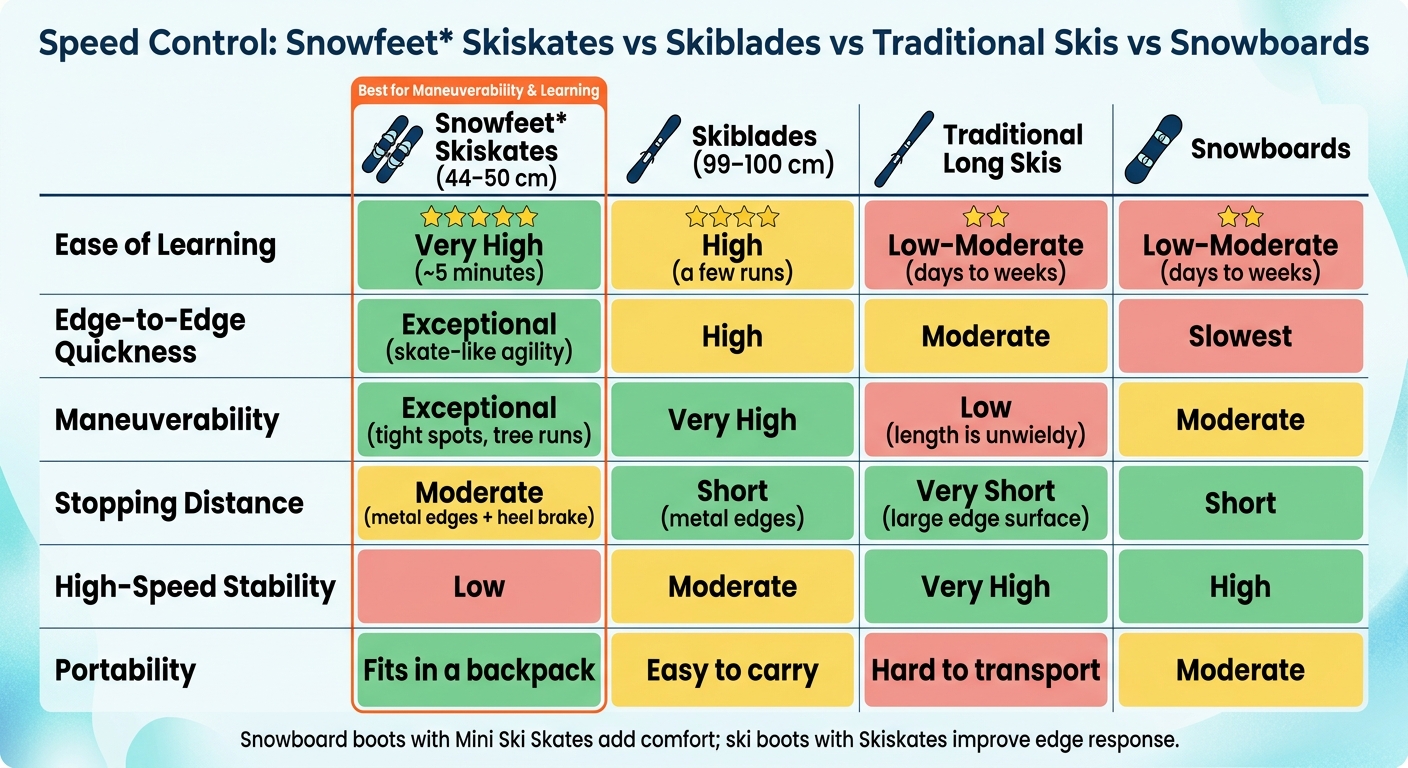
Skiskates vs Traditional Skis vs Snowboards: Speed Control Comparison
Here's how Snowfeet* gear stacks up against traditional long skis and snowboards when it comes to speed control. The design of your equipment plays a big role in how you manage speed - it affects stopping distance, turning ability, and overall responsiveness. This table breaks it all down:
| Factor | Snowfeet* Mini Ski Skates/Skiskates (44–50 cm) | Skiblades (99–100 cm) | Traditional Long Skis | Snowboards |
|---|---|---|---|---|
| Ease of Learning | Very High - most riders pick it up in ~5 minutes | High - typically a few runs | Low to Moderate - takes days to weeks | Low to Moderate - takes days to weeks |
| Edge-to-Edge Quickness | Exceptional - narrow waist and short length provide skate-like agility | High | Moderate | Slowest |
| Maneuverability | Exceptional - great for tight spots, tree runs, and crowded slopes | Very High | Low - length makes them unwieldy | Moderate |
| Stopping Distance | Moderate - metal edges + integrated heel brake | Short - metal edges help | Very Short - large edge surface aids stopping | Short - decent edge surface |
| High-Speed Stability | Low | Moderate | Very High | High |
| Portability | Fits in a backpack | Easy to carry | Hard to transport | Moderate |
This table highlights the strengths of Snowfeet* gear, especially when applying the speed control techniques we’ve discussed - like turn shaping, side-slipping, and short-radius turns. While traditional long skis excel in high-speed stability, Snowfeet* gear shines in maneuverability and ease of learning. Its edge-to-edge quickness and ability to navigate tight spaces make it a standout choice for riders looking for precision and control.
Skiblades (99–100 cm) offer a balance between the two. They’re easier to handle than full-length skis and provide more stability at higher speeds compared to the shorter 44–50 cm models. Riders often find them forgiving and versatile.
And don’t forget: your boot choice matters! Using snowboard boots with Mini Ski Skates adds comfort, while ski boots with Skiskates improve edge response.
Conclusion
Skiskating speed control comes down to mastering seven well-connected techniques. Each plays a role in handling different slopes and conditions. Turn shape helps manage speed on groomed runs, while micro edge control and side-slipping let you fine-tune your descent on firmer or narrower sections. For beginners, the snowplow and hybrid wedge provide a trusty safety net. Short-radius brake turns are perfect for quickly slowing down when the terrain gets tighter, and adjusting your body position helps manage momentum without altering your line. Using the mountain's natural contours adds another layer of control, and step-by-step braking ties everything together for the steepest, most challenging pitches.
Snowfeet* Skiskates are a fantastic tool for building these skills. With their compact 44–50 cm (17–20 in) length, they offer agility and responsiveness, making it easier to learn and refine each technique. As one satisfied buyer, Brad Tolin, put it, they’re "super easy to control, quick to turn, and way more forgiving than traditional skis". That forgiving design is key when experimenting and gaining confidence with new skills.
Take it step by step. Start with turn shape on easier runs, then work in side-slipping and hybrid wedge exits as you grow more confident. From there, add short-radius brake turns and terrain reading for steeper slopes. Each skill builds on the last.
Mastering speed control isn’t about holding you back - it’s what opens the door to more fun. With solid control, you’ll feel confident exploring new lines, tackling tighter terrain, and enjoying longer days on the snow with agile, responsive Snowfeet* Skiskates.
FAQs
Which speed-control technique should I learn first on Snowfeet* Skiskates?
To get started, try the snowplow stop. Push your heels outward to form a V-shape, and lean back slightly to engage the metal edges of the skiskates. Thanks to Snowfeet*’s compact design, this technique feels less demanding compared to traditional skis.
Begin practicing on flat ground or gentle slopes (with an incline of less than 10 degrees). This will help you build your balance and confidence before moving on to more advanced maneuvers.
How do I control speed on icy hardpack vs soft powder with skiskates?
When navigating icy hardpack, lean on your ankles to activate the hockey-style edges of your Snowfeet*. This helps you carve out sharp, controlled turns. Make sure to keep your knees bent and your stance balanced for maximum control. In softer powder, adjust by shifting your weight slightly backward and lifting your toes - this keeps the tips from catching. Snowfeet* shine brightest on groomed or packed snow, delivering a level of precision that traditional long skis just can’t match.
Are Snowfeet* Skiskates or traditional long skis easier to stop on steep slopes?
Traditional long skis have an advantage on steep, icy slopes because their longer edges give you more grip and braking power. On the other hand, Snowfeet Skiskates* shine when it comes to agility, making quick hockey stops a breeze on moderate terrain. If you're cruising down green or blue runs, Snowfeet* offer a fun and easy-to-pick-up experience. However, for tackling steep, high-speed descents, long skis are the better choice.











Deja un comentario
Este sitio está protegido por hCaptcha y se aplican la Política de privacidad de hCaptcha y los Términos del servicio.