



















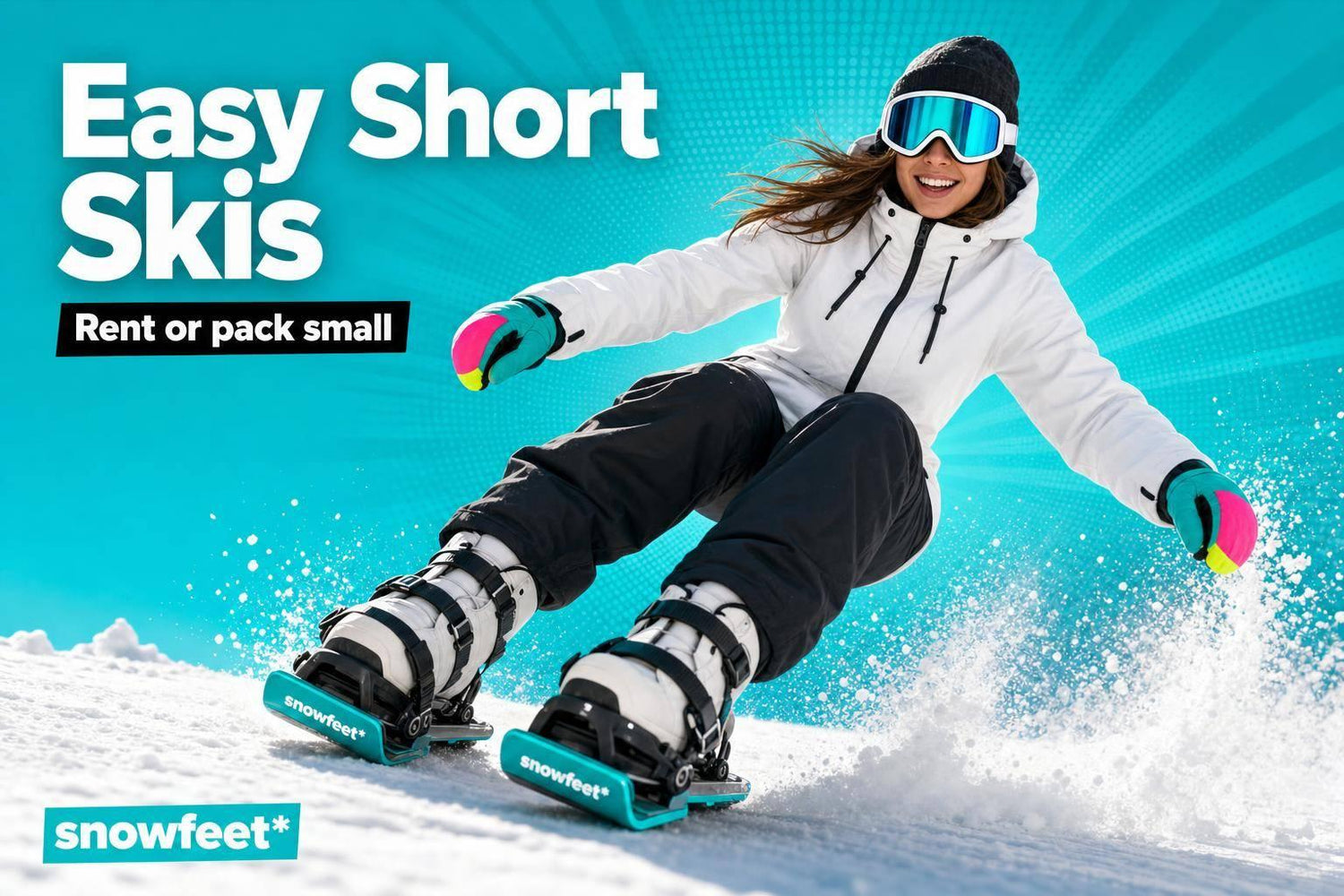
If you ski just 2–5 days a year, buy for easy travel and easy control - not for max performance. That’s the whole story.
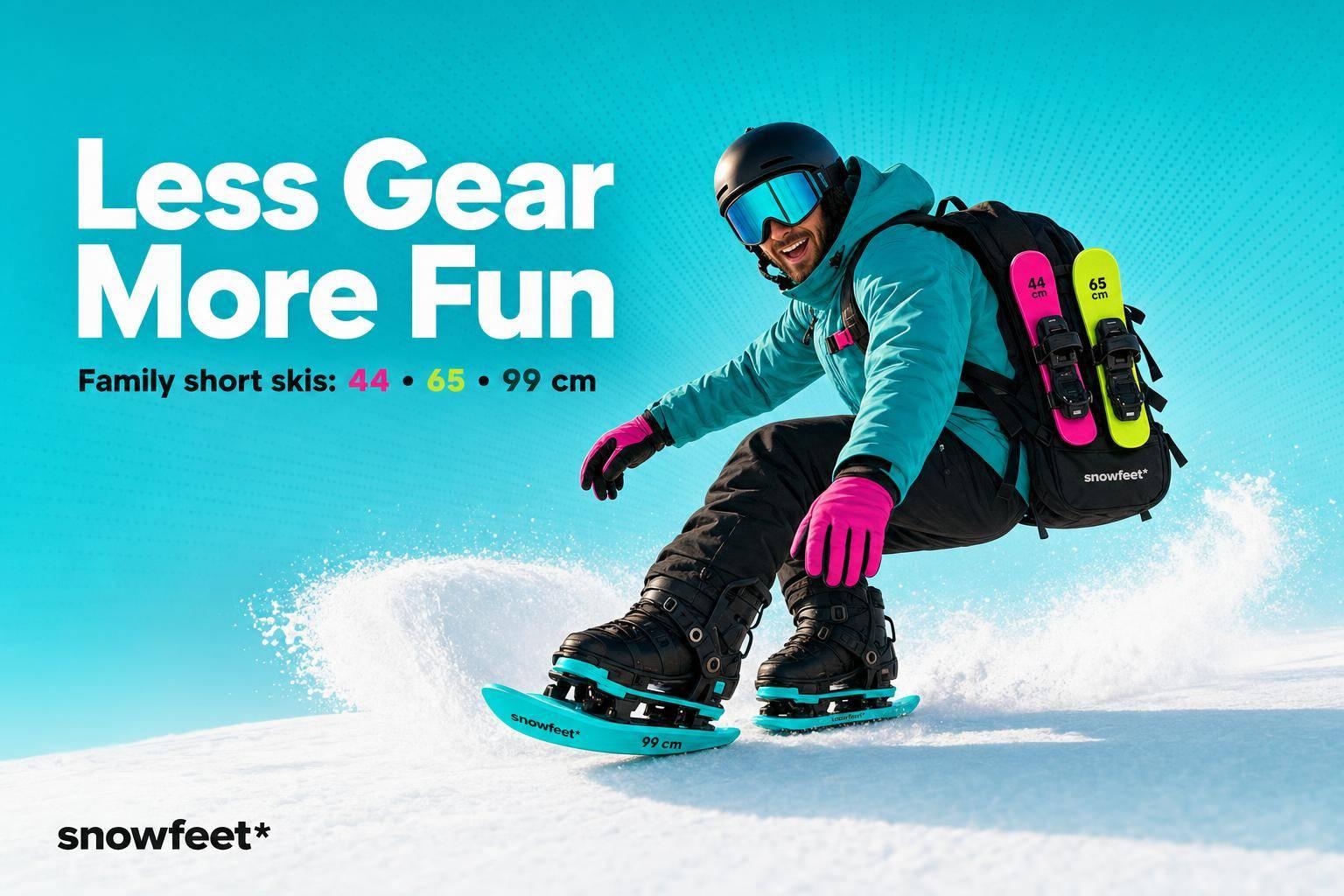
I’d put it this way: rent if this is a one-time trip, but if you go often enough to get annoyed by rental lines and bad boot fits, compact short skis make a lot of sense. In this lineup, Snowfeet* 44 cm is the smallest pick, PRO 50 cm adds a bit more control, 65 cm Skiblades hit the best middle ground, and 99 cm models feel closer to regular skis. Rental skis still win on low upfront cost at $40–$70/day, while some Snowfeet* models start at $299 and higher.
Here’s the short version:
- Best for flights: Snowfeet* 44 cm or PRO 50 cm
- Best middle ground: Snowfeet* 65 cm Skiblades
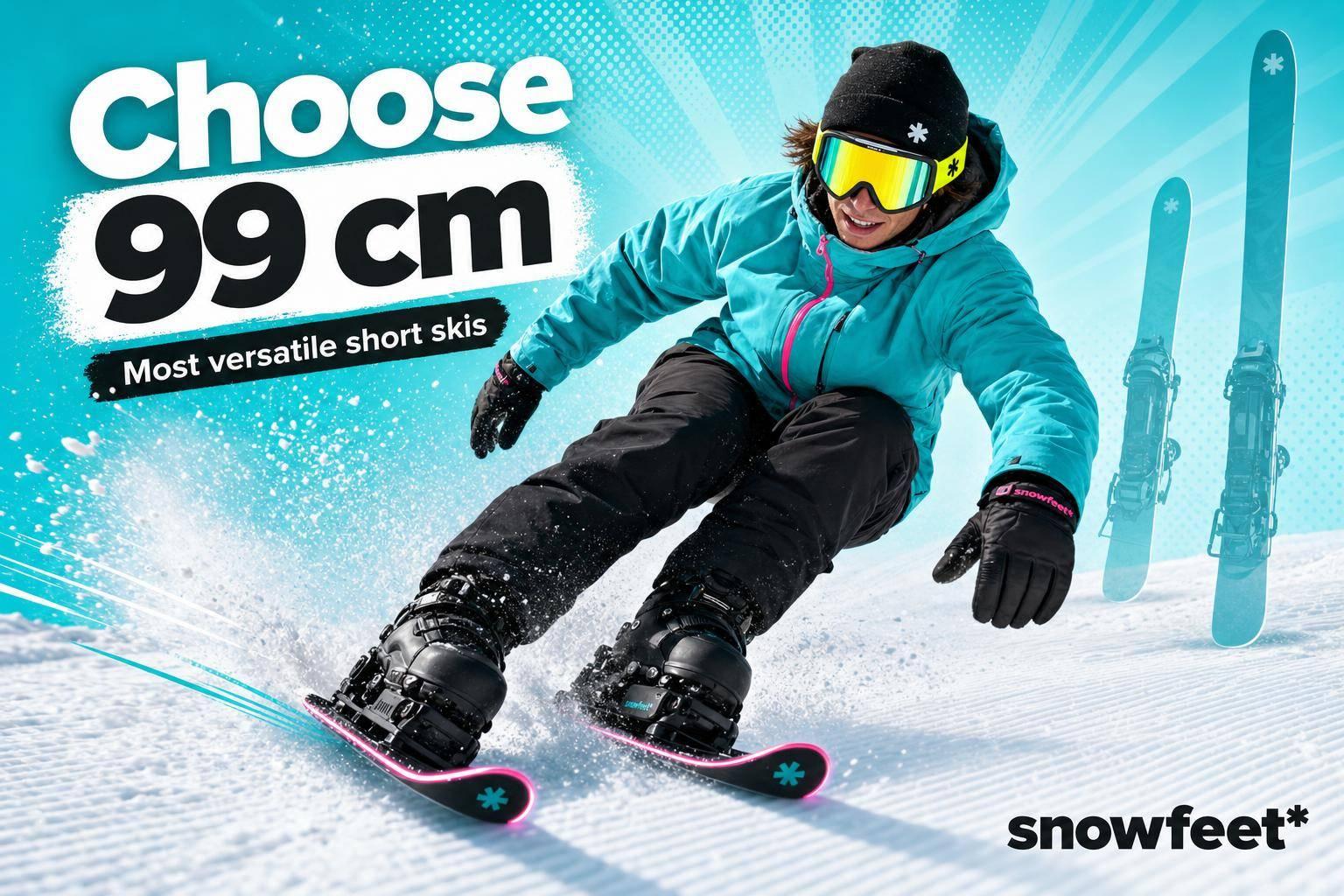
- Best for more ski-like feel: Snowfeet* 99 cm Skiblades
- Best for soft snow days: Snowfeet* POWDER 99 cm
- Best for one-off trips: Rental skis
- Best if you want to try boarding once: Rental snowboard
- Less ideal for most casual skiers: older Salomon-style snowblades and ODR-style skiskates
What stood out to me is simple: for casual skiers, packing size, slow-speed control, and total trip hassle matter more than top speed. A 44–65 cm setup is much easier to carry than a 170 cm rental ski setup, and that alone can change how much you enjoy the trip :)
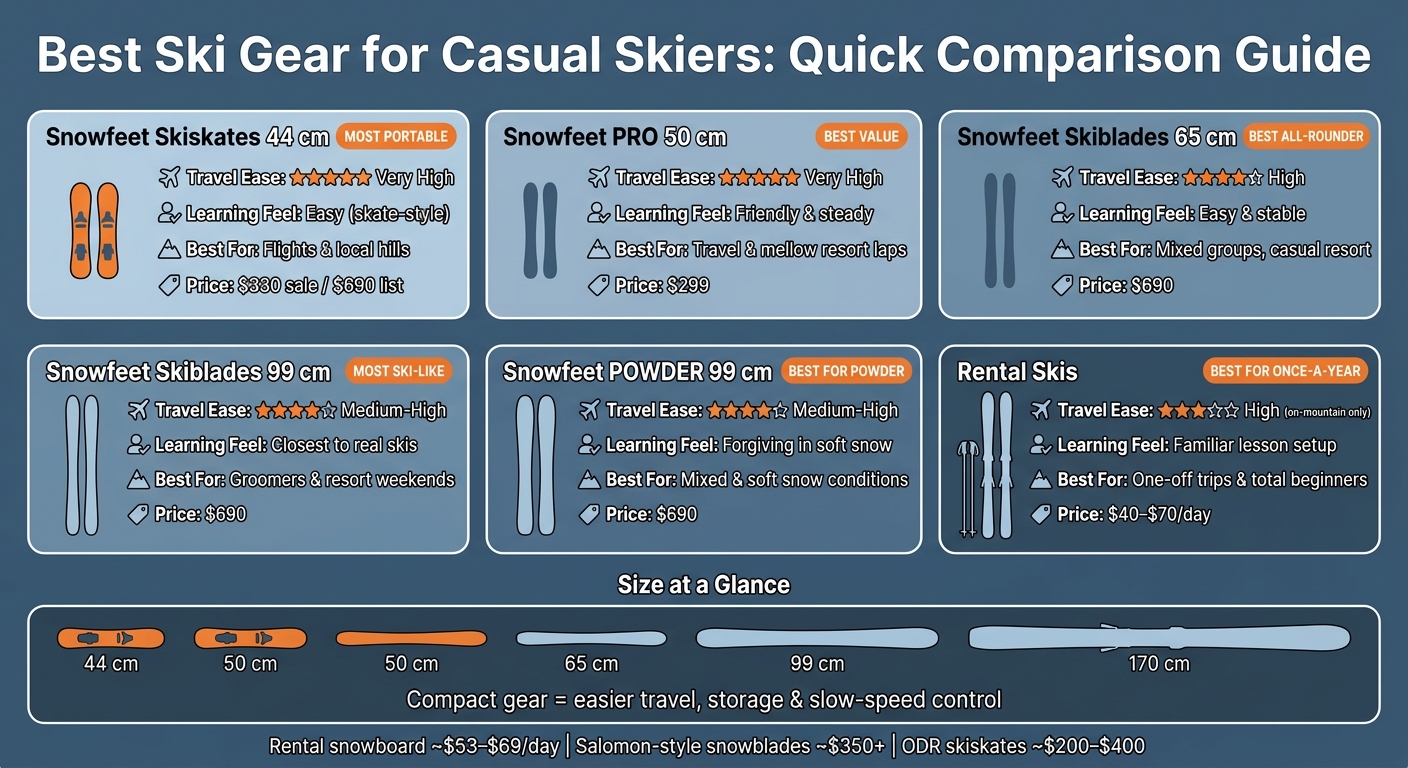
Best Ski Gear for Casual Skiers: Quick Comparison Guide
Snowboarder tries Snowfeet* | Which Snowfeet* Short Ski is the Best? | Snowblades 44, 65, 99 Review
Quick Comparison
| Gear | Best Use | Travel Ease | Learning Feel | Price |
|---|---|---|---|---|
| Snowfeet* Skiskates 44 cm | Flights, local hills, short trips | Very high | Easy for skaters, playful | $330 sale / $690 list |
| Snowfeet* PRO 50 cm | Travel, mellow resort laps | Very high | Friendly, a bit steadier | $299 |
| Snowfeet* Skiblades 65 cm | Casual resort skiing, mixed groups | High | Easy, more stable | $690 |
| Snowfeet* Skiblades 99 cm | Groomers, resort weekends | Medium-high | Closer to regular skis | $690 |
| Snowfeet* POWDER 99 cm | Mixed resort snow, soft snow | Medium-high | Friendly, best in softer snow | $690 |
| Rental skis | One-off ski trips | High before/after skiing | Familiar lesson setup | $40–$70/day |
| Rental snowboard | Trying snowboarding | High before/after riding | Harder day one | About $53–$69/day |
| Salomon-style snowblades | Short-ski fans | Medium | Easy on groomers | About $350+ |
| ODR-style skiskates | Skate-style riding | High | Longer ramp-up | $200–$400 |
My take: if you want the least fuss, start small. If you want the best mix of comfort and control, go 65 cm. If you’re only going once, save your cash and rent.
And that’s the lens I’d use for the full breakdown below.
1. Snowfeet* Skiskates 44 cm
At 44 cm, Skiskates are the shortest Snowfeet* option. On snow, they feel closer to skating than skiing. That’s a big part of the appeal. They’re easy to get the hang of for casual riders, and they make a lot of sense for short, relaxed ski days.
Learning Curve
Because they feel more like skating, they can seem less intimidating than full-length skis. That’s good news if you only ski a few times a year and don’t want your first run to feel like a wrestling match with giant planks :)
Easy Low-Speed Control
Their short length makes turning fast and simple. At low speeds, they’re easy to control, which helps a lot when you’re just cruising and not trying to bomb down the hill.
Portability
At 44 cm, they fit into a backpack or carry-on with far less hassle than full-size skis. Storage is easier too. No awkward corner in the garage. No giant ski bag taking over your trip.
Total Cost
They cost about $690 at the regular price, with sale prices around $330. For occasional skiers, that means you can buy one compact setup, keep it at home, and bring it along for each ski trip.
If you like this idea but want a bit more stability, the PRO 50 cm is the next step up.
2. Snowfeet* PRO Ski Skates 50 cm
If the 44 cm Skiskates feel a bit too loose, the PRO 50 cm gives you more control without turning into a full ski. It’s a nice middle ground for casual riders who want something easier than standard skis, but steadier than the 44 cm model. You still get metal ski edges and a built-in heel brake for easier stopping. And it stays small enough to pack for travel without the usual ski-trip circus.
Learning Curve
The learning curve is pretty friendly. If you already skate, you’ll likely get used to them faster than you would with standard skis or a snowboard. That side-to-side balance from skating carries over well.
Even if you’re new, they’re still approachable. A first run on a gentle green slope is often enough to get the basic feel. That makes the 50 cm version a better pick for mixed skill groups than full-size skis. It works well on easy greens and mellow blues.
Low-Speed Control
At lower speeds, the short platform feels quick and responsive. Small ankle and knee movements are often enough to steer, which makes turns on green runs and easy blues feel smooth and direct. The heel brake helps with stopping, and the metal edges give you solid grip on groomed snow.
There is a catch, though. That same quick response can feel a little twitchy if you lean too far forward or too far back. Stay on mellow terrain and keep your speed moderate, and that quick handling starts to feel like the whole point. For laid-back resort laps, that matters more than chasing speed.
Portability
At 50 cm, the PRO fits into a standard checked bag or a large duffel. That means no oversized ski bag, no roof rack, and no awkward airport shuffle with long skis banging into everything in sight.
Total Cost
The Snowfeet* PRO 50 cm costs $299. At that price, it can pay for itself after a few rental days. You also get to skip the rental line every time, which, let’s be honest, is half the battle on a ski trip :)
3. Snowfeet* Skiblades 65 cm
The 65 cm Skiblades sit right in the middle between skiskates and full skis. They’re long enough to make real carved turns on groomers, but still short enough to feel quick, light, and easy to handle.
Learning Curve
These give you more stability than the 44 cm and 50 cm models, but they don’t lose that easy, nimble feel. The steel edges help with control and hold up well over time. Camber underfoot helps the skis carve cleanly instead of sliding or washing out. For most casual riders, linking basic turns on groomed green runs happens within a few runs.
Low-Speed Control
On green runs and easy blues, the 65 cm length feels responsive without getting twitchy. That’s a nice sweet spot. You can make proper carved turns even at lower speeds, which is a big deal if you don’t want to bomb the hill just to feel in control. They also stay responsive on greens and easy blues, and they deal with chopped-up resort snow better than longer skis.
Portability
At 65 cm / 26 in and about 3 lb 13 oz per pair with bindings, they’re easy to pack. You can fit them in a backpack or suitcase, which makes travel and storage simple. No roof rack drama. No giant ski bag flopping around in the parking lot.
Total Cost
The Snowfeet* Skiblades 65 cm start at $690 for the premium wood core model. If you ski just a few days each season, that price can make sense fast compared with paying $40–$70 per rental day.
If you want more stability and a feel that’s closer to a short ski, move up to the 99 cm Skiblades.
4. Snowfeet* Skiblades 99 cm
If you want more stability than the 65 cm Skiblades but don’t want to jump all the way to full-length skis, the 99 cm model hits a nice middle spot. For casual resort skiers, it feels more like a normal ski, just with less bulk and less hassle.
Learning Curve
The 99 cm model stands out for one simple reason: its deep sidecut. With dimensions of 11.5 / 8.5 / 11 cm and about a 6 m radius, it helps carving feel easier. That’s a big plus if you only ski now and then and don’t want your first few runs to feel like a wrestling match.
Snowfeet* says most riders get comfortable in about five minutes, and honestly, that sounds pretty believable for returning skiers.
That short length also helps when you’re not skiing. They’re just easier to carry, stash, and deal with.
Low-Speed Control
At casual speeds, the 99 cm length stays easy to steer in lift lines, on groomers, and during slow turns. The 5 cm tip and tail rise keeps the ski responsive without making it feel bulky.
So, if your day looks more like mellow laps than charging downhill like you’re late for lunch, this size makes a lot of sense.
Portability
At 99 cm / 39 in, these Skiblades are still compact enough to carry and store without much drama. That helps if you fly, drive a small car, or just don’t want long skis leaning in every corner of your place.
Fit options are broad too:
- Ski boot bindings fit about US sizes 4.5–14.5
- Snowboard boot bindings fit about US sizes 6–14.5
Total Cost
The 99 cm Skiblades (wood core) start at $690. If you ski 5+ days a year, buying your own pair can start to pencil out. That’s even more true once you think about tuning, waxing, bindings, and the upside of using the same familiar setup on every trip.
They work well for:
- Groomed beginner and intermediate terrain
- Mellow resort laps
- Playful cruising
For powder, high speed, or hard-charging all-mountain skiing, longer skis still come out on top.
If you want a lower upfront cost, rentals are the next thing to look at.
5. Snowfeet* POWDER 99 cm
The POWDER 99 keeps the compact 99 cm size but adds more float for soft snow. So if your ski days sometimes drift into powder, this is the 99 cm Snowfeet model built for that lane. It uses a wide tip, narrow waist, wide tail, and twin tips with a 6 m radius to keep turns quick and easy.
Learning Curve
For casual skiers, the POWDER 99 feels pretty easy to get along with from the start. The deep sidecut helps the ski roll into turns without much fuss, and the wider shape gives you more float when the snow gets soft. That said, it still skis like a short ski. In deep powder, it won’t give you the same ride as a full-size powder ski.
Low-Speed Control
On groomers and packed snow, the POWDER 99 stays nimble at slower speeds. Part of that comes from its 5 cm tip and tail rise. But its main edge shows up in soft snow and light off-piste use, where the wider platform gives you more surface area underfoot.
That makes it a solid pick for the kind of resort day where conditions are all over the place - some groomed runs, some chopped-up snow, maybe a soft stash if you get lucky :) It’s better suited to mixed conditions than all-out powder hunting.
Portability
It keeps the same 99 cm footprint, so it’s still easy to pack, carry, and travel with.
Total Cost
The POWDER 99 is listed at $690. Buy it if soft-snow days come up often enough that you want a compact ski ready for them. If powder only shows up once in a blue moon, renting is still the smarter move.
sbb-itb-17ade95
6. Rental Skis
Rental skis are the go-to pick for a lot of casual skiers in the U.S. If you only ski two or three days a year, renting is usually the cheaper move. It solves the big upfront cost, which is nice. The catch? You’re still stuck with shop stock and rental lines.
Learning Curve
Beginner rental skis are made to help new skiers get the hang of things. They’re shorter, softer, and more forgiving than performance skis. That matters when you’re learning, because the ski won’t punish every little mistake.
Ski school also tends to work around standard ski setups, so rental skis fit neatly into that system if you’re taking lessons.
Low-Speed Control
Beginner rental skis usually have a softer flex and a generous sidecut. In plain English, that helps the skis turn more easily, even if your technique is still a work in progress. They also have a longer edge contact length, which helps with grip and braking on groomed snow.
That steady, predictable feel is a big plus on busy groomers, where you want the ski to do what you expect - not throw you a curveball.
Portability
Renting is handy on the mountain, but the bigger win often starts before you even click into your bindings. A typical adult ski-and-binding setup weighs about 10–12 lb and can be as long as 170 cm, which makes it awkward to haul through airports, shuttle buses, and hotel hallways.
Renting on-site means no ski bag, no oversize luggage, and no wrestling long gear through a crowded terminal. If you only fly for ski trips once in a while, that’s a pretty nice break. Short gear avoids the bag and still stays with you trip after trip.
Total Cost
At most U.S. resorts, a standard ski, boot, and pole package costs about $40–$70 per day. Demo or performance gear can hit $100 per day.
So if you ski just two or three days each season, you’re looking at about $80–$210 per year. That’s still well below the cost of buying even entry-level gear.
One thing to plan for: time. If you pre-book online and pick up the night before, the process is smoother. If you don’t, weekend morning lines can run 30–60 minutes. For occasional skiers, rentals still make sense. For repeat trips, though, they’re not the fastest option.
7. Rental Snowboard
If you want to try snowboarding instead of skiing, renting is the easy way in. You get to test the sport without buying a full setup or hauling gear home. That’s a nice deal if you’re just dabbling for a day or two.
That said, if you’re a casual skier and want the easiest and most compact option, Snowfeet is still the simpler pick.
Learning Curve
A rental snowboard comes with a real learning curve. Both feet are locked onto one board, you ride sideways, and yeah - falls on day one are pretty common.
A lesson helps. A lot. But even with that, snowboards are still less beginner-friendly than Snowfeet if your goal is a quick, casual ski trip without much fuss.
Low-Speed Control
Once you get past that first day, a snowboard can feel stable on easy groomers. But in tight spots or slow-moving areas, it’s less precise than skis or short skis.
Think lift lines, crowded base areas, and little turns at low speed. That’s where the difference shows up.
Portability
Portability isn’t a huge trip problem with rentals because the shop usually handles tuning and storage. So, in that sense, the hassle is lower.
Still, the board itself is bulkier than compact Snowfeet gear when you’re walking through the lodge or crossing the parking lot. You feel that pretty fast.
Total Cost
Daily snowboard rental prices are about the same as ski rental prices. Wisp Resort lists all-day snowboard rental at $69 and night rental at $49. Marquette Mountain charges $53 for a full adult ski and snowboard rental set.
For one or two days a year, renting is the smarter buy. If you only get out once in a while and care more about ease than trying a new sport, compact Snowfeet gear still comes out ahead for simplicity.
8. Salomon-Style Snowblades
Salomon made snowblades popular in the late 1990s. These were short twin-tip skis, usually around 75–99 cm, built for simple groomed runs. These days, “Salomon-style snowblades” is often used for the whole short-ski category. For casual skiers, the big issue is pretty simple: does an older snowblade design still make more sense than newer compact gear?
Learning Curve
Snowblades are easy to get the hang of, especially if you only ski a few days each year. The short length helps a lot. They feel less intimidating than full skis, which is a big plus for casual resort riders.
But there’s a catch. The older foam-core Salomon models got known for feeling shaky once speed picked up. So, they tend to work best on easy groomers at a relaxed pace. That’s fine for mellow laps, but once conditions get mixed, they’re not always the easiest ride.
Low-Speed Control
On smooth beginner runs, snowblades feel quick and easy to turn. They’re fun in that setting. Almost playful.
The trouble starts when the snow gets messy. Chopped-up snow and deeper powder can be a weak spot, and those conditions show up all the time during a normal resort day.
Portability
Snowblades are shorter than full skis, so they’re easier to pack and carry. Still, they take up more room than Snowfeet 44 cm, 50 cm, and 65 cm models.
If you’re flying, this matters. You may still need a ski bag, and yep, that can mean baggage fees.
Total Cost
For casual skiers, the downside is pretty clear: many U.S. resorts don’t rent snowblades, so buying is often your only option. A newer pair with bindings can cost about $350 on sale.
Then the extras pile on:
- Boots
- Tuning
- Waxing
That’s where things can get expensive fast. If you want that same short-ski feel with easier travel and less hassle, Snowfeet 99 cm Skiblades are the better pick. And if owning your setup matters more than renting, Snowfeet’s smaller models often make more sense for occasional skiers.
9. ODR-Style Skiskates
ODR-style skiskates are a more niche pick than Snowfeet's strap-on models. They use a short platform with steel edges and connect straight to winter or snowboard boots. So while Snowfeet* works with more boot setups, ODR-style skiskates put you into one fixed fit.
Learning Curve
If you already skate, you may get the hang of them faster. But for casual skiers, it still takes time on the hill to feel settled. One detailed user report says it can take 15+ days on the slopes over the course of a year to get there. That’s a long ramp-up if you only ski a few times each season.
Low-Speed Control
On smooth groomers, they can be fun for short turns and riding backward. Once the snow gets rough, though, things change fast. They can feel tiring, and edge catches become more common. In plain English: they’re best as a low-speed groomer setup, not an all-conditions pick for the occasional skier.
Total Cost
In the U.S., ODR-style skiskates usually cost about $200–$400. At first glance, that may seem like a solid deal. But the fixed boot setup gives you less room down the line.
Snowfeet* skiskates make more sense for casual skiers. You still get that small, playful feel, but without being stuck with one fit. And if you already own winter or snowboard boots, your total spend can stay lower.
That leaves one question: what matters most on a casual ski trip - price, portability, or the easiest learning curve?
What Actually Matters on a Casual Ski Trip
After you stack up the options, it comes down to four simple trade-offs. If you only ski a few days each year, the best gear is usually the gear that feels easiest from day one. For most casual skiers, that means looking at:
- How fast you’ll feel comfortable
- How easy the gear is to control at slow speeds
- How annoying it is to travel with
- What it costs over time
The big idea is simple: buy for ease, not top-end performance.
Learning Curve
Shorter, more forgiving gear helps people relax faster. And that matters a lot when you only ski now and then. For occasional skiers, shorter gear feels less intimidating and makes those first runs a lot less tense.
Low-Speed Control and Portability
On crowded weekend runs, in lift lines, and on narrow cat tracks, shorter gear has a real edge. Casual skiers usually care more about calm, predictable control at slow speeds than rock-solid stability when going fast. That’s where skiblades and skiskates shine. They let you make small, tight moves without needing a big turn shape.
Rental skis feel stable, but they’re harder to handle at slow speeds and in crowds. Rental snowboards take more time to learn and tend to struggle the most on flat cat tracks. That part can feel like a workout nobody asked for.
Portability is another clear win for compact gear. Short gear is easy to bring along. Full skis? Not so much.
Rent vs. Buy
If you ski several days a year, buying compact Snowfeet gear usually makes more sense. If you’re doing a one-off trip, rent.
Here’s the fast way to match gear to how often you ski.
| Gear Type | Storage Burden | Best For |
|---|---|---|
| Snowfeet* Skiskates 44 cm | Very low | Local hills, flying, a few days/year |
| Snowfeet* PRO 50 cm | Very low | Local hills, travel, a few days/year |
| Snowfeet* Skiblades 65 cm | Very low | Mixed-skill groups, all-mountain |
| Snowfeet* Skiblades 99 cm | Low | Resort weekends, driving |
| Rental gear | None | One-off trips, total beginners |
Scenario quick guide:
- Traveling or driving to the hill: Any Snowfeet* model fits in a sedan trunk or checked bag - no ski bag, no roof rack, no oversized luggage fees.
- Mixed-skill group: The 65 cm Skiblades work for nervous beginners and more confident riders alike.
- Total beginner, one trip: Rent. It’s the lowest-friction option when you don’t know if you’ll go back.
Next, weigh the pros and cons of each setup before choosing.
Pros, Cons, and Which Gear to Choose
Here’s the fast comparison. If you want the shortest path to the right setup, start with this table.
| Gear | Pros | Cons | Best For |
|---|---|---|---|
| Snowfeet* Skiskates 44 cm | Ultra-portable, works with your boots, easy for skaters to pick up | Less stable at speed, limited in deeper snow | City travelers, skaters, local hills |
| Snowfeet* PRO 50 cm | More edge than the 44 cm version, durable, very portable, more stable as confidence builds | Not ideal for fast groomer laps or deep powder | Travelers who want a small step up |
| Snowfeet* Skiblades 65 cm | Easy to turn, beginner-friendly, ski-boot compatible, compact | Less float in soft snow than the 99 cm options | Mixed-skill groups, local hills, slower groomers |
| Snowfeet* Skiblades 99 cm | Stable on hardpack, better edge grip, more ski-like feel | Less portable than shorter models, less stable at very high speeds than full skis | Resort weekends, skiers who want to progress |
| Snowfeet* POWDER 99 cm | Wider shape, more float in soft snow, forgiving at slower speeds | Slower edge-to-edge on firm groomers | Western resort trips, occasional powder days |
| Rental Skis | Proper fit, no storage | Daily cost adds up, bulky, shop lines | One-off trips, total beginners |
| Rental Snowboard | Best for boarders, no gear to own | Steeper learning curve, recurring daily rental cost | First-time snowboard testers |
| Salomon-Style Snowblades | Familiar ski stance, decent groomer grip | Less portable, need tuning | Skiers who want a short-ski feel with standard technique |
| ODR-Style Skiskates | Ultra-compact, skate-like movement | Less stable at speed, limited crossover to standard skiing | Skaters who want stripped-down short gear |
After that, match the gear to how you actually ski. That’s the part people skip, and then they end up with gear that looks good on paper but feels wrong on snow.
The verdict by skier type:
For occasional skiers, the best pick comes down to three things:
- How often you travel
- How confident you feel
- How much hassle you want to deal with
Fly to ski? Go with the Snowfeet* Skiskates 44 cm or PRO 50 cm. They pack easily and feel natural fast, especially if you already skate. Big win if you hate lugging giant ski bags through an airport :)
Drive to a local hill on weekends? The Snowfeet* Skiblades 65 cm are the sweet spot. They’re easy to manage, help you learn real turns, and fit in your trunk without turning your car into a gear closet.
Want more stability on longer groomed runs? Pick the Snowfeet* Skiblades 99 cm. They give you more stability and edge grip, but they’re still far easier to carry than full-size skis.
Heading to a Western resort with powder potential? Look at the POWDER 99 cm. It handles mixed conditions better than the standard 99 cm model once the snow gets soft.
Genuinely unsure whether skiing is for you - or going exactly once? Rent. Rent when you want a proper fit and no upfront purchase.
FAQs
Should I rent or buy if I ski 2–5 days a year?
If you only ski 2–5 days a year, buying standard ski gear usually doesn’t make much sense. The math is pretty simple.
Rentals often run $50–$70 per day. A full ski setup, on the other hand, can cost $800–$1,500. That’s a big spend for gear you’ll only use a handful of times, and then you still have to store it somewhere. Not ideal if your garage is already packed or your apartment closet is hanging on for dear life.
Snowfeet gear is often the smarter buy. Most models cost $190–$275, which puts them in the same ballpark as just a few days of rentals. They also work with regular winter shoes, so you don’t need a big pile of extra gear. And because they’re small enough to fit in a backpack, they’re much easier to carry and stash away.
Which Snowfeet* size is best for beginners?
For beginners, the best Snowfeet* picks are the 38 cm Mini Ski Skates and 50 cm Snowfeet PRO. They’re light, easy to control, and work with regular waterproof winter boots.
The 65 cm Skiblades are also a good fit for new riders. They have a playful, quick-turn feel that makes learning turns and stops easier than on long skis. Shorter models can help you build confidence faster because they don’t feel as big or heavy as standard ski gear.
Can I use my regular winter boots with Snowfeet*?
Yes. Many Snowfeet* models work with regular waterproof winter boots, mainly the versions with snowboard-style bindings.
So, you can skip ski boots. That’s a big plus if you want a setup that feels simple and low-fuss.
For the best support and control, go with sturdy waterproof boots. Think solid ankle support, a snug fit, and enough grip to handle snow without feeling sloppy.
Some models also come with ski boot-compatible bindings if you want a more classic on-snow feel.











اترك تعليقًا
This site is protected by hCaptcha and the hCaptcha Privacy Policy and Terms of Service apply.